
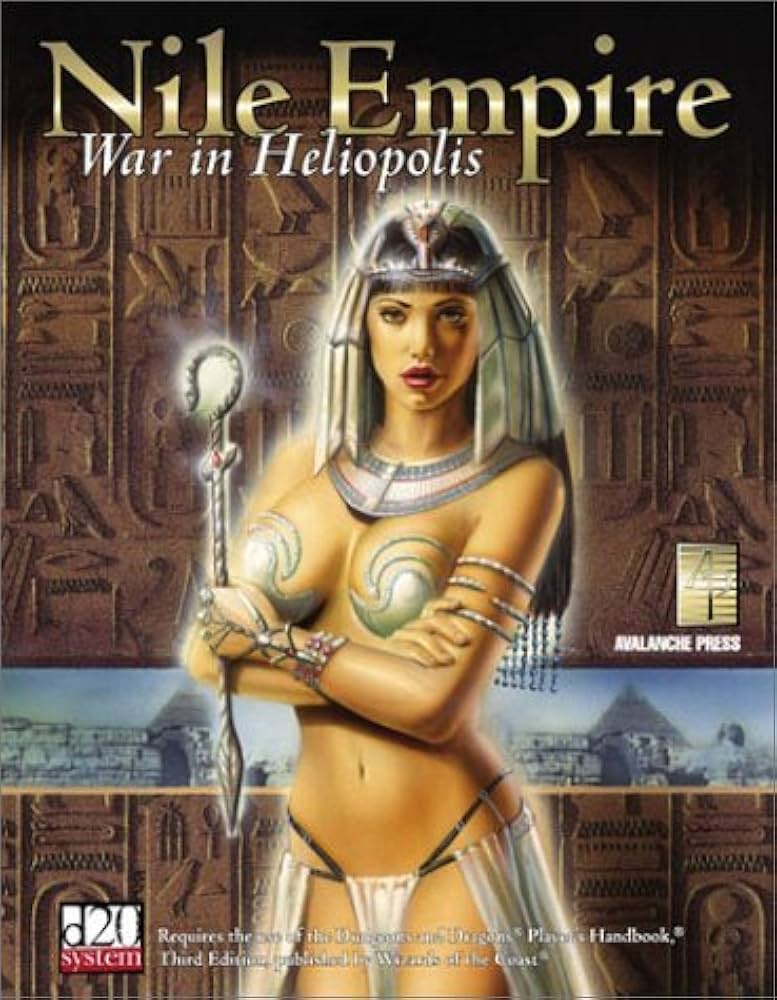
Nile Empire: War in Heliopolis
RPG Family or System:
d20 System
Year:
2002
Nationality:
USA
Authors:
Fred Jandt, John R. Phythyon Jr.
Art Director:
Peggy Gordon, Lorenzo Sperlonga, Terry Moore Strickland
Publisher:
Avalanche Press Ltd.
Genre:
Fantasy, Fiction
Other websites:

Videos by players :
Summary of the game
Nile Empires: War in Heliopolis is an open access companion to the D&D Third Edition role-playing game. This book incorporates materials on Egyptian history, culture, and society so that players and game directors can design and play an adventure set in ancient Egypt using the elements of the D&D (D20) game system.
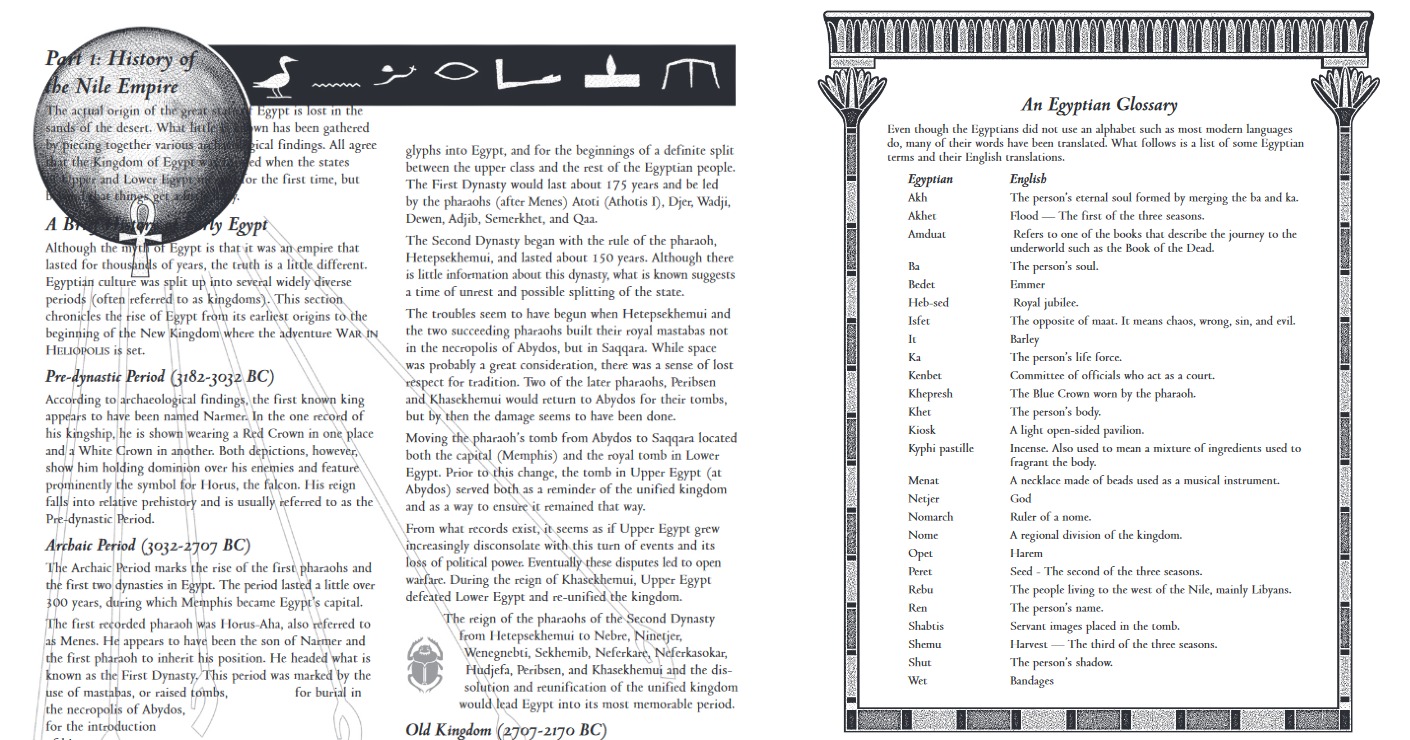
Example of the use of Egyptian elements, such as hieroglyphs and solar symbolism, in the layout of the book (left) and Glossary of Egyptian terms (right) (Screenshots by author)
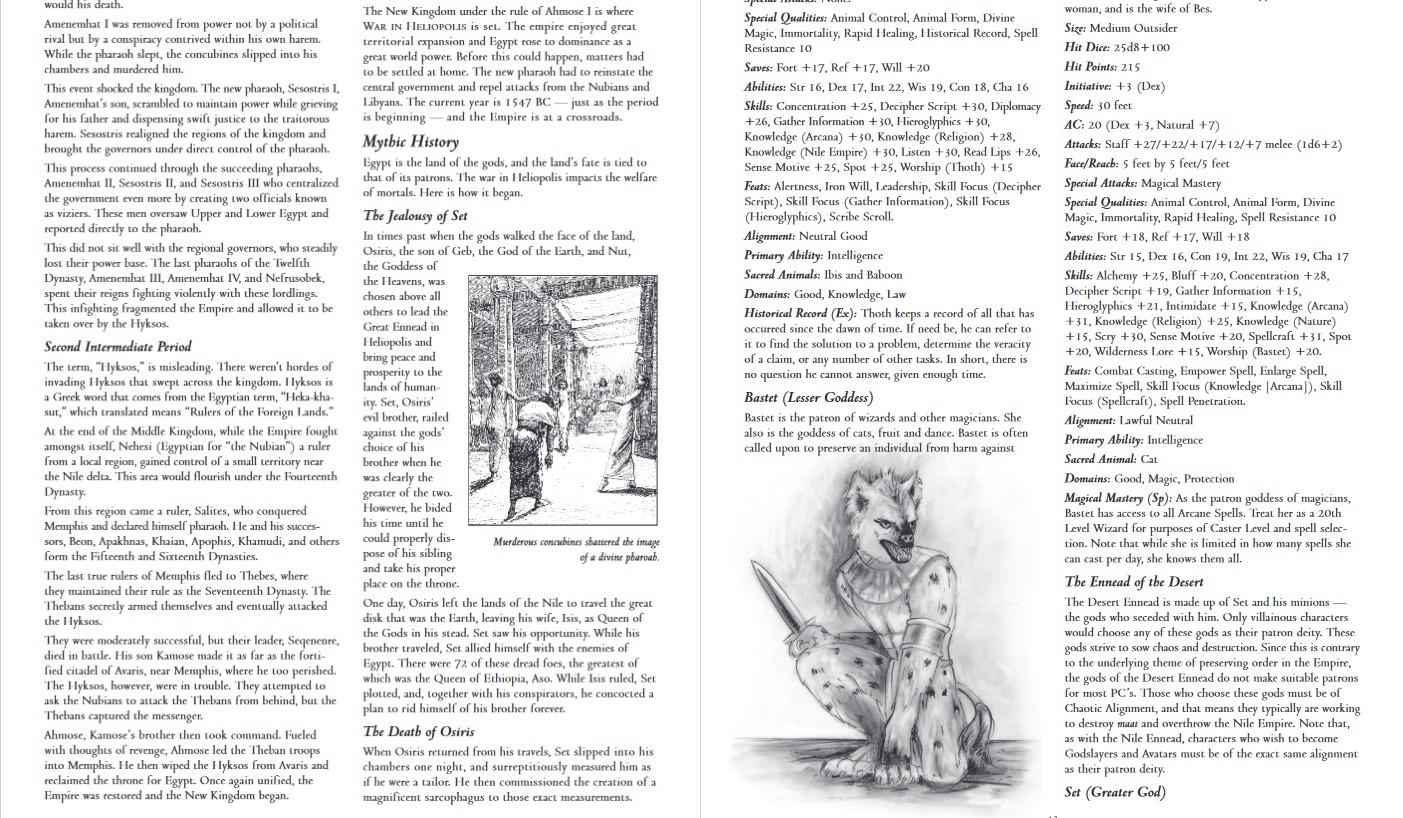
Page with content on the history of Ancient Egypt (left) and Egyptian gods (right) (Screenshots by author)
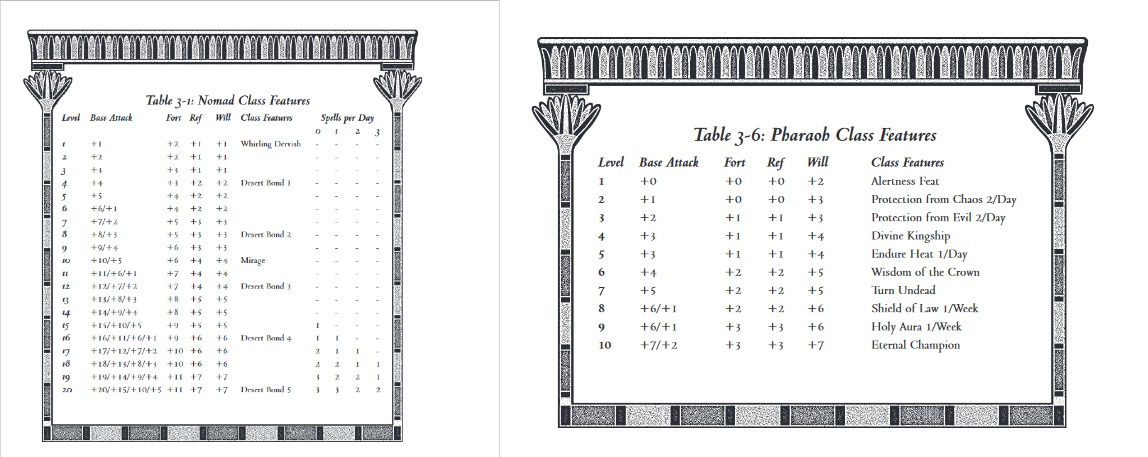
Table of benefits for the Nomad class (left) and table with levels of the Pharaoh prestige class (right) (Screenshots by author)
Egyptomania narratives or motifs
In this game module, players play characters of the 18th Egyptian dynasty, whose characteristics are set in a similar way to those involved in D&D character design: there are, therefore, limitations of race (only humans are allowed) and class (only those compatible with the Egyptian society of the New Kingdom). These characters are involved in adventures to protect Egypt from the forces of evil, embodied by Apophis, Set, and their minions, both supernatural and human in nature.
Because the setting is in the New Kingdom, the module contains two initial chapters focused solely on explaining the history, society, and culture of ancient Egypt in that period, including facts about daily life, and appendices with glossaries of terms useful for adventure design and game development. In this general information on the context of the game, certain fictional elements have been introduced, such as the linking of Set and Apophis, the conflict between Osiris, Horus, and Set in the Middle Kingdom, and the Hyksos invasion as a conflict that takes place mainly in Heliopolis, but in which the divinities are mainly pitted against each other. Chapter 3 contains descriptions of the character classes, including the scribe, the nomad, the merchant, and other so-called 'prestige' classes, such as Pharaoh, Avatar (of good or evil divinities), and Godslayer (sent by the gods to eliminate the avatars of their rivals). The final two chapters focus on the Egyptian pantheon, its connection to the struggle to dominate Egypt, and an explanation and appendices of the game, which presents bestiaries, enemy lists, etc. In addition to these elements, in the design of the game we find multiple visual references that illustrate the book with Egyptianised elements.
Because the setting is in the New Kingdom, the module contains two initial chapters focused solely on explaining the history, society, and culture of ancient Egypt in that period, including facts about daily life, and appendices with glossaries of terms useful for adventure design and game development. In this general information on the context of the game, certain fictional elements have been introduced, such as the linking of Set and Apophis, the conflict between Osiris, Horus, and Set in the Middle Kingdom, and the Hyksos invasion as a conflict that takes place mainly in Heliopolis, but in which the divinities are mainly pitted against each other. Chapter 3 contains descriptions of the character classes, including the scribe, the nomad, the merchant, and other so-called 'prestige' classes, such as Pharaoh, Avatar (of good or evil divinities), and Godslayer (sent by the gods to eliminate the avatars of their rivals). The final two chapters focus on the Egyptian pantheon, its connection to the struggle to dominate Egypt, and an explanation and appendices of the game, which presents bestiaries, enemy lists, etc. In addition to these elements, in the design of the game we find multiple visual references that illustrate the book with Egyptianised elements.
Author: Víctor Sánchez Domínguez
Other information
Fernández Pichel, A.I. and Sánchez Domínguez, V. 2023. Egypt and Role-Playing Games. Does the World of Darkness Universe Use Ancient Egyptian Sources?, in A.I. Fernández Pichel (ed.) How Pharaohs Became Media Stars: Ancient Egypt and Popular Culture: 207.Oxford: Archaeopress.
Open access
Tags
Write a Comment
Tem de iniciar a sessão para publicar um comentário.