

Clanbook: Setites and Followers of Set
RPG Family or System:
Vampire: The Masquerade (1st) / Classic World of Darkness
Year:
1995-2001
Nationality:
USA
Authors:
Richard Watts, Dean Shomshak
Art Director:
Richard Thomas
Publisher:
White Wolf
Genre:
Horror, Conspiracy, Gothic, Oriental
Other websites:

Videos by players :

Summary of the game
The sands of Egypt conceal a frightening menace a cult of vampires dedicated to their fallen lord. The Followers of Set are scattered all over the world, seducing mortals into cults and enslaving other Kindred through their own vices. Yet the Setites do not exist for excess alone: They gather secrets from the darkness that spawned them, secrets that can be yours for a price. (Ulisses Spiele)
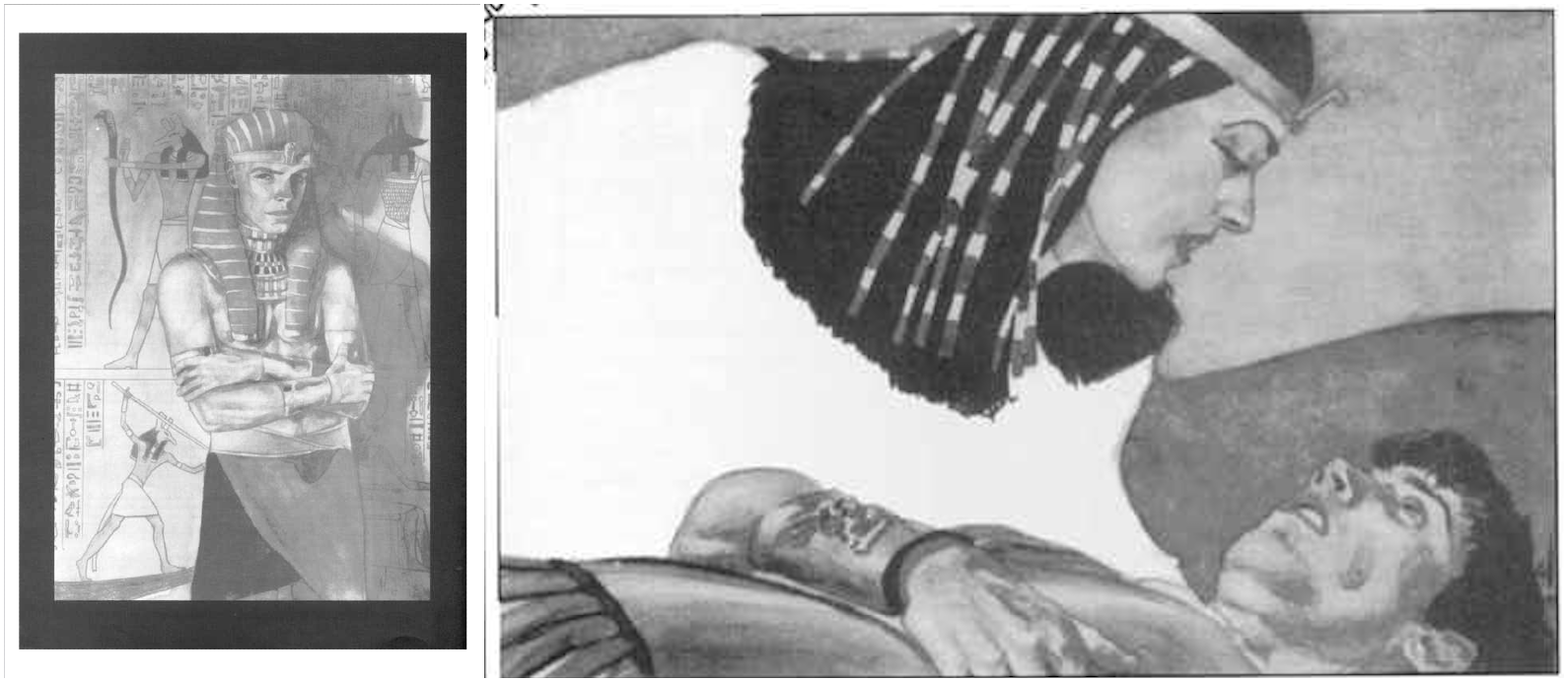
Artistic design for Clanbook: Setites (Screenshot by the author)
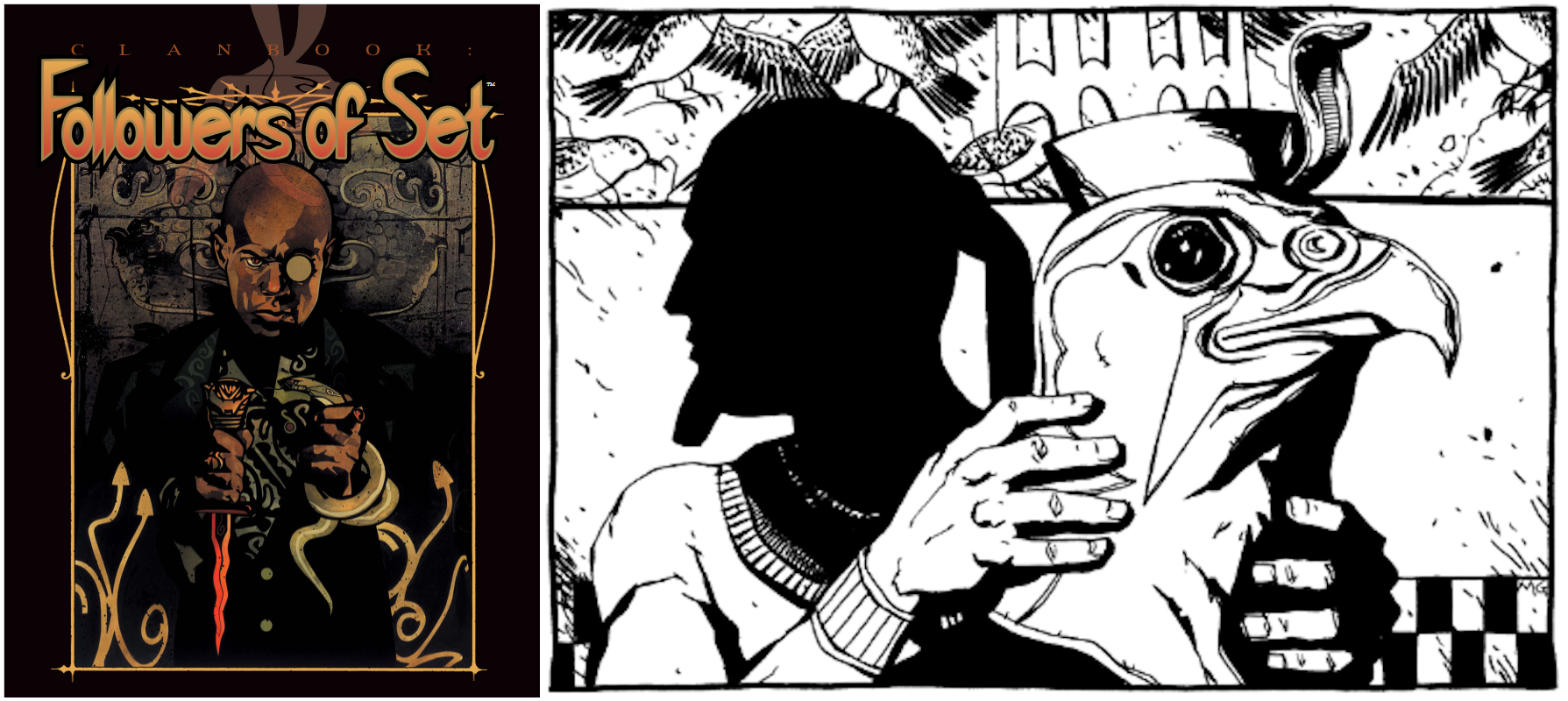
Artistic design for Followers of Set (Screenshot by the author)
Egyptomania narratives or motifs
Clanbook: Setites, and its subsequent 2001 reprint (Followers of Set) is a book that expands the universe of the RPG Vampire: The Masquerade, in which players play the role of a vampire in a gothic punk version of our society set around the turn of the century (1990-1999).
Several chapters of Clanbook: Setites tell part of the backstory of the game, in the precise case where players choose a vampire of the setite type. Thus, through the story about Set, the author explains how vampires are grouped into "clans" (families of vampires with a common ancestor). The setite is one of these clans, which was originated by Set, the Egyptian divinity, formerly human and later turned into a vampire. This starting point is completed in the book with a synthesis of the history of the clan, with multiple references to the history of Egypt, and its main vampiric characteristics. All this is done in order to define the game characters that the players can play.
Thus, in the characterisation of Set and his followers in the game, it brings together some of the ideas transmitted by Egyptian mythology, mainly in relation to the negative facet of this divinity. The Setites are thus presented as agents of corruption in modern society, mainly corrupt politicians and policemen, prostitutes, or antique dealers specialised in magic and arcane rituals. In their private lives, these characters possess numerous Egyptian artefacts, such as statues, sarcophagi, and inscriptions.
With regard to the history of the clan and its initial link to vampirism, the book explains that most of the clans came from vampires descended from the biblical Cain. Thus, Set, or Suketh, was an Egyptian hunter, grandson of the tribal leader Ra, who was turned by an unnamed descendant of Cain in the deserts around Egypt. After a disagreement with the other vampires, Set swore revenge on them and returned to Egypt. From here, the story adapts a distorted version of the Osirian myth according to the version of the classical author Plutarch (1st-2nd century AD). It is about the conflict between Set and Osiris and, concurrently, Set and Horus, in which Osiris is also a vampire. Isis is a powerful sorceress charged with resurrecting Osiris, after the dismemberment of his body, and bringing Horus back to life by making him the first mummy. From Chapter 2 onwards, the book narrates the development of the clan, its hegemonic role in Egypt, and its expansion throughout the world up to the present day. It is interesting to note that the rulership of Horus and Isis is related to the peak periods of the Egyptian civilisation, with power centralised in Memphis and Thebes, while the periods of Setite dominance are centred on the Hyksos and 19th Dynasties.
Throughout the ages and up to the present day, the Setites have carried out the cult of Set, and, for this purpose, they have built numerous temples, whose design and decoration reproduce many Egyptian elements, along with those of other cultures of the past.
The aim of the Setites is to follow the designs of Set, fighting against the other vampires by means of corruption and deception, as well as against Horus and his allies. This hatred has led Set and his progeny to worship Apep, the sun-devouring serpent Apophis.
Finally, within this analysis, it should be noted that the book is peppered with a multitude of elements that directly evoke or transpose the image of ancient Egypt. For example, there are drawings of characters dressed in Egyptian garb, the inner pages of the book are decorated with hieroglyphs, there is an abundance of ancient Egyptian names (alternating with many of Arabic origin), and some drawings with Egyptian iconography are also included.
In 2001, this book was republished under the name Followers of Set, with a new text by Dean Shomshak. This new edition retains many of the elements of the old role-playing manual, but also incorporates new concepts and expands on others already present in the initial book.
It is again in chapter 2 where we see more references to Egyptian culture, as much of it consists of explaining the history of the clan in Egypt.
Unlike the 1995 book, where the version of Set as one of Cain's vampire descendants predominates, in The followers of Set version Set, after killing Osiris, is banished to the Duat, or netherworld, where he kills the serpent Apep and devours its heart, thus becoming the first vampire. These seemingly contradictory reformulations in the versions are common in the game Vampire The Masquerade.
This volume is also much richer in detail concerning the historical development of the clan. New additions include: events during the Amarnian heresy, against which the Setites fight to install the pharaoh Tutankhamon and make him a puppet of the clan's will; the possible parentage of Alexander the Great as a son of Set; and a section devoted to how the Setites tried to destroy Rome and Carthage by fueling their rivalries. While the Egyptianising elements are reduced as the clan's history progresses, there are even sections in this chapter devoted to the contemporary rediscovery of Egypt and the development of Egyptomania.
Several chapters of Clanbook: Setites tell part of the backstory of the game, in the precise case where players choose a vampire of the setite type. Thus, through the story about Set, the author explains how vampires are grouped into "clans" (families of vampires with a common ancestor). The setite is one of these clans, which was originated by Set, the Egyptian divinity, formerly human and later turned into a vampire. This starting point is completed in the book with a synthesis of the history of the clan, with multiple references to the history of Egypt, and its main vampiric characteristics. All this is done in order to define the game characters that the players can play.
Thus, in the characterisation of Set and his followers in the game, it brings together some of the ideas transmitted by Egyptian mythology, mainly in relation to the negative facet of this divinity. The Setites are thus presented as agents of corruption in modern society, mainly corrupt politicians and policemen, prostitutes, or antique dealers specialised in magic and arcane rituals. In their private lives, these characters possess numerous Egyptian artefacts, such as statues, sarcophagi, and inscriptions.
With regard to the history of the clan and its initial link to vampirism, the book explains that most of the clans came from vampires descended from the biblical Cain. Thus, Set, or Suketh, was an Egyptian hunter, grandson of the tribal leader Ra, who was turned by an unnamed descendant of Cain in the deserts around Egypt. After a disagreement with the other vampires, Set swore revenge on them and returned to Egypt. From here, the story adapts a distorted version of the Osirian myth according to the version of the classical author Plutarch (1st-2nd century AD). It is about the conflict between Set and Osiris and, concurrently, Set and Horus, in which Osiris is also a vampire. Isis is a powerful sorceress charged with resurrecting Osiris, after the dismemberment of his body, and bringing Horus back to life by making him the first mummy. From Chapter 2 onwards, the book narrates the development of the clan, its hegemonic role in Egypt, and its expansion throughout the world up to the present day. It is interesting to note that the rulership of Horus and Isis is related to the peak periods of the Egyptian civilisation, with power centralised in Memphis and Thebes, while the periods of Setite dominance are centred on the Hyksos and 19th Dynasties.
Throughout the ages and up to the present day, the Setites have carried out the cult of Set, and, for this purpose, they have built numerous temples, whose design and decoration reproduce many Egyptian elements, along with those of other cultures of the past.
The aim of the Setites is to follow the designs of Set, fighting against the other vampires by means of corruption and deception, as well as against Horus and his allies. This hatred has led Set and his progeny to worship Apep, the sun-devouring serpent Apophis.
Finally, within this analysis, it should be noted that the book is peppered with a multitude of elements that directly evoke or transpose the image of ancient Egypt. For example, there are drawings of characters dressed in Egyptian garb, the inner pages of the book are decorated with hieroglyphs, there is an abundance of ancient Egyptian names (alternating with many of Arabic origin), and some drawings with Egyptian iconography are also included.
In 2001, this book was republished under the name Followers of Set, with a new text by Dean Shomshak. This new edition retains many of the elements of the old role-playing manual, but also incorporates new concepts and expands on others already present in the initial book.
It is again in chapter 2 where we see more references to Egyptian culture, as much of it consists of explaining the history of the clan in Egypt.
Unlike the 1995 book, where the version of Set as one of Cain's vampire descendants predominates, in The followers of Set version Set, after killing Osiris, is banished to the Duat, or netherworld, where he kills the serpent Apep and devours its heart, thus becoming the first vampire. These seemingly contradictory reformulations in the versions are common in the game Vampire The Masquerade.
This volume is also much richer in detail concerning the historical development of the clan. New additions include: events during the Amarnian heresy, against which the Setites fight to install the pharaoh Tutankhamon and make him a puppet of the clan's will; the possible parentage of Alexander the Great as a son of Set; and a section devoted to how the Setites tried to destroy Rome and Carthage by fueling their rivalries. While the Egyptianising elements are reduced as the clan's history progresses, there are even sections in this chapter devoted to the contemporary rediscovery of Egypt and the development of Egyptomania.
Author: Víctor Sánchez Domínguez
Other information
Fernández Pichel, A.I. and Sánchez Domínguez, V. 2023. Egypt and Role-Playing Games. Does the World of Darkness Universe Use Ancient Egyptian Sources?, in A.I. Fernández Pichel (ed.) How Pharaohs Became Media Stars: Ancient Egypt and Popular Culture: 205-224.Oxford: Archaeopress.
Open access
Tags
Write a Comment
Tem de iniciar a sessão para publicar um comentário.