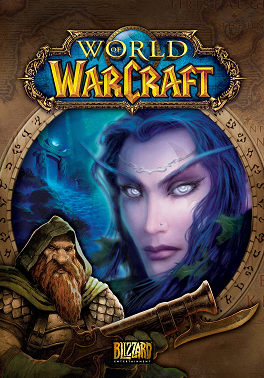
World of Warcraft
Game Family:
Warcraft
Year:
2004
Nationality:
USA
Authors:
Shane Dabiri, Carlos Guerrero
Designer:
Rob Pardo, Jeff Kaplan, Tom Chilton
Artists:
William Petras, Kevin Beardslee, Justin Thavirat
Publisher:
Blizzard Entertainment
Number of Players:
Multiplayer
Genre:
MMORPG
Other websites:

Videos by players:

Summary of the game
World of Warcraft is a massively multiplayer online role-playing game (MMORPG). Players create an avatar character to explore the open world of Azeroth and complete quests, dungeons, and raids. The game currently has 9 main expansions.
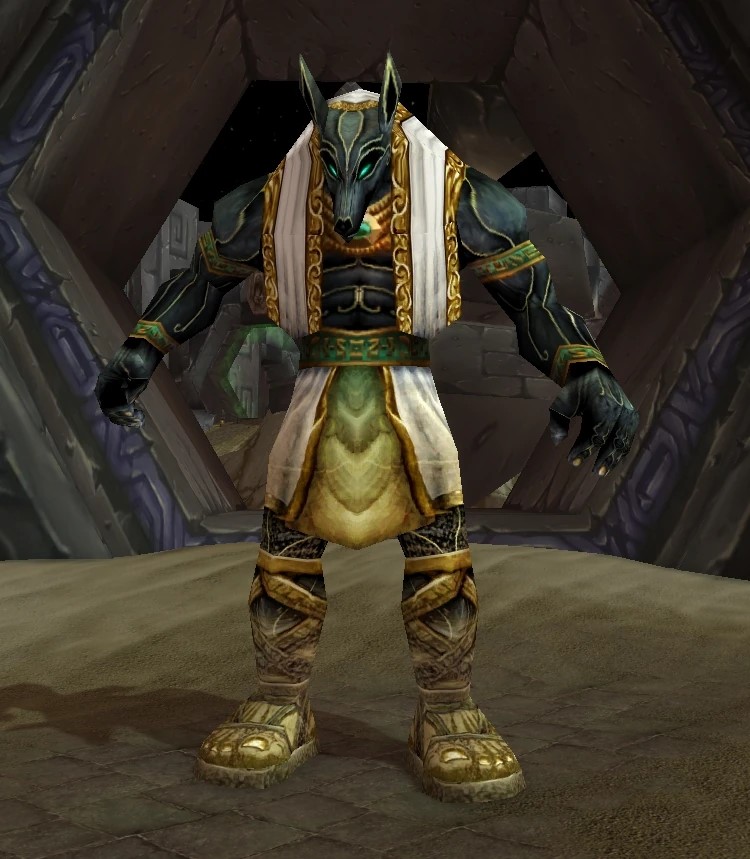
Setis, an Anubisath of the Qiraji (Image from Wowpedia: https://static.wikia.nocookie.net/wowpedia/images/2/2b/Setis.jpg/revision/latest?cb=20180522094412)
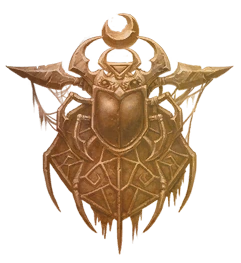
Icon of the Nerubian faction from the Lich King expansion of World of Warcraft (Image from Wowpedia: https://static.wikia.nocookie.net/wowpedia/images/7/7d/Race-icon-nerubianbig.png/revision/latest?cb=20201208232920)
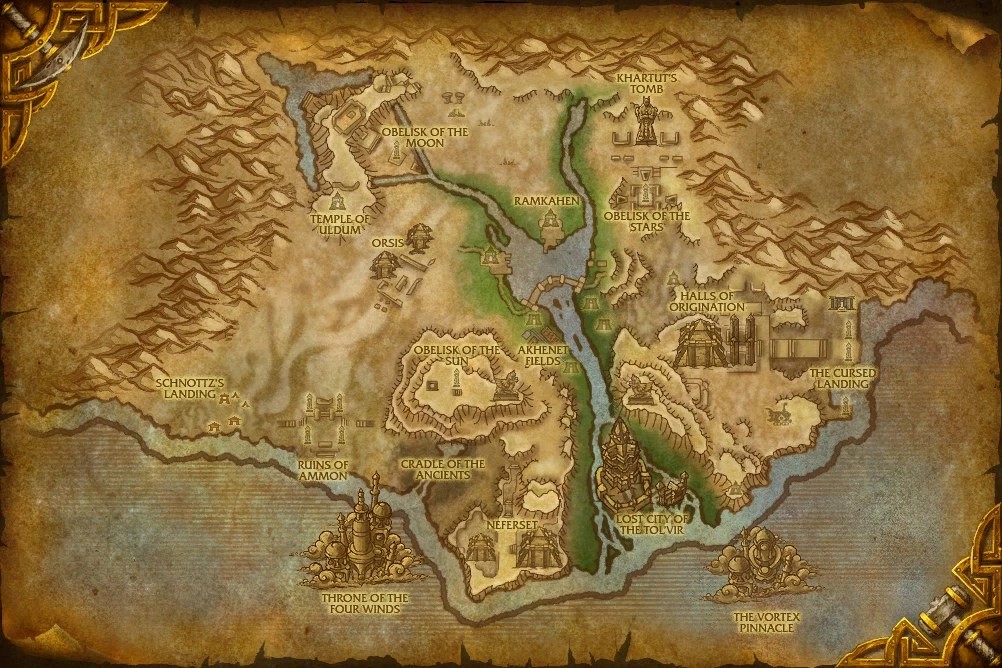
Map of Uldum from Word of Warcraft: Cataclysm (Image from Wowpedia: https://static.wikia.nocookie.net/wowpedia/images/b/b3/WorldMap-Uldum.jpg/revision/latest?cb=20140216144447)
Egyptomania narratives or motifs
During the initial run of the game, referred to as Vanilla WoW by players, Patch 1.9 was released (patches are updates to the current playable version of the game that fix bugs or add more playable content), entitled the “Gates of Ahn’Qiraj.” The gate to which the title refers is known as the Scarab Wall, an octagonal gate with a stylized scarab on it that is flanked by obelisks. The gate guards the ruins of Ahn’Qiraj, which is an Egyptianizing city, and home of the Qiraji civilization, which is loosely based on the Egyptian civilization. The Qiraji are made up of several groups, including the Silithid beetles (who look like large scarabs), the Anubisath (giant Anubis like humanoids), the Horusath (similar to the Abubisath, but with a falcon head), and the Obsidian Destroyers (figures that are made of stone, with the face of a cat, the upper body of a man, and the lower body of a cat with wings). There are two named Anubisath and Horusath, Setis (see screenshot) and Ossirian the Unscarred, respectively. Egyptian motifs are visible throughout the city, including obelisks and pyramids, and the Qiraji characters wear Egyptian-style garments, like linen kilts, pectoral necklaces, decorative belts, nemes headdresses, armbands, and sandals (see the screenshot of Setis).
In a later expansion, Wrath of the Lich King (2007), players discover that another group of arachnoids and insectoids, distantly related to the Qiraji, founded a settlement in Northrend, called Azjol-Nerub, and renamed themselves the Nerubians. This group also contains many Egyptian and Nubian references. For instance, one of the main types of Nerubians, known as a Crypt Lord, takes the form of a large scarab beetle, and another, known as a Vizier, take the form of a large spider-like figure that wears vaguely Egyptian attire. The icon that represents this group is a golden (sometime also purple) scarab beetle (see screenshot).
In the Cataclysm expansion (2010), one of the playable zones, called Uldum (which is east of Silithus, where the Ahn’Qiraj are located), is also heavily Egyptian themed. Uldum is inhabited by the Tol’vir, a race of feline humanoids (in this expansion, players found out that the Obsidian Destroyers of Ahn’Qiraj are Tol’vir who had been turned to stone). The Tol’vir have three tribes: the Ramkahen, Neferset, and Orsis, all of which are Egyptionizing names, and they are led by figures who also reference Egyptian culture, such as Dark Pharaoh Tekahn of the Neferset. Within the main Tol’vir city, the buildings are Egyptian in style and motif and include pyramids and obelisks. Throughout Uldum the different locations reference Egypt, including the Ruins of Ammon, the Cradle of the Ancients, and the Obelisk of the Stars (see screenshot of the Uldum map). The NPCs (non-playable characters, or computer AI characters that the player interacts with) wear Egyptian-style clothing, such as linen kilts, decorative belts and armbands, and pectoral necklaces. Tthe bosses the player fights in the dungeons of Uldum have Egyptian-esque names, including Isiset, Ammunae, Setesh, and Rajh.
In a later expansion, Wrath of the Lich King (2007), players discover that another group of arachnoids and insectoids, distantly related to the Qiraji, founded a settlement in Northrend, called Azjol-Nerub, and renamed themselves the Nerubians. This group also contains many Egyptian and Nubian references. For instance, one of the main types of Nerubians, known as a Crypt Lord, takes the form of a large scarab beetle, and another, known as a Vizier, take the form of a large spider-like figure that wears vaguely Egyptian attire. The icon that represents this group is a golden (sometime also purple) scarab beetle (see screenshot).
In the Cataclysm expansion (2010), one of the playable zones, called Uldum (which is east of Silithus, where the Ahn’Qiraj are located), is also heavily Egyptian themed. Uldum is inhabited by the Tol’vir, a race of feline humanoids (in this expansion, players found out that the Obsidian Destroyers of Ahn’Qiraj are Tol’vir who had been turned to stone). The Tol’vir have three tribes: the Ramkahen, Neferset, and Orsis, all of which are Egyptionizing names, and they are led by figures who also reference Egyptian culture, such as Dark Pharaoh Tekahn of the Neferset. Within the main Tol’vir city, the buildings are Egyptian in style and motif and include pyramids and obelisks. Throughout Uldum the different locations reference Egypt, including the Ruins of Ammon, the Cradle of the Ancients, and the Obelisk of the Stars (see screenshot of the Uldum map). The NPCs (non-playable characters, or computer AI characters that the player interacts with) wear Egyptian-style clothing, such as linen kilts, decorative belts and armbands, and pectoral necklaces. Tthe bosses the player fights in the dungeons of Uldum have Egyptian-esque names, including Isiset, Ammunae, Setesh, and Rajh.
Author: Tara Sewell-Lasater
Other information
Bernauer, L. 2009. ‘Elune be Praised!’ World of Warcraft, its People and Religions, and Their Real World Inspiration. Literature & Aesthetics 19(2): 313-314.
Open access
Tags
Write a Comment
Tem de iniciar a sessão para publicar um comentário.