
Tibia
Game Family:
Year:
1997
Nationality:
Germany
Authors:
Guido Lübke, Stephan Payer, Ulrich Schlott and Stephan Vogler
Designer:
Guido Lübke, Stephan Payer, Ulrich Schlott and Stephan Vogler
Artists:
Publisher:
CipSoft
Number of Players:
Single-player
Genre:
MMORPG
Other websites:

Videos by players:

Summary of the game
Tibia is a two-dimensional tile-based MMORPG with text-based elements. It is set in an open fantasy world that uses pixel art graphics, an oblique projection, and a top-down perspective. The core gameplay involves killing monsters to receive loot and gain experience, which causes the player to advance in level. (Wikipedia)

A plan of Akhramun as seen on the map. The city is mostly made of pyramids (left); Pharaoh Arkhotep (bottom) in the funerary chamber inside his pyramid (right) (Source: https://tibia.fandom.com/wiki/)
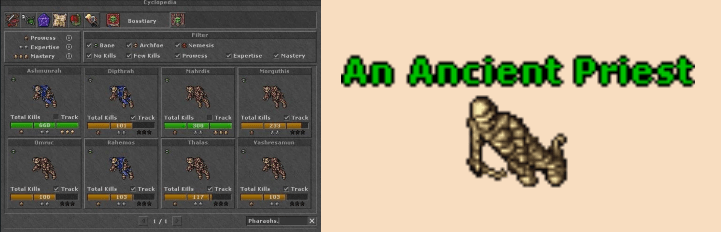
The eight conspirators in their undead forms (left) and an Ancient Priest in his mummy appearance (Source: https://tibia.fandom.com/wiki/)

Pharaoh Horestis’ Curse spawns scorpions from the body of a defeated scarab (Source: https://tibia.fandom.com/wiki/)

The Holy Scarab, the most valuable collectible dropped by Ashmunrah upon defeat (Source: https://tibia.fandom.com/wiki/)
Egyptomania narratives or motifs
The Eastern part of the world of Tibia includes a desert region called Darama, whose caves and sands are plagued by larvae, cobras, scorpions, and aggressive giant scarabs – a classic Egyptomania trope in video games (e.g. Tomb Raider The Last Revelation, The Mummy, Age of Mythology) that appeared in literature as early as 1868. The southern portion of Darama is occupied by the city of Ankrahmun. The administration and clergy of the city are all made of living mummies. The lore of the city is a wonderful pastiche of Orientalistic tropes deriving from 1800s English literature (pharaoh’s curses and carnivorous beetles), 1920s Egyptomania (tombs full of gold guarded by curses and monsters), and 1930s American movies (rotting mummies embodying all the grotesque traits of body horror that were the opposite of ‘good’ European men). Ankrahmun is composed of a vast majority of pyramids that serve as homes and shops; although, some retain their funerary function. The monarch of this region is the undead pharaoh Arkhothep, who lives in his own pyramid in the center of the city and who is also the high priest and primary deity of the local religion, a cult that celebrated the undead as the key to immortality. All undead creatures in Ankrahmun are living mummies wrapped in dirty-looking, shaggy bandages. Arkhotep and some of the other seven ‘pharaohs’ wear a blue pectoral and loincloths to signal their status (and all conspirators are larger than the players), while their servants, such as Grand Vizier Ishebad, the Sorcerer Tothdral, and the unnamed Ancient Priest, look like regular mummies and are player-sized.
Players can undertake ‘The Ancient Tomb Quest’ around Ankrahmun and discover more of the history of the place: when Arkhothep was alive, eight of his advisors were entrusted with the secret to forge part of an ancient powerful mask (the Helmet of the Ancients), but they conspired together to get rid of their king. As punishment, seven were banished to their tombs, condemned to be eternally undying. They were tasked with forever guarding the secret to forging each part of the Helmet, while the eighth conspirator was appointed to guard the sacred altar used to fuse the pieces together. These advisors are called ‘pharaohs’ in the game, although they were never rulers. The seven tombs can be found scattered in the desert around Ankrahmun, while the altar is under the city, in the library under the royal palace. Players have to defeat all eight conspirators to obtain the Helmet, and each ‘pharaoh’ is the final boss in his tomb. Each structure is full of traps and various monstrous creatures, such as mummies, giant scarabs, cobras, skeletons, and undead guardians. The conspirators drop some rare loot, among which are Egyptian-inspired objects, such as a Pharaoh’s Sword, a Crystal Mace, a Holy Falcon, a Holy Scarab (which is essentially an image of the Egyptian god Khepri holding the sun-disk), and a very Egyptian-looking Ravager’s Axe.
Another quest involving mummies and tombs is the Mummy’s Curse World Change, during which players have to investigate the tomb of Horestis, the first pharaoh of Ankrahmun. The building is, of course, protected by many monstrous creatures summoned by the owner himself, who is the final boss. In order to face Horestis, players have to find and destroy five jackal-headed Ornate Canopic Jars containing his viscera. Canopic jars in Ancient Egypt did indeed contain some of the internal organs of mummified individuals. But there were only four of them (like the four sons of Horus), and usually only one with the head of a jackal. There are two consequences to finishing this mission: players receive the ability to use giant sandstone scorpions as mounts, and the scarabs around Ankrahmun become cursed and start spawning scorpions when they are killed.
Players can undertake ‘The Ancient Tomb Quest’ around Ankrahmun and discover more of the history of the place: when Arkhothep was alive, eight of his advisors were entrusted with the secret to forge part of an ancient powerful mask (the Helmet of the Ancients), but they conspired together to get rid of their king. As punishment, seven were banished to their tombs, condemned to be eternally undying. They were tasked with forever guarding the secret to forging each part of the Helmet, while the eighth conspirator was appointed to guard the sacred altar used to fuse the pieces together. These advisors are called ‘pharaohs’ in the game, although they were never rulers. The seven tombs can be found scattered in the desert around Ankrahmun, while the altar is under the city, in the library under the royal palace. Players have to defeat all eight conspirators to obtain the Helmet, and each ‘pharaoh’ is the final boss in his tomb. Each structure is full of traps and various monstrous creatures, such as mummies, giant scarabs, cobras, skeletons, and undead guardians. The conspirators drop some rare loot, among which are Egyptian-inspired objects, such as a Pharaoh’s Sword, a Crystal Mace, a Holy Falcon, a Holy Scarab (which is essentially an image of the Egyptian god Khepri holding the sun-disk), and a very Egyptian-looking Ravager’s Axe.
Another quest involving mummies and tombs is the Mummy’s Curse World Change, during which players have to investigate the tomb of Horestis, the first pharaoh of Ankrahmun. The building is, of course, protected by many monstrous creatures summoned by the owner himself, who is the final boss. In order to face Horestis, players have to find and destroy five jackal-headed Ornate Canopic Jars containing his viscera. Canopic jars in Ancient Egypt did indeed contain some of the internal organs of mummified individuals. But there were only four of them (like the four sons of Horus), and usually only one with the head of a jackal. There are two consequences to finishing this mission: players receive the ability to use giant sandstone scorpions as mounts, and the scarabs around Ankrahmun become cursed and start spawning scorpions when they are killed.
Author: Kate Minniti
Tags
Write a Comment
Tem de iniciar a sessão para publicar um comentário.