
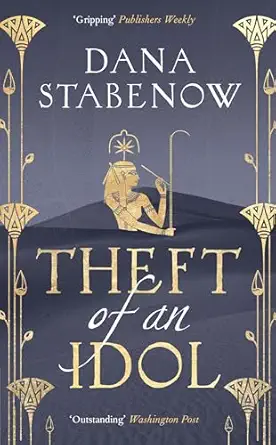
Theft of an Idol (Eye of Isis #3)
Year:
2022
Author:
Dana Stabenow
Contry:
USA
Language:
English
Publisher:
Bloomsbury Publishing
Genre:
Historical fiction, Mystery
Other websites:

Summary
This book, the third in the Eye of Isis historical mystery book series by Dana Stabenow, is set just after the events of the first and second book. Tetesheri Nebenteru, fictionalized childhood friend of Cleopatra VII and Eye of Isis, private spy to the monarch, has been tasked with finding a missing actress. Along the way she uncovers tomb robbers and human traffickers.
Egyptomania narratives or motifs
Similarly to the first and second books, while the main plot of the book is fictionalized, the author does a good job of situating the fictionalized aspects within wider themes of Ptolemaic Egypt and highlighting some key motifs of Egyptomania. Rather than reproducing 19th- and 20th-century Orientalist tropes, such as hypersexualization, mysticism, or pyramid-centric spectacle, the series reframes Egypt through political realism, administrative complexity, and Mediterranean geopolitics.
While previous books in this series were primarily set in Alexandria, this book sees Tetisheri travelling throughout Egypt to several outlying nomes in search of a missing actress. It does a good job of highlighting some of the realities of governance during the period, including that the Ptolemaic monarchs centered their rule in Alexandria and relied on elite families and officials to oversee the various nomes of the kingdom. Stabenow hints at the importance of bureaucratic governance, tax systems, and rural temple life in Ptolemaic Egypt.
As a result, religion is a key motif of this book as well. The author does a good job of emphasizing the syncretism of religions in Ptolemaic Egypt, highlighting especially how the gods of Greece/Rome were combined with Egyptian gods. Serapis, for instance, is described as a key figure of the period. But, the author also includes scenes that show how the native Egyptian religion and religious rituals did still continue under Ptolemaic rule. For example, Tetisheri is depicted as visiting temple complexes dedicated to both Seshat and Ptah, and while there are some inaccuracies represented for the sake of the murder mystery plot, the author does do a good job of referencing the importance of these gods, the Egyptian religion, and the temple-complexes to the people at the time. The temples themselves, especially the temple of Ptah which serves as the sanctuary of the main villain/priest, is depicted as atmospheric, secretive, and politically charged, which fits broader Egyptomania patterns of the temple-as-liminal-zone, where this temple is used to demonstrate the transition between the old Egyptian religion and its lessening influence in the face of syncretic Greek and Roman gods.
Another key motif of this book is Cleopatra’s genealogy, which is a heavily debated topic among scholars. A side-plot of the book is Tetesheri’s musings on if the actress she is looking for is Cleopatra’s secret sister. This subplot participates in the current popular fascination with secret bloodlines and highlights the trope of dynastic secrecy and the potential of hidden heirs often seen in popular culture. In exploring this fictionalized plot, the author highlights the common argument that Cleopatra was Auletes’ daughter by a concubine, rather than his sister-wife, Cleopatra V Tryphaena. This also obliquely references how Cleopatra’s ethnicity/race has become a modern cultural flashpoint.
In general, one final Egyptomania theme that must be highlighted, and which is present in all the books of the series, is utilizing ancient Egypt as a backdrop for mystery/detective fiction. In contemporary popular culture, Egypt is seen as a site of intrigue, secret knowledge, conspiracies, hidden tombs, coded texts, etc. So, a modern Egyptomania phenomenon is seen in the ease with which detective plots are set in Egypt, due to audiences’ belief that Egypt is inherently a space of mysticism and intrigue. In this book, the entire plot is also centered on tomb robbery, which is one of the most enduring Egyptomania tropes. The motif taps into the long Western association between Egypt and looted antiquities, the fetishization of sacred objects, and tombs as a setting for mystic, eerie, or criminal events.
While previous books in this series were primarily set in Alexandria, this book sees Tetisheri travelling throughout Egypt to several outlying nomes in search of a missing actress. It does a good job of highlighting some of the realities of governance during the period, including that the Ptolemaic monarchs centered their rule in Alexandria and relied on elite families and officials to oversee the various nomes of the kingdom. Stabenow hints at the importance of bureaucratic governance, tax systems, and rural temple life in Ptolemaic Egypt.
As a result, religion is a key motif of this book as well. The author does a good job of emphasizing the syncretism of religions in Ptolemaic Egypt, highlighting especially how the gods of Greece/Rome were combined with Egyptian gods. Serapis, for instance, is described as a key figure of the period. But, the author also includes scenes that show how the native Egyptian religion and religious rituals did still continue under Ptolemaic rule. For example, Tetisheri is depicted as visiting temple complexes dedicated to both Seshat and Ptah, and while there are some inaccuracies represented for the sake of the murder mystery plot, the author does do a good job of referencing the importance of these gods, the Egyptian religion, and the temple-complexes to the people at the time. The temples themselves, especially the temple of Ptah which serves as the sanctuary of the main villain/priest, is depicted as atmospheric, secretive, and politically charged, which fits broader Egyptomania patterns of the temple-as-liminal-zone, where this temple is used to demonstrate the transition between the old Egyptian religion and its lessening influence in the face of syncretic Greek and Roman gods.
Another key motif of this book is Cleopatra’s genealogy, which is a heavily debated topic among scholars. A side-plot of the book is Tetesheri’s musings on if the actress she is looking for is Cleopatra’s secret sister. This subplot participates in the current popular fascination with secret bloodlines and highlights the trope of dynastic secrecy and the potential of hidden heirs often seen in popular culture. In exploring this fictionalized plot, the author highlights the common argument that Cleopatra was Auletes’ daughter by a concubine, rather than his sister-wife, Cleopatra V Tryphaena. This also obliquely references how Cleopatra’s ethnicity/race has become a modern cultural flashpoint.
In general, one final Egyptomania theme that must be highlighted, and which is present in all the books of the series, is utilizing ancient Egypt as a backdrop for mystery/detective fiction. In contemporary popular culture, Egypt is seen as a site of intrigue, secret knowledge, conspiracies, hidden tombs, coded texts, etc. So, a modern Egyptomania phenomenon is seen in the ease with which detective plots are set in Egypt, due to audiences’ belief that Egypt is inherently a space of mysticism and intrigue. In this book, the entire plot is also centered on tomb robbery, which is one of the most enduring Egyptomania tropes. The motif taps into the long Western association between Egypt and looted antiquities, the fetishization of sacred objects, and tombs as a setting for mystic, eerie, or criminal events.
Author: Tara Sewell-Lasater
Tags
Write a Comment
Tem de iniciar a sessão para publicar um comentário.