

The Picture of Dorian Gray
Year:
1945
Running time:
110 mn
Nationality:
USA
Language:
English
Genre:
Drama, Thriller
Director:
Albert Lewin
Producer:
Metro-Goldwyn-Mayer (MGM)
Screenwriter/s:
Albert Lewin
Cast:
Hurd Hatfield, George Sanders, Donna Reed, Angela Lansbury, Peter Lawford, Lowell Gilmore, and others
Other websites:


Trailer:

Summary of the film
Innocent young Dorian Gray has his portrait painted by a close friend. Soon after, under the influence of amoral Lord Henry Wotton, he jilts his fiancee, leading to her suicide. This is the start of a life of increasing debauchery, Gray realising that the outward signs of this are apparent only in the portrait. Eventually the picture, secreted in his childhood playroom, becomes almost hideous to behold. But Gray still has one pure love - Gladys, the niece of the original painter. (FIlmaffinity)
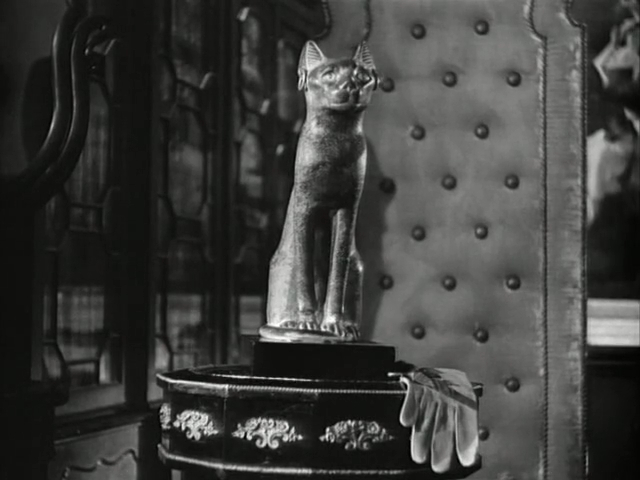
The cat statuette as it appears in the film (Screenshot by the author)
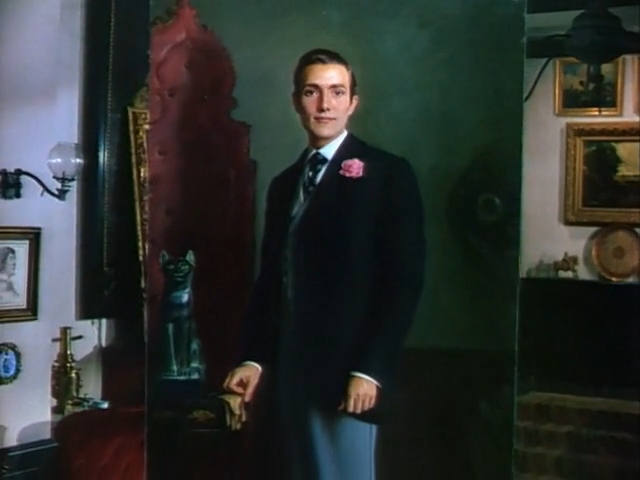
The portrait of Dorian Gray as it originally appears, featuring the cat statuette (Screenshot by the author)
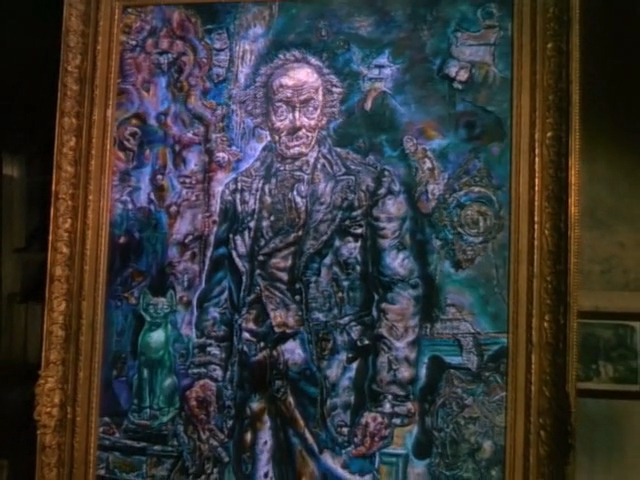
The portrait of Dorian Gray once it has changed, featuring the (unchanged) cat statuette (Screenshot by the author)
Egyptomania narratives or motifs
Based on Oscar Wilde’s 1890/1891 novella of the same name, Lewin’s 1945 take on The Picture of Dorian Gray introduces an ancient Egyptian cat statuette to the story. This statuette plays a significant role in the narrative, implied to be a representation of a deity who grants Dorian’s wish to remain young, while the recently painted portrait of him (executed by the painter Basil Hallward) grows old instead. When Dorian utters this wish aloud, another character, Lord Henry, reproaches him:
While there is little to suggest the cat as a particularly appropriate sacred symbol in ancient Egypt for bringing this dark wish to fruition, the statuette features ominously in many of the early shots in the film, in which it seems to loom behind Dorian. Dorian’s fiancée (whom he later drives to suicide by rejecting her) comments that she thinks she has seen its eyes move, and Dorian admits that the statuette frightens him, all of which draws upon the occult connotations of ancient Egyptian artefacts in the popular imaginary. It raises questions as to whether we might more accurately refer to the granted wish as a curse, given the indelible association between ancient Egyptian artefacts – especially those removed from their country of origin – and ill-fate. That the cat features in the painted portrait of – and is the one feature that stays the same between the image of the portrait as it is first painted and the hideous version at the end of Dorian’s life – suggests that Egypt represents a kind of timeless unchanging quality that Dorian attempts (and fails) to replicate.
You oughtn’t to express such a wish in the presence of that cat, Dorian. It’s one of the seventy-three great gods of Egypt and is quite capable of granting your wish.
While there is little to suggest the cat as a particularly appropriate sacred symbol in ancient Egypt for bringing this dark wish to fruition, the statuette features ominously in many of the early shots in the film, in which it seems to loom behind Dorian. Dorian’s fiancée (whom he later drives to suicide by rejecting her) comments that she thinks she has seen its eyes move, and Dorian admits that the statuette frightens him, all of which draws upon the occult connotations of ancient Egyptian artefacts in the popular imaginary. It raises questions as to whether we might more accurately refer to the granted wish as a curse, given the indelible association between ancient Egyptian artefacts – especially those removed from their country of origin – and ill-fate. That the cat features in the painted portrait of – and is the one feature that stays the same between the image of the portrait as it is first painted and the hideous version at the end of Dorian’s life – suggests that Egypt represents a kind of timeless unchanging quality that Dorian attempts (and fails) to replicate.
Author: Eleanor Dobson
Other information
Stilling, R. (2013), ”An Image of Europe: Yinka Shonibare’s Postcolonial Decadence”. In PMLA, 128.2, pp. 299-321.
Open access
Tags
Write a Comment
Tem de iniciar a sessão para publicar um comentário.