
The Dog-Eared God
Year:
1926
Author:
Frank Belknap Long Jr.
Contry:
USA
Language:
English
Publisher:
Weird Tales
Genre:
Horror, Weird Fiction
Other websites:

Summary
"The Dog-Eared God" traces the story of an Egyptologist, Professor Dewey, who has been smuggling mummies out of Egypt for a number of years. This short story starts with his acquisition of an unusual specimen, whose head has apparently canine features. Considering the theriomorphic Egyptian gods, Dewey is convinced of their historical (or pre-historical) basis in fact. Dewey and George (the narrator) spend the night in Dewey’s mummy-room, and George is awakened to faint noises, before experiencing a vision (or the projection of memories from the newly acquired specimen – George is unclear on this point) of animal-headed deities carrying the strange eponymous god to its burial. When the narrator comes to from the vision, the dog-eared god is awake and destroys both Dewey and much of his house in a fiery conflagration as the narrator flees the scene.
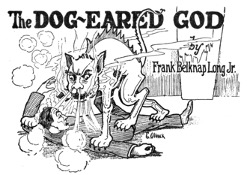
G. O. Olinick’s illustration for the story from Weird Tales, November 1926 (Source: Wikimedia Commons, Public Domain]
Egyptomania narratives or motifs
Frank Belknap Long’s story is based on the idea of the real and continued existence of beings which were depicted as gods in ancient Egyptian culture. He cites a passage from Herodotus at the very beginning in order to give historical precedent to such a conception:
Similarly, the opium-fuelled horror of Egyptian deities expressed in Thomas De Quincey’s "Confessions of an Opium-Eater" is also mentioned at the beginning. This notion is developed on a pseudo-rational basis by the professor, who is apparently known to have some colourful theories regarding ancient Egypt from his fear of being mocked by his professional ‘enemies’. For example:
The vision given to the narrator of the animal-headed deities carrying this unknown god in a procession links back to the processions of ancient Egyptian festivals, but possibly also to H.P. Lovecraft’s "Imprisoned with the Pharaohs" (1924), whose conception and usage of such a motif is strikingly similar. This would be unsurprising given the two’s prolonged friendship in which ideas were often exchanged. For example, Long’s "The Horror From the Hills" (1931) was based on a dream described by Lovecraft in a letter.
Another interesting point is the reflection of collecting offered in the story. Dewey is conceived of as an eccentric, morally questionable misanthrope, who possibly engaged in mummy unwrappings, as George mentions ‘unhallowed and unsavoury practices’ which required disposing of (presumably human) hair and nails. Similarly, he furnished his mummy-room with ‘the trappings of occult melodrama’, reflecting the different milieus in which contemporary collectors operated and the popularity of occultism and spiritualism at this time. Similar conceptions of eccentric and dangerous collectors and Egyptologists can be found in the works of many authors of the late 19th and 20th centuries, from Sax Rohmer to Robert Bloch.
Finally, the story features a variation on a curse, or more properly speaking, a prophecy. One member of the procession, a high priest with a lizard’s head proclaims:
This proclamation reflects contemporary interest in curses (this story first appeared four years after the discovery of Tutankhamun’s tomb, and three years after the death of Lord Carnarvon). The fear of the figures in the procession of the addressed god also has possible connections with the trope of the feared ruler of Egypt. An example with which Long would have been familiar would be Nitocris. She is mentioned in Herodotus’ Histories which Long quoted at the beginning of the story, as well in Lord Dunsany’s play The Queen’s Enemies (1917) and H.P. Lovecraft’s The Outsider (1926) which had appeared earlier that year. The latter was Long’s close friend, while the former was a significant influence for both Long and Lovecraft, among their other acquaintances.
The Egyptians’ gods are shaped like beasts, but why they represent them in this way I had rather not mention.
Similarly, the opium-fuelled horror of Egyptian deities expressed in Thomas De Quincey’s "Confessions of an Opium-Eater" is also mentioned at the beginning. This notion is developed on a pseudo-rational basis by the professor, who is apparently known to have some colourful theories regarding ancient Egypt from his fear of being mocked by his professional ‘enemies’. For example:
It is absurd to believe that the Egyptians created their monstrous bestial gods from mere observation of living animals. There is something so immense, so physically terrible about the Egyptian gods that it is difficult to believe them simply the product of normal human imagination. They are either the imaginings of some dreamer of wild and unheard-of powers, an Edgar Poe among the Egyptians, or–
The vision given to the narrator of the animal-headed deities carrying this unknown god in a procession links back to the processions of ancient Egyptian festivals, but possibly also to H.P. Lovecraft’s "Imprisoned with the Pharaohs" (1924), whose conception and usage of such a motif is strikingly similar. This would be unsurprising given the two’s prolonged friendship in which ideas were often exchanged. For example, Long’s "The Horror From the Hills" (1931) was based on a dream described by Lovecraft in a letter.
Another interesting point is the reflection of collecting offered in the story. Dewey is conceived of as an eccentric, morally questionable misanthrope, who possibly engaged in mummy unwrappings, as George mentions ‘unhallowed and unsavoury practices’ which required disposing of (presumably human) hair and nails. Similarly, he furnished his mummy-room with ‘the trappings of occult melodrama’, reflecting the different milieus in which contemporary collectors operated and the popularity of occultism and spiritualism at this time. Similar conceptions of eccentric and dangerous collectors and Egyptologists can be found in the works of many authors of the late 19th and 20th centuries, from Sax Rohmer to Robert Bloch.
Finally, the story features a variation on a curse, or more properly speaking, a prophecy. One member of the procession, a high priest with a lizard’s head proclaims:
For thirty centuries you shall sleep, but a little shameless creature with no hair to cover him shall drag you forth, because in his time he shall be as a god. But his evil day will not be long under the sun. He too shall return unto dust, and a very thin creature with neither legs nor eyes shall play havoc with his bones. It is written. Rest in peace, and remember us who worshipped you!
This proclamation reflects contemporary interest in curses (this story first appeared four years after the discovery of Tutankhamun’s tomb, and three years after the death of Lord Carnarvon). The fear of the figures in the procession of the addressed god also has possible connections with the trope of the feared ruler of Egypt. An example with which Long would have been familiar would be Nitocris. She is mentioned in Herodotus’ Histories which Long quoted at the beginning of the story, as well in Lord Dunsany’s play The Queen’s Enemies (1917) and H.P. Lovecraft’s The Outsider (1926) which had appeared earlier that year. The latter was Long’s close friend, while the former was a significant influence for both Long and Lovecraft, among their other acquaintances.
Author: Lawrence Webb
Other information
Webb, L. 2025. The Call of Nighted Khem: Tracing Ancient Egypt through Weird Fiction, in John Rogers, Catherine Bishop-Allen, Henry Bohun, Reuben G. Hutchinson-Wong and Marina Sartori (eds) Current Research in Egyptology 2024: 369. Oxford: Archaeopress.
Open access
Tags
Write a Comment
Tem de iniciar a sessão para publicar um comentário.