

Sid Meier’s Civilization VI
Game Family:
Sid Meier's Civilization
Year:
2016
Nationality:
USA
Authors:
Dennis Shirk
Designer:
Ed Beach
Artists:
Brian Busatti
Publisher:
Firaxis
Number of Players:
Single-player, Multiplayer
Genre:
Turn-based strategy, 4X
Other websites:

Videos by players:

Summary of the game
The sixth installment of the Civilization video game series, Civilization VI (abbreviated Civ VI) is a turn-based strategy video game (meaning players plan their moves in turns) where the player is able to act as the ruler of one of 50 different civilizations as they lead them through various periods of development (from the rise of civilizations around 4000 BCE to the Space Age). This series pioneered the “4X” style of gameplay, in which players explore land, expand into new territories, exploit resources, and exterminate opposing civilizations. In Civ VI, just as in Civ V, each civilization is led by a ruler, who is represented by a fully animated figure of the leader, who speaks to the player in their native language (or as close to that language as possible and which is then translated for the player via subtitles).
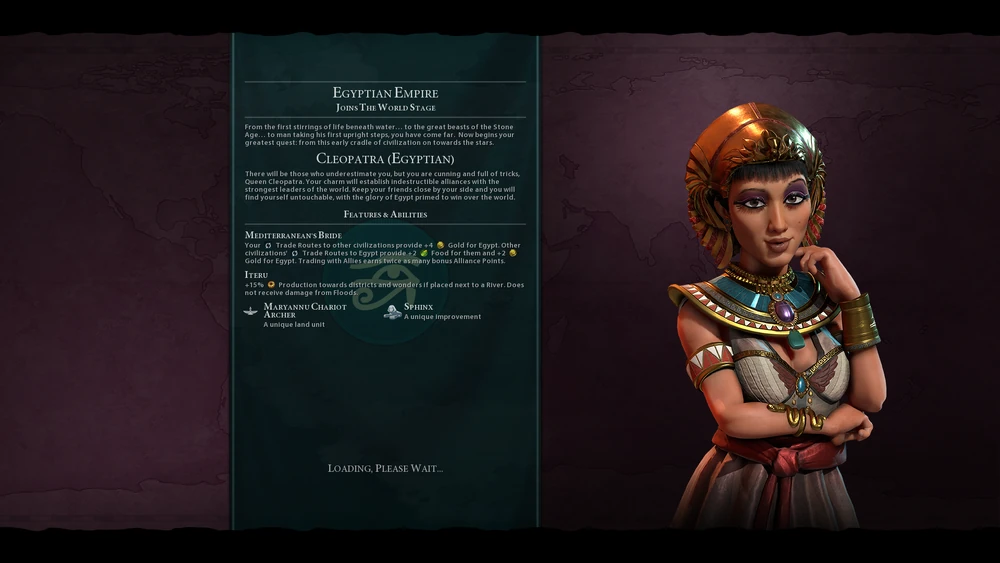
Information screen for the Egyptian civilization and Kleopatra VII’s Egyptian avatar from Civilization VI (Source: https://civilization.fandom.com/wiki/Cleopatra_(Civ6)?file=Cleopatra_loadscreen_%28Civ6%29.png)
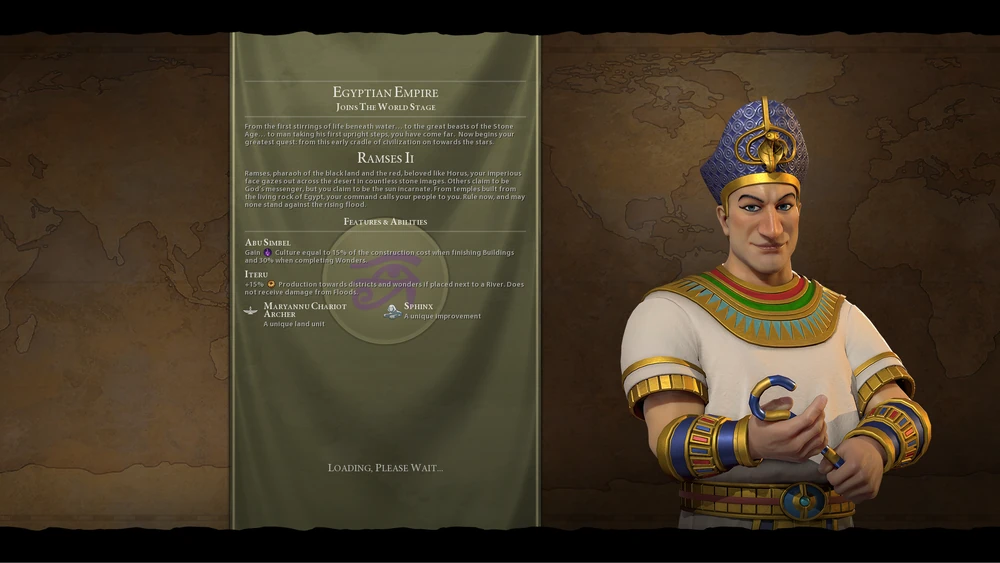
Information screen for the Egyptian civilization and Ramses II avatar from Civilization VI (Source: https://civilization.fandom.com/wiki/Ramses_II_(Civ6)?file=Ramses_II_loadscreen_%28Civ6%29.png)
Egyptomania narratives or motifs
In Civ VI Egypt is a playable civilization, led by Kleopatra VII or Ramses II, and players can select from a wide variety of Egyptian cities to build, including a capital city at Râ-Kedet (Rhacotis, later Alexandria), under Kleopatra, or Thebes, under Ramses. Both leader’s avatars speak Middle Egyptian, utilizing modern Egyptian pronunciation, which is anachronistic not only due to the use of modern pronunciation guidelines, but also because Middle Egyptian was used primarily during the Middle Kingdom period in Egypt. As a ruler during the New Kingdom, Ramses II’s main language would have been Late Egyptian. As a Ptolemaic monarch, Kleopatra’s main language would have been Koine Greek; although, as Plutarch notes, she may have been able to speak several additional languages, including Egyptian. By the Ptolemaic period in Egypt, however, Demotic was the main spoken form of Egyptian. The game designers may have chose to use Middle Egyptian for both avatars since it is the most well-documented and most-studied version of the ancient language.
In appearance, the Kleopatra avatar has two versions the Egyptian and Ptolemaic. She speaks the same language in both, but her dress differs. In the Ptolemaic version, she wears a brown dress, perhaps modelled on a chiton-style garment, pinned at the shoulders, and belted around her waist with a gold wrap (see screenshot). She wears Egyptian-esque arm bands and has a black braided wig with a stylized bird headpiece. Her Egyptian garments include a linen dress, a pectoral collar, arm bands, and a golden headpiece that seems to be a stylized imitation of the vulture headdress commonly worn by Egyptian queens (see screenshot). In both versions she has kohl-lined eyes with bright purple eyeshadow. In her mannerisms and characteristics, the Kleopatra avatar is based on the popular culture version of the queen, in which her sensuality and charm are heavily emphasized. For example, in her Egyptian version, her leader agenda, called “Queen of the Nile”, requires that she favors other civilizations with strong militaries and dislikes those with weaker militaries, which alludes to her alliance with Julius Caesar and Mark Antony. An interesting note, when Kleopatra greets the player, she says “I am Isis reborn, I am the living Nile, I am Cleopatra and an ally, if you are worthy.” This references her role as the New Isis during her reign and the power she wielded as a result of that assimilation to the goddess.
The Ramses II avatar in Civ VI looks very similar to the Ramesses II avatar in Civ V (although two distinct spellings of his name are used from game to game). Ramses wears a white linen tunic with a gold belt, wrist cuffs, a pectoral neckpiece, the blue war crown (khepresh), and he holds a heqa scepter (see screenshot). In Civ VI he is just missing the false beard that his Civ V iteration included. His leader agenda is called “Ma’at” in which he clears and improves all possible tiles, which seems to be a reference to the historical Ramesses’ various building projects.
Players who play as the Egyptian civilization can summon a unique military unit, the Maryannu Chariot Archer. The chariot archer has appeared as a special Egyptian unit in previous installments of this game, acknowledging the importance of that unit in the Egyptian army; however, Civ VI is the first to name them as Maryannu and to give information on the historical significance of that unit within the game’s Civilopedia.
In Civ VI, each civilization has a unique ability as well, which provides bonuses during game play. The Egyptian civilization’s ability is Iteru, which allows them to build wonders and cities faster if they are placed next to a river and allows them to also build these structures on desert floodplains, making Egypt and Nubia the only civilizations in the game that can build structures (besides farms) on these types of tiles. Each civilization can also build a unique structure or infrastructure. For the Egyptians, their unique structure is the Sphinx, and it is the first time this monument has been featured in the Civ games. Building this structure gives the player bonuses to culture, appeal, and faith. It is also notable that the Nubian’s special structure are Nubian pyramids. As with previous installments of the Civ games, the Great Pyramid, Great Library of Alexandria, and Great Lighthouse are Egyptian Wonders that are buildable by all civilizations.
When playing as the Egyptian civilization there is not a lot that distinguishes the gameplay as uniquely Egyptian, other than interacting with Kleopatra or Ramses as the civilization’s leading avatars and being able to utilize the civilization’s special features. The player progresses through the same gameplay, the same technological advancements, and the same technological periods as they would with any of the other civilizations.
In appearance, the Kleopatra avatar has two versions the Egyptian and Ptolemaic. She speaks the same language in both, but her dress differs. In the Ptolemaic version, she wears a brown dress, perhaps modelled on a chiton-style garment, pinned at the shoulders, and belted around her waist with a gold wrap (see screenshot). She wears Egyptian-esque arm bands and has a black braided wig with a stylized bird headpiece. Her Egyptian garments include a linen dress, a pectoral collar, arm bands, and a golden headpiece that seems to be a stylized imitation of the vulture headdress commonly worn by Egyptian queens (see screenshot). In both versions she has kohl-lined eyes with bright purple eyeshadow. In her mannerisms and characteristics, the Kleopatra avatar is based on the popular culture version of the queen, in which her sensuality and charm are heavily emphasized. For example, in her Egyptian version, her leader agenda, called “Queen of the Nile”, requires that she favors other civilizations with strong militaries and dislikes those with weaker militaries, which alludes to her alliance with Julius Caesar and Mark Antony. An interesting note, when Kleopatra greets the player, she says “I am Isis reborn, I am the living Nile, I am Cleopatra and an ally, if you are worthy.” This references her role as the New Isis during her reign and the power she wielded as a result of that assimilation to the goddess.
The Ramses II avatar in Civ VI looks very similar to the Ramesses II avatar in Civ V (although two distinct spellings of his name are used from game to game). Ramses wears a white linen tunic with a gold belt, wrist cuffs, a pectoral neckpiece, the blue war crown (khepresh), and he holds a heqa scepter (see screenshot). In Civ VI he is just missing the false beard that his Civ V iteration included. His leader agenda is called “Ma’at” in which he clears and improves all possible tiles, which seems to be a reference to the historical Ramesses’ various building projects.
Players who play as the Egyptian civilization can summon a unique military unit, the Maryannu Chariot Archer. The chariot archer has appeared as a special Egyptian unit in previous installments of this game, acknowledging the importance of that unit in the Egyptian army; however, Civ VI is the first to name them as Maryannu and to give information on the historical significance of that unit within the game’s Civilopedia.
In Civ VI, each civilization has a unique ability as well, which provides bonuses during game play. The Egyptian civilization’s ability is Iteru, which allows them to build wonders and cities faster if they are placed next to a river and allows them to also build these structures on desert floodplains, making Egypt and Nubia the only civilizations in the game that can build structures (besides farms) on these types of tiles. Each civilization can also build a unique structure or infrastructure. For the Egyptians, their unique structure is the Sphinx, and it is the first time this monument has been featured in the Civ games. Building this structure gives the player bonuses to culture, appeal, and faith. It is also notable that the Nubian’s special structure are Nubian pyramids. As with previous installments of the Civ games, the Great Pyramid, Great Library of Alexandria, and Great Lighthouse are Egyptian Wonders that are buildable by all civilizations.
When playing as the Egyptian civilization there is not a lot that distinguishes the gameplay as uniquely Egyptian, other than interacting with Kleopatra or Ramses as the civilization’s leading avatars and being able to utilize the civilization’s special features. The player progresses through the same gameplay, the same technological advancements, and the same technological periods as they would with any of the other civilizations.
Author: Tara Sewell-Lasater
Other information
Mol, A.A.A., Politopoulos A., Ariese-Vandemeulebroucke C.E. (2017). "From the Stone Age to the Information Age. History and Heritage in Sid Meier’s Civilization VI", Advances in Archaeological Practice 5(2): 214-219.
Open access
Tags
Write a Comment
Tem de iniciar a sessão para publicar um comentário.