
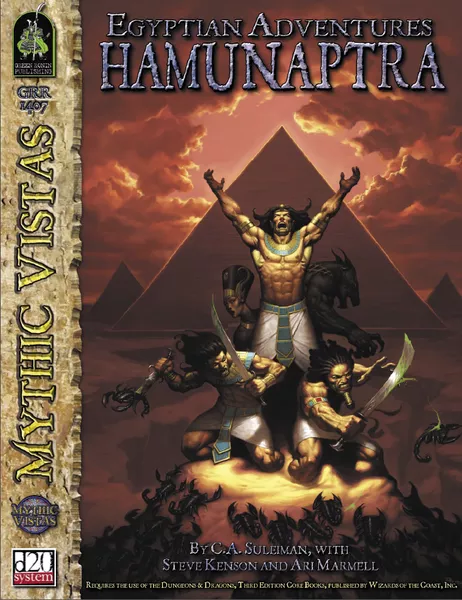
Egyptian Adventures: Hamunaptra
RPG Family or System:
d20 System
Year:
2004
Nationality:
USA
Authors:
Steve Kenson, Ari Marmell, C. A. Suleiman
Art Director:
Toren Atkinson
Publisher:
Green Ronin Publishing
Genre:
Fantasy, Ancient History
Other websites:

Videos by players :
Summary of the game
A role-playing game in the Mythic line of historical fantasy settings from Green Robin Publishers, Hamunaptra presents three volumes that adapt the D&D system to an idealised vision of Ancient Egypt. This game is compatible with other games such as Testament: Roleplaying in the Biblical or Trojan Wars. The boxed set includes three volumes, the Book of Days, which deals with magic, the Book of Gates, which provides information on daily life, culture and religion within the game, and the Book of Law, with technical aids for players and the game master.
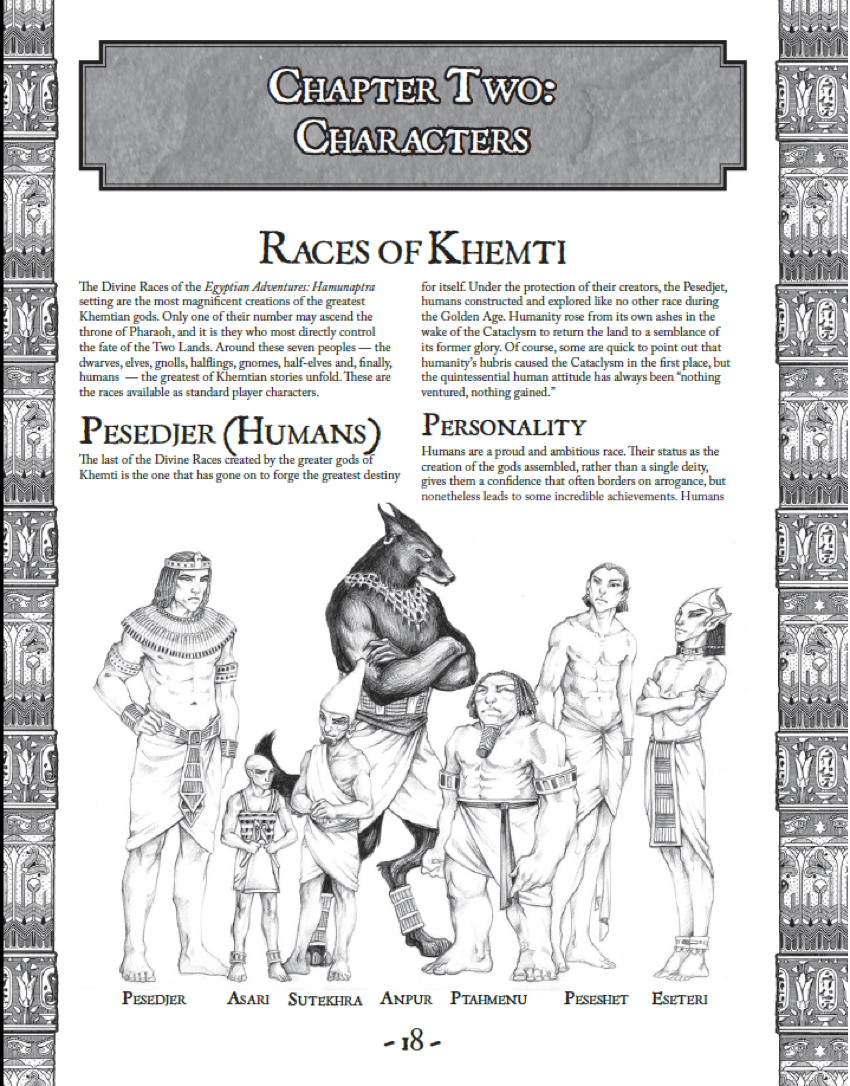
Description of Egyptian characters in the game (Scanned from the book by the author)
Egyptomania narratives or motifs
Egyptian Adventures: Hamunaptra is a fantasy game mainly inspired by the religion and mythology of the ancient Egyptian civilization and mixing it with the fantastic universe of Dungeons and Dragons. Throughout the three books which comprise this game, Hamunaptra describes the history and geographical environment of the world in which the adventures will take place, a mirror of Ancient Egypt. The game’s list of items, spells, bestiaries, and several pre-designed adventures are also included.
Players are able to choose from a wide number of characters and races to play. In addition to humans, there are what the game has termed “divine races”, pre-projects of each of the “Egyptian” gods made before the creation of humanity. These include the pthamenu (equivalent to the dwarves of fantasy narratives), the asari (gnomes of the D&D world), the sutekhra (the halflings of D&D), the anpur (gnolls, hybrids of canids and humans), the eseteri (elves) and the pesehet (half-elves). The humans, known as “pesedjer”, was the race created by the gods and therefore the dominant race.
The adventures are set in Khemti, a country crossed by the river Yor, which is almost identical to the Nile valley, including the divisions between the black lands of the valley and the red lands of the deserts. The cities are loosely inspired by those of ancient Egypt as well. Thus, Hamunaptra, the city of “White Walls” erected by the first pharaoh on the primeval mountain, bears a strong resemblance to the city of Memphis. Some architectural differences include the great citadel, a multi-storey fortress housing the temple of Osiris, the pharaoh's palace, and military outbuildings.
The political history of this fictional kingdom follows elements of Egyptian history, often very loosely. An example is the conflict between the north and the south of Khemti, which is reminiscent of the presumed confrontation between Upper and Lower Egypt at the origin of Egyptian history. Other events of the game have to do with dynastic development and the pharaohs of the past: the pyramids built by the sons and grandsons of Djedhor in the fourth dynasty or the regency and self-proclamation of the princess and later pharaoh Sitra (similar to the story of Hatshepsut in some details).
The background of the game takes a series of important and realistic concepts from Egyptology and adapted them to the created universe of the game and its characters: for instance, terms like Duat, Maat, or titles like Neb Tawy or Divine Adorer are present, and other examples include the calendar being divided into three seasons (Akhet, Peret and Shemu) or inclusion of festivals like the Heb-Sed.
The game also incorporates issues of racial conflict. There is a predominant race, the human race, which coexists with other racial minorities who, although not oppressed, are excluded from certain positions in the administration and, above all, are kept separate from the noble families that govern cities and nomos. In addition to this, the need to link the narrative to the medieval fantasy D&D game means that concepts, such as slavery, are explored in more depth by positing a slave-like society. Additionally, all sorts of references to this game itself are added, such as moral alignments, the domains of magic (schools of magic grouped by domains in which one or more divinities intervene), etc.
Finally, it is noteworthy that the last book/chapter focuses on items, spells, powers, and quests in the form of listings typical of the D&D games. The most important quests are desert travel, the search and looting of ancient tombs or ruins, those linked to monster hunting, or the search for arcane treasures, all of which are common issues in the treatment of ancient Egypt in popular culture as well.
Players are able to choose from a wide number of characters and races to play. In addition to humans, there are what the game has termed “divine races”, pre-projects of each of the “Egyptian” gods made before the creation of humanity. These include the pthamenu (equivalent to the dwarves of fantasy narratives), the asari (gnomes of the D&D world), the sutekhra (the halflings of D&D), the anpur (gnolls, hybrids of canids and humans), the eseteri (elves) and the pesehet (half-elves). The humans, known as “pesedjer”, was the race created by the gods and therefore the dominant race.
The adventures are set in Khemti, a country crossed by the river Yor, which is almost identical to the Nile valley, including the divisions between the black lands of the valley and the red lands of the deserts. The cities are loosely inspired by those of ancient Egypt as well. Thus, Hamunaptra, the city of “White Walls” erected by the first pharaoh on the primeval mountain, bears a strong resemblance to the city of Memphis. Some architectural differences include the great citadel, a multi-storey fortress housing the temple of Osiris, the pharaoh's palace, and military outbuildings.
The political history of this fictional kingdom follows elements of Egyptian history, often very loosely. An example is the conflict between the north and the south of Khemti, which is reminiscent of the presumed confrontation between Upper and Lower Egypt at the origin of Egyptian history. Other events of the game have to do with dynastic development and the pharaohs of the past: the pyramids built by the sons and grandsons of Djedhor in the fourth dynasty or the regency and self-proclamation of the princess and later pharaoh Sitra (similar to the story of Hatshepsut in some details).
The background of the game takes a series of important and realistic concepts from Egyptology and adapted them to the created universe of the game and its characters: for instance, terms like Duat, Maat, or titles like Neb Tawy or Divine Adorer are present, and other examples include the calendar being divided into three seasons (Akhet, Peret and Shemu) or inclusion of festivals like the Heb-Sed.
The game also incorporates issues of racial conflict. There is a predominant race, the human race, which coexists with other racial minorities who, although not oppressed, are excluded from certain positions in the administration and, above all, are kept separate from the noble families that govern cities and nomos. In addition to this, the need to link the narrative to the medieval fantasy D&D game means that concepts, such as slavery, are explored in more depth by positing a slave-like society. Additionally, all sorts of references to this game itself are added, such as moral alignments, the domains of magic (schools of magic grouped by domains in which one or more divinities intervene), etc.
Finally, it is noteworthy that the last book/chapter focuses on items, spells, powers, and quests in the form of listings typical of the D&D games. The most important quests are desert travel, the search and looting of ancient tombs or ruins, those linked to monster hunting, or the search for arcane treasures, all of which are common issues in the treatment of ancient Egypt in popular culture as well.
Author: Víctor Sánchez Domínguez
Other information
Fernández Pichel, A.I., Sánchez Domínguez, V. 2023. Egypt and Role-Playing Games Does the World of Darkness Universe Use Ancient Egyptian Sources?, in A.I. Fernández Pichel (ed.) How Pharaohs Became Media Stars: Ancient Egypt and Popular Culture: 207. Oxford: Archaeopress.
Open access
Carbó García, J. R. 2019. Living Antiquity. Role-Playing Games with a Setting in Ancient Times. Collection de l'Institut des Sciences et Techniques de l'Antiquité 1476(1): 253.
Open access
Tags
Write a Comment
Tem de iniciar a sessão para publicar um comentário.