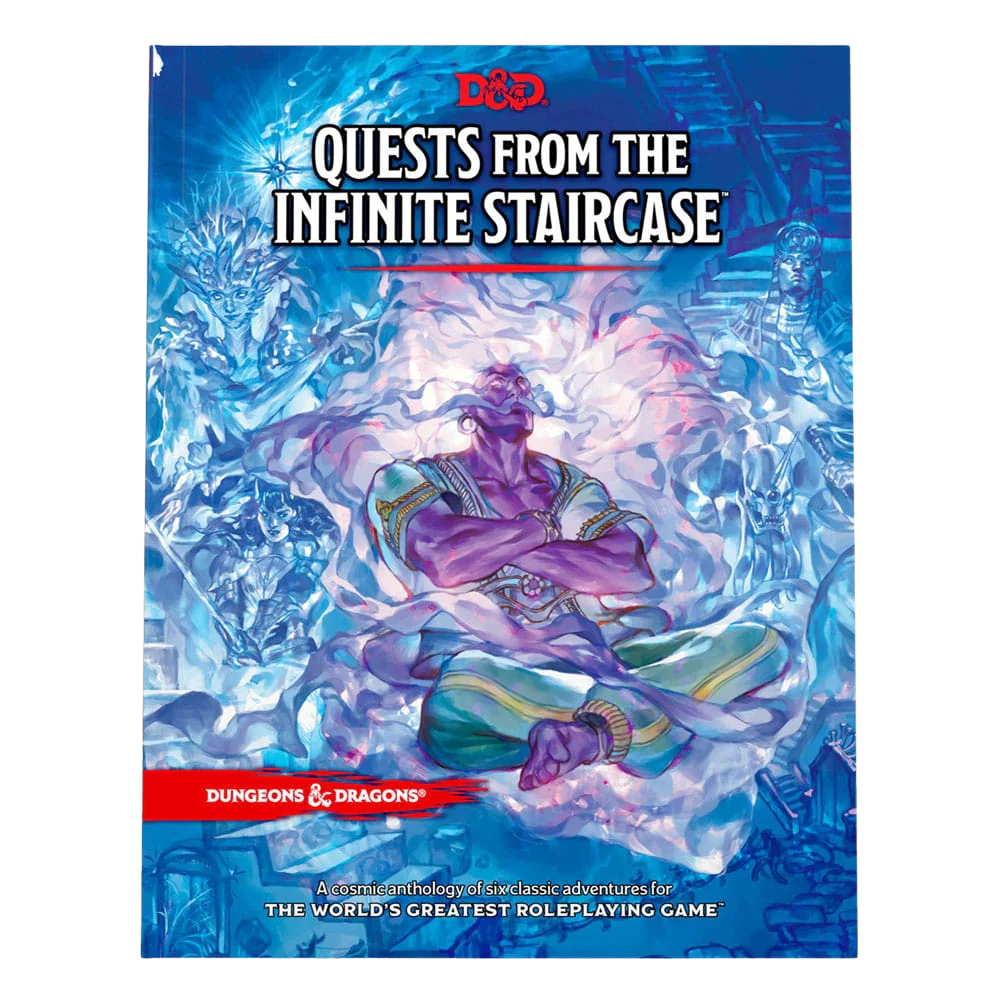
Quest from the Infinite Staircase: Pharaoh
RPG Family or System:
D&D 5e
Year:
2024
Nationality:
USA
Authors:
Justice Ramin Arman
Art Director:
Emi Tanji
Publisher:
Wizards of the Coast
Genre:
Horror, Adventure, Mystery
Other websites:

Videos by players :

Summary of the game
Pharaoh is the first adventure in the three-part Desert of Desolation series and was published in 1982. In this adventure, the ghost of a long-dead pharaoh beseeches the characters to delve into his dangerous tomb and set his cursed soul free (from the Quests from the Infinite Staircase Rulebook: Introduction). An updated version has been released in 2024 as part of a set of re-mastered D&D adventures found in Quests from the Infinite Staircase.
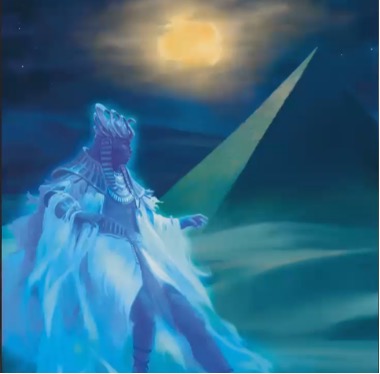
The ghost of Pharaoh Amun Sa with his pyramid behind (Source: https://www.enworld.org/attachments/pharoah-by-tomas-duchek-png.370290/)
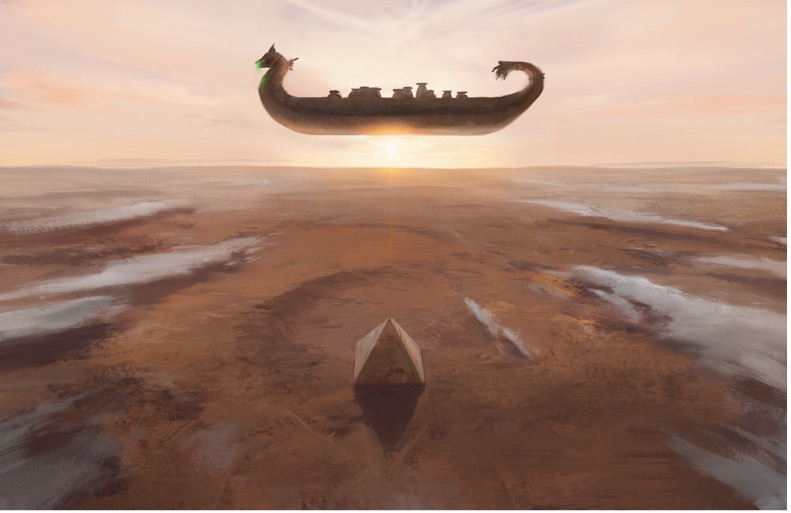
The solar barque of Amun Sa and his pyramid below (Source: https://www.enworld.org/threads/a-peek-at-quests-from-the-infinite-staircase.705057/)
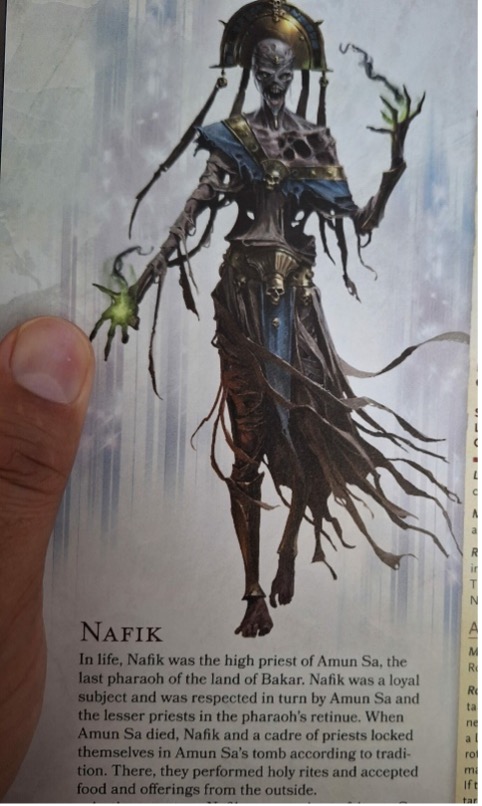
Nafik, the evil mummy priest and final boss (Source: https://www.belloflostsouls.net/wp-content/uploads/2024/07/Nafik-staircase-scaled-e1721240339559.jpg)
Egyptomania narratives or motifs
Few deserts are as harsh and inhospitable as the Desert of Desolation, where the sun, the wind, and the land itself seem to despise all living things. The ghost of a long-dead pharaoh, Amun Sa (AH-muhn sah), roams the sun-scorched dunes, appearing to those who trek across the sands. Condemned to wander the desert for eternity, Amun Sa pleads with adventurers to free his cursed soul and saved this doomed land – but none have returned from his pyramid. Within the pharaoh's tomb lie deadly traps, sinister threats, and the secret to ending the ancient curse (from Quests from the Infinite Staircase: Chapter 5).
In Pharaoh, players end up in a scorching desert known as the Desert of Desolation, where an ancient kingdom known as Bakar used to exist. Bakar closely resembles Ancient Egypt, with the exception that the river (named Athis) that used to flow throughout the country has dried up because of a curse affecting the land, resulting in a wasted and forsaken place. While wandering through the desert, players encounter the spirit of one of the Bakar Pharaohs, Amun Sa, whose name alludes to the Egyptian god Amun(-Ra). Amun Sa recounts how he used many resources from his kingdom to build his huge pyramid. Due to heavy taxation, the inhabitants of Bakar revolted against him and assaulted his tomb. Amun Sa decided to curse his people by decreeing that if he were to be killed, the river would stop flowing. After his assassination, indeed, the river Athis ceased to flow, causing the ruin of the entire kingdom, which ended up being swallowed by the sand. This relationship between the well-being of the pharaoh and the river Nile and the role of the king as a “maintainer” of the forces of order and chaos closely resembles Egyptian royal ideology.
The gods were angry with Amun Sa’s actions and decided to curse him to roam the desert for eternity. As a result, the pharaoh asks the players to find the staff and the gem, which lie within his pyramid, so that both his curse and the curse of his people can be lifted.
Players must explore and navigate through Amun Sa’s huge labyrinthic pyramid while facing many trials and tribulations along the way, such as monsters, bandits, traps, puzzles, etc. The pyramid is an orientalist, fantasy portrayal of a real Egyptian pyramid: walls are decorated with hieroglyphs (players can translate them and use them as hints for solving puzzles) and statues of the king, but its corridors are filled with tomb robbers, mummies and other fantasy creatures. In addition, the pyramid contains many traps, false corridors and entrances, as well as puzzles that players need to solve. Many of its halls also contain treasure that can be looted.
While exploring the pyramid, characters will learn that Amun Sa was supported by a group of priests led by a high priest called Nafik. After Amun Sa’s death, they all locked themselves within the tomb as part of Bakar’s religious tradition. With time, Nafik grew jealous of the late pharaoh’s honor of being granted an eternal afterlife while they had to live forever locked in the tomb, so he began to learn dark magic to gain eternal life. However, he failed to do so and instead turned himself and the rest of the priests into mummies who must dwell within the pyramid forever. Nafik is the final boss of the adventure and a very powerful magician who can curse people into disintegrating into dust (Rotting Fist) and who can revive 24 hours after being killed if his heart isn’t destroyed (Rejuvenation). This portrayal of Nafik as a treacherous, conspiring priest fits within orientalist schemes of Egyptian priests and religion seen as exotic, decadent and deceptive, as well as with popular culture motifs such as mummies, curses and rejuvenation.
After Nafik is defeated, players must find his heart and destroy it before he is able to revive. If they manage to achieve this, they will come across a column of water that will ask three questions (called The Trial of Truth). If players answer deceitfully, the column will harm them. If they answer truthfully, the column of water will lead them to Amun Sa’s final chamber. This Trial of Truth closely resembles both the Afterlife Trial that the deceased must face before Osiris as is shown in the The Book of Coming Forth by Day, as well as the Greek myth of the Riddle of the Sphinx.
Once players reach the tomb of Amun Sa, they can retrieve his staff. Within the burial chamber, one of its walls is decorated with a solar barque of the king containing canopic jars. If players touch the mural, they will be teleported to a place in the middle of the sky on top of the pyramid: the solar barque lies floating in the sky, and the gemstone can be found in the boat’s bow. After retrieving the gemstone and the treasure found in the canopic jars, players will fall safely into the ground. The floating barque of Amun Sa is a direct reference to Ra’s solar barque and the god’s journey through the skies according to Egyptian beliefs.
Finally, after the enemy has been destroyed forever and the curse is lifted, the river Athis starts flowing again, allowing for the region Bakar to flourish once more. This importance of the river alludes again to the Nile as being a “gift” that allowed the development of Ancient Egyptian civilization.
In Pharaoh, players end up in a scorching desert known as the Desert of Desolation, where an ancient kingdom known as Bakar used to exist. Bakar closely resembles Ancient Egypt, with the exception that the river (named Athis) that used to flow throughout the country has dried up because of a curse affecting the land, resulting in a wasted and forsaken place. While wandering through the desert, players encounter the spirit of one of the Bakar Pharaohs, Amun Sa, whose name alludes to the Egyptian god Amun(-Ra). Amun Sa recounts how he used many resources from his kingdom to build his huge pyramid. Due to heavy taxation, the inhabitants of Bakar revolted against him and assaulted his tomb. Amun Sa decided to curse his people by decreeing that if he were to be killed, the river would stop flowing. After his assassination, indeed, the river Athis ceased to flow, causing the ruin of the entire kingdom, which ended up being swallowed by the sand. This relationship between the well-being of the pharaoh and the river Nile and the role of the king as a “maintainer” of the forces of order and chaos closely resembles Egyptian royal ideology.
The gods were angry with Amun Sa’s actions and decided to curse him to roam the desert for eternity. As a result, the pharaoh asks the players to find the staff and the gem, which lie within his pyramid, so that both his curse and the curse of his people can be lifted.
Players must explore and navigate through Amun Sa’s huge labyrinthic pyramid while facing many trials and tribulations along the way, such as monsters, bandits, traps, puzzles, etc. The pyramid is an orientalist, fantasy portrayal of a real Egyptian pyramid: walls are decorated with hieroglyphs (players can translate them and use them as hints for solving puzzles) and statues of the king, but its corridors are filled with tomb robbers, mummies and other fantasy creatures. In addition, the pyramid contains many traps, false corridors and entrances, as well as puzzles that players need to solve. Many of its halls also contain treasure that can be looted.
While exploring the pyramid, characters will learn that Amun Sa was supported by a group of priests led by a high priest called Nafik. After Amun Sa’s death, they all locked themselves within the tomb as part of Bakar’s religious tradition. With time, Nafik grew jealous of the late pharaoh’s honor of being granted an eternal afterlife while they had to live forever locked in the tomb, so he began to learn dark magic to gain eternal life. However, he failed to do so and instead turned himself and the rest of the priests into mummies who must dwell within the pyramid forever. Nafik is the final boss of the adventure and a very powerful magician who can curse people into disintegrating into dust (Rotting Fist) and who can revive 24 hours after being killed if his heart isn’t destroyed (Rejuvenation). This portrayal of Nafik as a treacherous, conspiring priest fits within orientalist schemes of Egyptian priests and religion seen as exotic, decadent and deceptive, as well as with popular culture motifs such as mummies, curses and rejuvenation.
After Nafik is defeated, players must find his heart and destroy it before he is able to revive. If they manage to achieve this, they will come across a column of water that will ask three questions (called The Trial of Truth). If players answer deceitfully, the column will harm them. If they answer truthfully, the column of water will lead them to Amun Sa’s final chamber. This Trial of Truth closely resembles both the Afterlife Trial that the deceased must face before Osiris as is shown in the The Book of Coming Forth by Day, as well as the Greek myth of the Riddle of the Sphinx.
Once players reach the tomb of Amun Sa, they can retrieve his staff. Within the burial chamber, one of its walls is decorated with a solar barque of the king containing canopic jars. If players touch the mural, they will be teleported to a place in the middle of the sky on top of the pyramid: the solar barque lies floating in the sky, and the gemstone can be found in the boat’s bow. After retrieving the gemstone and the treasure found in the canopic jars, players will fall safely into the ground. The floating barque of Amun Sa is a direct reference to Ra’s solar barque and the god’s journey through the skies according to Egyptian beliefs.
Finally, after the enemy has been destroyed forever and the curse is lifted, the river Athis starts flowing again, allowing for the region Bakar to flourish once more. This importance of the river alludes again to the Nile as being a “gift” that allowed the development of Ancient Egyptian civilization.
Author: Esperanza Macarena Ródenas Perea
Tags
Write a Comment
Tem de iniciar a sessão para publicar um comentário.