

Pharaoh
Game Family:
Pharaoh
Year:
1999
Nationality:
USA
Authors:
Ken Parker and Greg Sheppard
Designer:
Chris Beatrice
Artists:
Henry Beckett and Keith Zizza
Publisher:
Sierra Studios
Number of Players:
Genre:
City building
Other websites:

Videos by players:

Summary of the game
The game is an isometric city-building game belonging to Sierra’s City Building series. The player’s task is to construct and administer various Egyptian cities, starting with small settlements to great towns and cities. The player starts as a simple local administrator only to become pharaoh by the end of the game. Along the game they gradually discover the history of Egypt in five campaigns: Predynastic Period, Archaic Period, Old Kingdom, Middle Kingdom, and New Kingdom. They are also expected to construct some of Egypt’s greatest monuments, including the pyramids, sun temples, and Sphinx. In order to complete their task, the player is expected to take care of agriculture, trade, entertainment, as well as religious life of the city.
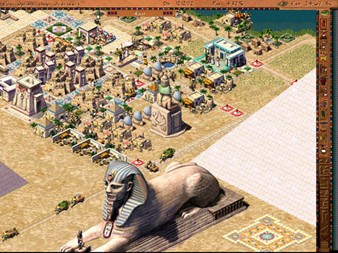
Construction of an Egyptian city according to Pharaoh (Screenshot by the author)
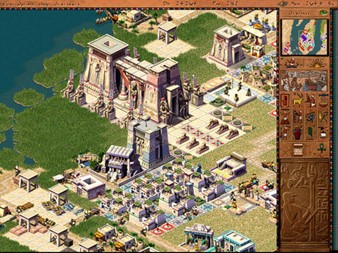
Detail of the construction of the great temple of the city (Screenshot by the author)
Egyptomania narratives or motifs
The game is explicitly set in ancient Egypt, so the player can familiarise themselves with the history and culture of the pharaohs. The game develops from the Predynastic Period to the beginning of the New Kingdom and the player is expected not only to build particular cities, but also construct important monuments, such as the pyramids (including Step Pyramid at Saqqara, Bent and Red Pyramids at Dahshur or the Giza Pyramids), the Great Sphinx at Giza, 5th dynasty sun temples, or Early Dynastic mastabas. The player can also get some knowledge of Egyptian religion, as building temples and taking care of the gods is an important part of the game. The game is also provided with explanatory notes, which make it possible for the player, to get more information on various aspects of Egyptian civilisation, thus joining entertainment with education.
Author: Filip Taterka
Other information
Taterka, F. (2016), Egyptianizing Motifs in the Products of Popular Culture Addressed to Younger Recipients, in K. Dominas, E. Wesołowska, and B. Trocha (eds), Antiquity in Popular Literature and Culture, Newcastle upon Tyne, p. 212.
Open access
Tags
Write a Comment
Tem de iniciar a sessão para publicar um comentário.