
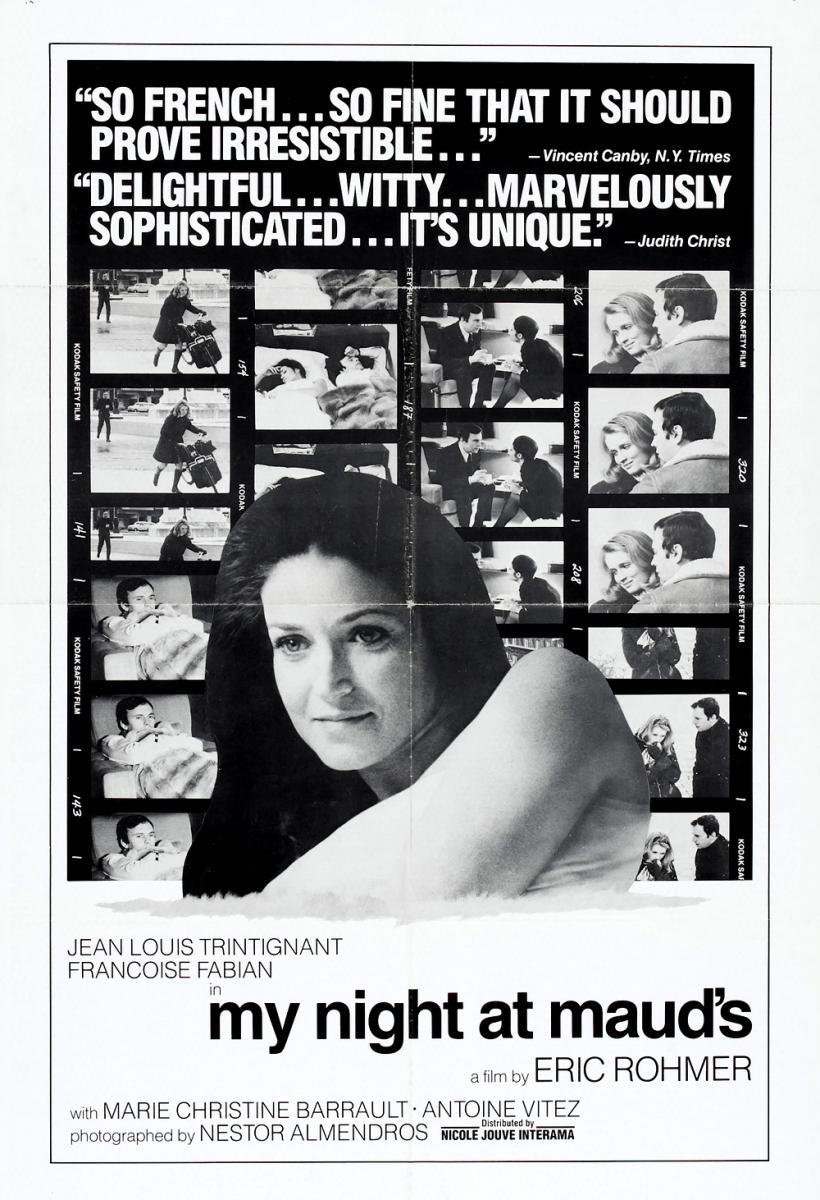
Ma nuit chez Maud
Year:
1969
Running time:
105 mn
Nationality:
France
Language:
French
Genre:
Romantic Drama, Nouvelle vague (New Wave), Cult movie
Director:
Eric Rohmer
Producer:
Les Films du Losange
Screenwriter/s:
Eric Rohmer
Cast:
Jean-Louis Trintignant, Françoise Fabian, Marie-Christine Barrault, Antoine Vitez, Leonid Kogan, and others
Other websites:


Trailer:

Summary of the film
3rd entry in the series "Six Moral Tales" by Eric Rohmer. The narrator (Jean-Louis), a devout Catholic, moves to a provincial town and vows to marry Francoise, a pretty blond he notices at mass. Vidal, an old school friend, invites him to visit the recently divorced Maud, and the narrator ends up staying the night, having philosophical discussions in her bedroom. Next morning the narrator engineers a meeting with Francoise. (Filmaffinity)
Egyptomania narratives or motifs
It may be surprising that the masters of the French Nouvelle Vague devoted some of their film to questions of ancient Egypt. "My Night with Maud" devotes only three words to this question and, therefore, its significance within the film is minor. The question is a brief allusion within a larger conversation. At the beginning of the conversation at Maud’s house, Jean-Louis and Vidal discuss issues such as marriage, the couple, women, religion, love relationships, etc. In the thread of this conversation, they talk about the "nose of Cleopatra" in the work of the French philosopher Blaise Pascal, who was born and lived in Clermont Ferrand, the city where Rohmer’s film takes place. This idea, set out by Pascal in his 1670 work Pensées, raises the question of the changes that could have occurred if the nose of the Ptolemaic queen had not been elongated, as it is often thought to have been due to certain representations of Cleopatra on coins and other media. Pascal states that in that case she might not have been able to seduce men as powerful as Julius Caesar. Pascal argues the insignificant change, while having sensitive but limited repercussions at the level of seduction and love, could have changed the whole face of the earth..
This is a brief allusion in the conversation about love, its transcendence in people’s lives, and how the world works.
This is a brief allusion in the conversation about love, its transcendence in people’s lives, and how the world works.
Author: Abraham I. Fernández Pichel
Tags
Write a Comment
Tem de iniciar a sessão para publicar um comentário.