
Lot No. 249
Year:
2023
Running time:
30 mn
Nationality:
UK
Language:
English
Genre:
Horror, TV Film, Half-length Film
Director:
Mark Gatiss
Producer:
Adorable Media
Screenwriter/s:
Mark Gatiss
Cast:
Kit Harington, Freddie Fox, John Heffernan, Andrew Horton, James Swanton, and others
Other websites:


Trailer:

Summary of the film
A group of Oxford students, one of whom undertakes research into the secrets of Ancient Egypt and becomes the talk of the college. Can these experiments breathe life to the horrifying bag of bones that is the Lot. No 249? (FIlmaffinity)
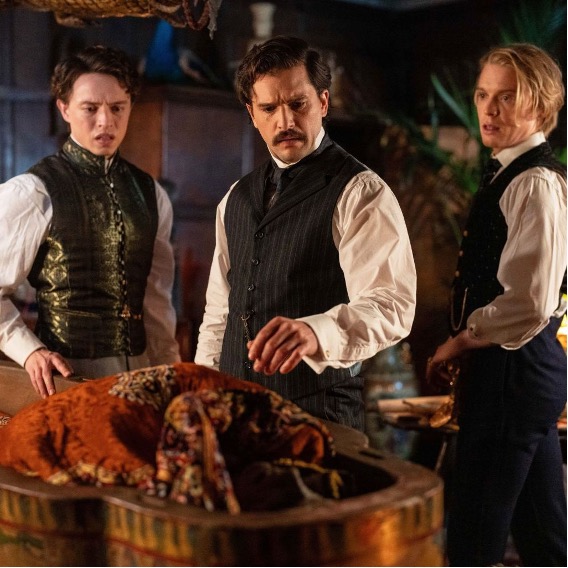
Bellingham, Smith and Lee stand in front of an ancient Egyptian sarcophagus, with the mummy concealed (Screenshot by author)

The figure of the mummy stands behind Bellingham (Sceenshot by author)

The Mummy’s costume (Screenshot by author)
Egyptomania narratives or motifs
Based on the short story by Arthur Conan Doyle Lot No. 249 tells the tale of an Egyptology student who purchases Egyptian antiquities and human remains for his own collection and nefarious, occultist reasons. Within this ‘collection’ is a Mummy. Referred to only as ‘Lot No. 249’ throughout the story and TV adaptation, the mummy has no name and it is unclear where he came from or who he was in life.
The mummy (Lot No. 249) is presented as a threatening presence, operating in the shadows and attacking victims. Unlike other depictions of the mummy as a slow, zombie-esque character, Conan-Doyle’s mummy moves with speed.
The mummy is shown only a few times throughout the TV show, with a huge effort put into the makeup of heavy bandaging and mummified skin. Additionally, dust was added to the costume and set to give the appearance that the mummy was indeed, ancient.
Bellingham, through engaging in occultist practice, controlled the physical form of the mummy, bending him to his will to murder his rivals.
The hero of the story, Smith, embodies the Victorian masculine ideals of academia and sportsmanship, and works to uncover the mystery of the attacks on campus, suspecting Bellingham as the culprit. As the story develops, it becomes clear to him that Bellingham has re-animated the mummy. He threatens Bellingham, who destroys the mummy via cremation. Bellingham then disappears to Sudan.
Conan Doyle’s short story features themes of madness, suspense, the supernatural and terror. Originally published in Harper’s Magazine (1892), at a time of renewed interest in Egypt, set against the aftermath of the Napoleonic invasion of Egypt in 1798. This wave of ‘Egyptomania’ was a result of colonialist pursuits and the story also appears to critique the Victorian interest in collecting ancient Egyptian mummified remains. However, it should be noted that Conan-Doyle was a supporter of Imperialism and during his lifetime made unfavourable comments about Egyptians. Ultimately, the story still serves as a cautionary tale against collecting mummified remains: Bellingham does so and meets a terrible fate because of it. The show furthers the conversation surrounding colonialism and features a romantically-charged exchange between Smith and Bellingham, in which Bellingham states that ‘Just the sort of chap to keep the flags of empire flying. I can just see you putting down a native uprising in the Sudan or some such?’ The conversation continues to discuss themes of colonial travel and explores the idea of mastery:
Bellingham: ‘Yes I have indeed have some success out East with my researches…and the people.’
Smith: ‘I am told you are able to Master them as those of the manor born’
With only a short amount of time on screen, it was inevitable that the story would stray somewhat from the original text. Romantic relationships between the men are alluded to in the TV show, and in addition, a depiction of Conan-Doyle himself makes an appearance. Most notably, the ending differs significantly, in which we see another mummified hand reach down to take a ring in a nod to the story "The Ring of Thoth". This also implies that Bellingham has continued his nefarious behaviour.
The mummy (Lot No. 249) is presented as a threatening presence, operating in the shadows and attacking victims. Unlike other depictions of the mummy as a slow, zombie-esque character, Conan-Doyle’s mummy moves with speed.
The mummy is shown only a few times throughout the TV show, with a huge effort put into the makeup of heavy bandaging and mummified skin. Additionally, dust was added to the costume and set to give the appearance that the mummy was indeed, ancient.
Bellingham, through engaging in occultist practice, controlled the physical form of the mummy, bending him to his will to murder his rivals.
The hero of the story, Smith, embodies the Victorian masculine ideals of academia and sportsmanship, and works to uncover the mystery of the attacks on campus, suspecting Bellingham as the culprit. As the story develops, it becomes clear to him that Bellingham has re-animated the mummy. He threatens Bellingham, who destroys the mummy via cremation. Bellingham then disappears to Sudan.
Conan Doyle’s short story features themes of madness, suspense, the supernatural and terror. Originally published in Harper’s Magazine (1892), at a time of renewed interest in Egypt, set against the aftermath of the Napoleonic invasion of Egypt in 1798. This wave of ‘Egyptomania’ was a result of colonialist pursuits and the story also appears to critique the Victorian interest in collecting ancient Egyptian mummified remains. However, it should be noted that Conan-Doyle was a supporter of Imperialism and during his lifetime made unfavourable comments about Egyptians. Ultimately, the story still serves as a cautionary tale against collecting mummified remains: Bellingham does so and meets a terrible fate because of it. The show furthers the conversation surrounding colonialism and features a romantically-charged exchange between Smith and Bellingham, in which Bellingham states that ‘Just the sort of chap to keep the flags of empire flying. I can just see you putting down a native uprising in the Sudan or some such?’ The conversation continues to discuss themes of colonial travel and explores the idea of mastery:
Bellingham: ‘Yes I have indeed have some success out East with my researches…and the people.’
Smith: ‘I am told you are able to Master them as those of the manor born’
With only a short amount of time on screen, it was inevitable that the story would stray somewhat from the original text. Romantic relationships between the men are alluded to in the TV show, and in addition, a depiction of Conan-Doyle himself makes an appearance. Most notably, the ending differs significantly, in which we see another mummified hand reach down to take a ring in a nod to the story "The Ring of Thoth". This also implies that Bellingham has continued his nefarious behaviour.
Author: Michelle Keeley-Adamson
Tags
Write a Comment
Tem de iniciar a sessão para publicar um comentário.