

La corte de faraón
Year:
1985
Running time:
96 mn
Nationality:
Spain
Language:
Spanish
Genre:
Musical, Comedy
Director:
José Luis García Sánchez
Producer:
Lince Films, RTVE
Screenwriter/s:
José Luis García Sánchez, Rafael Azcona
Cast:
Ana Belén, Fernando Fernán Gómez, Antonio Banderas, Josema Yuste, Agustín González, Quique Camoiras, Mary Carmen Ramírez, Juan Diego, Guilhermo Montesinos, Millán Salcedo, Antonio Gamero
Other websites:


Trailer:

Summary of the film
At the end of the 1940s, an unusual event occurred: an amateur company dared to premiere a play without the corresponding permits and censorship visas. It was the musical The Pharaoh's Court, banned for its political, erotic and religious daring. During a long night in a police station, the commissioner investigates the reasons that could have led this group to undertake such a crazy enterprise. During the interrogations, the incidents of the play are described, and the actors perform the musical numbers. (Filmaffinity)
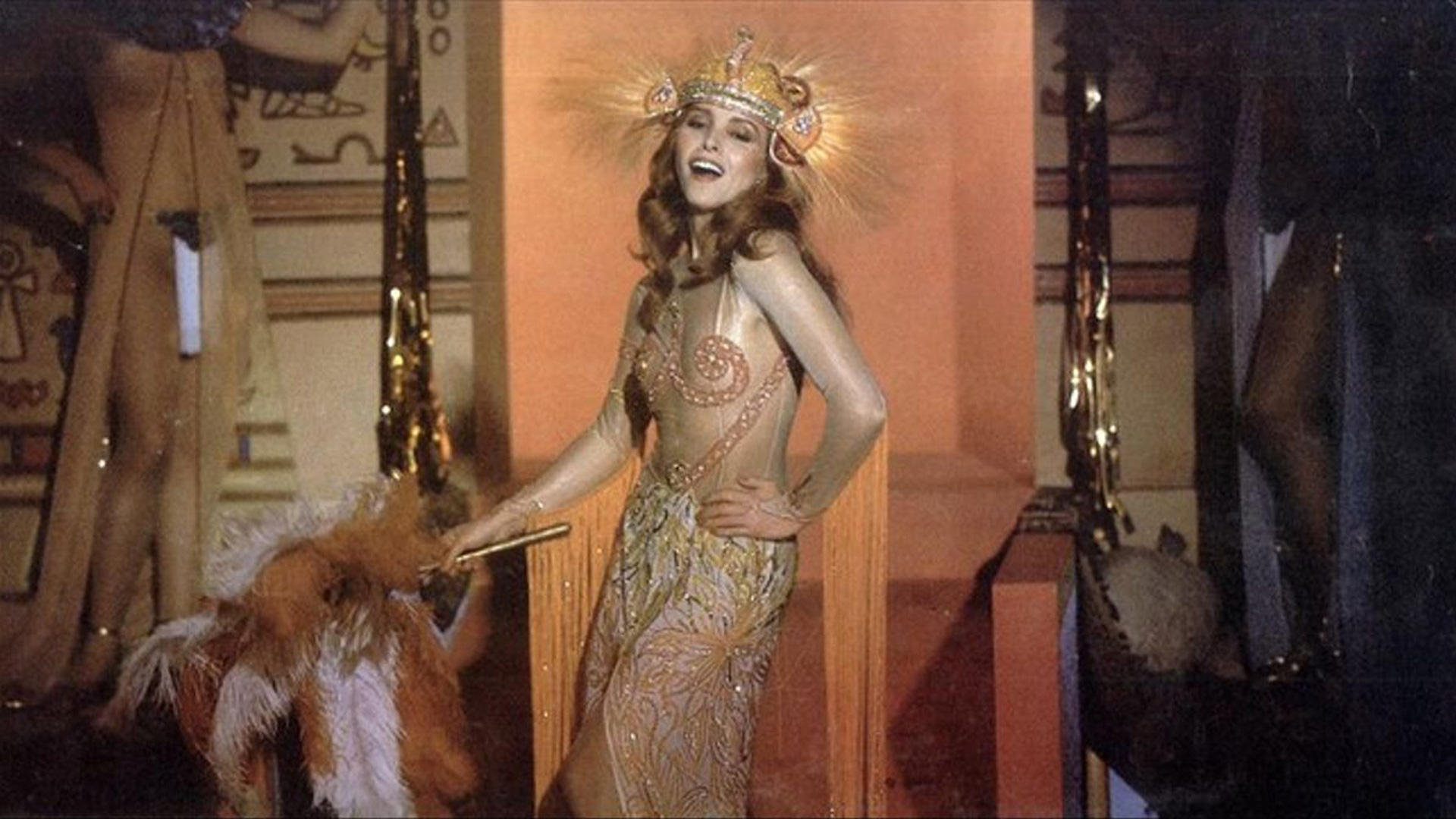
Singer and actress Ana Belén performs a musical number on an Egyptianised stage (Screenshot by the author)
Egyptomania narratives or motifs
Inspired by the eponymous classic zarzuela (a sort of Spanish operetta), Rafael Azcona and Jose Luis García Sánchez’s script for La corte de Faraón draws upon the play-within-the play convention to build a spoof working at different levels. The original “biblical operetta” from 1910 (written by Guillermo Perrín and Miguel de Palacios, with musical composition by Vicent Lleó) belonged to a set of theatrical pieces produced in Spain around the early 20th century as parodic offshoots of Giuseppe Verdi’s Aida (the paradigmatic example of the operas set in ancient Egypt). The plot of La corte de Faraón revolves around the misfortunes of “Chaste Joseph” (the Hebrew figure, son of Jacob, from The Book of Genesis) during his years as a captive in Egypt. Instead of relying on the usual narrative tropes of epic and morality tales, the zarzuela, as well as its cinematic derivative, presents a subversive, sexual farce around the biblical story of Joseph at the Pharaoh’s court in Memphis. García Sánchez and Azcona’s transcoding of the operetta participates of the same exotic stereotypes informing Perrín and Palacio’s libretto, in which ancient Egypt is staged, in decor and costume, following orientalist clichés. But, as it was the case with the musical play, the movie uses this burlesque, fantasy setting as a backdrop for a criticism on political conservatism and Catholic morals. In this, La corte de Faraón (the film) aligns itself with a noticeable trend of Spanish cinema of the Transition and early democratic years (from the mid-1970s to the mid-1980s, approximately); a trend that demanded a critical-historical reassessment of Francisco Franco’s fascist dictatorship in Spain.
Author: Samuel Fernández-Pichel
Other information
Sevilla Cueva, C. 2003. Vicent Lleó’s Operetta: La Corte de Faraón, in S. McDonald and M. Rice, Consuming Ancient Egypt: 63-75. London: University College London.
Not available
Tags
Write a Comment
Tem de iniciar a sessão para publicar um comentário.