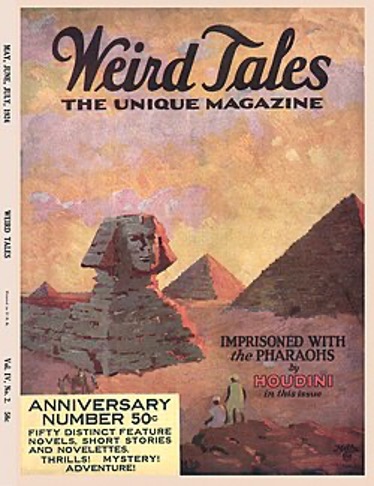
Imprisoned with the Pharaohs
Year:
1924
Author:
H. P. Lovecraft (ghost-writing for Harry Houdini)
Contry:
USA
Language:
English
Publisher:
Weird Tales
Genre:
Horror, Weird Fiction
Other websites:

Summary
Lovecraft’s story, Imprisoned with the Pharaohs (also later published as Under the Pyramids), was the product of a ghost-writing job offer to him on behalf the famed escapologist Harry Houdini. It features Houdini making a journey through Egypt as a stop-off on his way to Australia. Upon arrival at Cairo, via Port Said, Houdini acquires the services of a local guide, Abdul Reis el Drogman. They begin exploring the later monuments and sites of history such as the Citadel of Salah-ad-Din. After moving on to the ancient sites, including the Pyramids of Giza and the Great Sphinx, Abdul Reis and Houdini explore Cairo by night. Abdul Reis ostensibly becomes engaged in a dispute with one Ali Ziz, and after Houdini’s intervention, they agree to a fist-fight atop the pyramids. This turns out to be ruse concocted by the two aggressors, and Houdini is subsequently bound, blindfolded and gagged. Being lowered down into a hole in the ground, he is forced to put his escapologist training to work, freeing himself, before looking for a way back to the surface. In this subterranean chamber, Houdini confronts a procession of beings drawn from Egyptian mythology (as well as Khepren (also known as Khafre, but now also shown to be Houdini’s guide, Abdul Reis) and Nitocris). This procession is in the process of making offerings to a Sphinx-like beast with five-heads, possibly related to Lovecraft’s fictional deity Nyarlathotep. Houdini ultimately escapes, interpreting the whole episode (rather unconvincingly to both himself and the reader) as a dream.
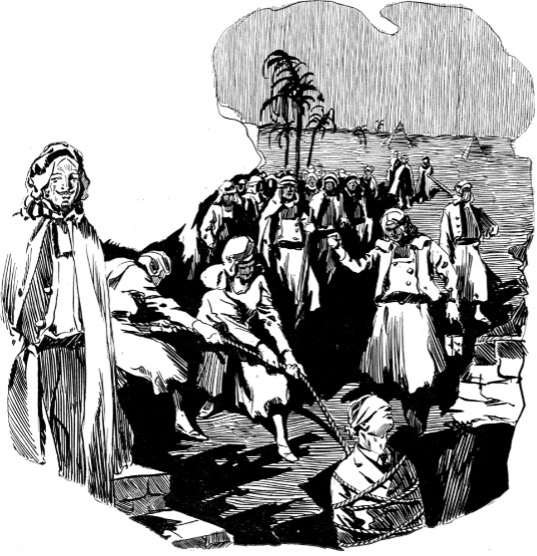
Illustration for the story from Weird Tales, May, June and July 1924. [Image from Wikimedia Commons, Public Domain]. Though uncredited, this illustration is likely by William F. Heitman; he illustrated other pieces in this issue (and prior issues) of Weird Tales, and it is stylistically very similar.
Egyptomania narratives or motifs
This story constitutes Lovecraft’s most in-depth focus on Egypt among his works. As with all of Lovecraft’s work, it shows a meticulous level of research. In a letter to Frank Belknap Long, he noted that he was:
Similarly, he certainly made use of the Metropolitan’s exhibition on the Tomb of Perneb (mentioned by name in the story), and its associated guide-book, which he retained in his private library.
This adherence, as far as possible, to factual context is also found in Lovecraft’s conceptions of ancient Egypt. Though he didn’t literally think that his inventions existed, he went to great efforts to give them a back-story which fit the established facts (or at least doesn’t explicitly contradict them). For instance, he used the historical re-carving of the Great Sphinx as a device to produce horror, foreshadowing the appearance of the creature at the end of the story: "There are unpleasant tales of the Sphinx before Khephren – but whatever its elder features were, the monarch replaced them with his own that men might look at the colossus without fear."
Then, when Houdini is dreaming (if he is indeed dreaming) in the tunnels beneath the Giza plateau, he also reflects on a question he idly asked himself earlier in the story: "That question, so innocent and whimsical then, assumed in my dream a meaning of frenetic and hysterical madness … what huge and loathsome abnormality was the Sphinx originally carven to represent?"
Again, after introducing the idea of ‘composite mummies’ (part animal, part human, to represent the theriomorphic gods of the Egyptian pantheon), Lovecraft makes sure to give a reason why they would be unknown today:
This characterisation of the whispers of the Arabs being ‘very wild’ signifies a specific attitude towards a certain period of Egypt within the story. Contemporary Egypt in the story fits a broadly Orientalist conception; a fall from a glorious past to a place where colonisers congregate among the locals. On the Bedouins at the pyramids, the narrator labels them ‘offensive’ and defying ‘every rule of taste.’ Lovecraft’s xenophobia is well-documented, and may well play into this conception.
However, some of Lovecraft’s influences point towards a broadly Orientalist conception of Egypt in other (sometimes surprising ways). While, as noted, he disparaged modern Egyptian (especially Bedouins), he shows a more nuanced approach to Cairo of the period between the contemporary and the ancient. This is undoubtedly due to his adoration of the Arabian Nights: "The next day, however, precipitated us delightfully into the heart of the Arabian Nights atmosphere; and in the winding ways and exotic skyline of Cairo, the Bagdad of Harun-al-Rashid seemed to live again."
He first read these stories at five, and became obsessed with it. He even adopted an Arabic-inspired pseudonym, Abdul Alhazred (which later became the author of the fictional Necronomicon in Lovecraft’s work). His descriptions of Cairo within the story read like something straight from the Arabian Nights. For example:
The attitude towards ancient Egypt is one that had been (and continues to be) influential in weird fiction. On one hand, a place of scientific and spiritual advancement (e.g. Edgar Allan Poe’s Some Words with a Mummy), on the other it was represented as a place of moral degradation, unwholesome longevity and with an unhealthy obsession with death (e.g. Algernon Blackwood’s A Descent Into Egypt). This conception is consistent with that of ancient Egypt in Imprisoned with the Pharaohs. For instance,
[…] at work familiarising myself with the geographical details of the Cairo-Gizeh locality where the alleged adventure is set – especially with the singular subterranean place betwixt the Sphinx and the second pyramid known as “Campbell’s Tomb”.
Similarly, he certainly made use of the Metropolitan’s exhibition on the Tomb of Perneb (mentioned by name in the story), and its associated guide-book, which he retained in his private library.
This adherence, as far as possible, to factual context is also found in Lovecraft’s conceptions of ancient Egypt. Though he didn’t literally think that his inventions existed, he went to great efforts to give them a back-story which fit the established facts (or at least doesn’t explicitly contradict them). For instance, he used the historical re-carving of the Great Sphinx as a device to produce horror, foreshadowing the appearance of the creature at the end of the story: "There are unpleasant tales of the Sphinx before Khephren – but whatever its elder features were, the monarch replaced them with his own that men might look at the colossus without fear."
Then, when Houdini is dreaming (if he is indeed dreaming) in the tunnels beneath the Giza plateau, he also reflects on a question he idly asked himself earlier in the story: "That question, so innocent and whimsical then, assumed in my dream a meaning of frenetic and hysterical madness … what huge and loathsome abnormality was the Sphinx originally carven to represent?"
Again, after introducing the idea of ‘composite mummies’ (part animal, part human, to represent the theriomorphic gods of the Egyptian pantheon), Lovecraft makes sure to give a reason why they would be unknown today:
What happened to those composite mummies is not told of – at least publicly – and it is certain that no Egyptologist ever found one. The whispers of Arabs are very wild, and cannot be relied upon. They even hint that old Khephren – he of the Sphinx, the Second Pyramid and the yawning gateway temple – lives far underground wedded to the ghoul-queen Nitocris and ruling over the mummies that are neither of man nor of beast.
This characterisation of the whispers of the Arabs being ‘very wild’ signifies a specific attitude towards a certain period of Egypt within the story. Contemporary Egypt in the story fits a broadly Orientalist conception; a fall from a glorious past to a place where colonisers congregate among the locals. On the Bedouins at the pyramids, the narrator labels them ‘offensive’ and defying ‘every rule of taste.’ Lovecraft’s xenophobia is well-documented, and may well play into this conception.
However, some of Lovecraft’s influences point towards a broadly Orientalist conception of Egypt in other (sometimes surprising ways). While, as noted, he disparaged modern Egyptian (especially Bedouins), he shows a more nuanced approach to Cairo of the period between the contemporary and the ancient. This is undoubtedly due to his adoration of the Arabian Nights: "The next day, however, precipitated us delightfully into the heart of the Arabian Nights atmosphere; and in the winding ways and exotic skyline of Cairo, the Bagdad of Harun-al-Rashid seemed to live again."
He first read these stories at five, and became obsessed with it. He even adopted an Arabic-inspired pseudonym, Abdul Alhazred (which later became the author of the fictional Necronomicon in Lovecraft’s work). His descriptions of Cairo within the story read like something straight from the Arabian Nights. For example:
The roofed, quieter bazaars were hardly less alluring. Spice, perfume, incense beads, rugs, silks, and brass – old Mahmoud Suleiman squats cross-legged amidst his gummy bottles while chattering youths pulverize mustard in the hollowed-out capital of an ancient classic column – a Roman Corinthian, perhaps from neighbouring Heliopolis, where Augustus stationed one of his three Egyptian legions. Antiquity begins to mingle with exoticism. And then the mosques and the museum – we saw them all, and tried not to let our Arabian revel succumb to the darker charm of Pharaonic Egypt which the museum’s priceless treasures offered.
The attitude towards ancient Egypt is one that had been (and continues to be) influential in weird fiction. On one hand, a place of scientific and spiritual advancement (e.g. Edgar Allan Poe’s Some Words with a Mummy), on the other it was represented as a place of moral degradation, unwholesome longevity and with an unhealthy obsession with death (e.g. Algernon Blackwood’s A Descent Into Egypt). This conception is consistent with that of ancient Egypt in Imprisoned with the Pharaohs. For instance,
I saw the horror and unwholesome antiquity of Egypt, and the grisly alliance it has always had with the tombs and temples of the dead. I saw phantom processions of priests with the heads of bulls, falcons, cats, and ibises; phantom processions marching interminably through subterraneous labyrinths and avenues of titanic propylaea beside which a man is as a fly, and offering unnameable sacrifice to indescribable gods. Stone colossi marched in endless night and drove herds of grinning androsphinxes down to the shores of illimitable stagnant rivers of pitch. And behind it all I saw the ineffable malignity of primordial necromancy, black and amorphous, and fumbling greedily after me in the darkness to choke out the spirit that had dared to mock it by emulation.
Author: Lawrence Webb
Other information
Bicker, R. 2023. "Gefangen bei den Pharaonen: H.P. Lovecraft und das alte Ägypten". MAAT: Nachrichten aus dem Staatlichen Museum Ägyptischer Kunst München 28: 70.
Open access
Card, J. J. 2019. "‘Older than brooding Egypt or the contemplative Sphinx’: Egypt and the Mythic Past in Alternative Egyptology and the Fiction of H.P. Lovecraft". Journal of History and Cultures 10: 27-28.
Open access
Dobson, E. 2020. Writing the Sphinx: Literature, Culture and Egyptology:133-134. Edinburgh: Edinburgh University Press.
Not available
Kolosova, H. 2017. "Theonyms in the Horror Story of Howard Phillips Lovecraft “Imprisoned with the Pharaohs”". Advanced Education. Issue 8: 92-98.
Open access
McGeough, K.M. 2015. The Ancient Near East in the Nineteenth Century: Appreciations and Appropriations (Volume 3; Fantasy and Alternative Histories): 377-378. Sheffield: Sheffield Phoenix Press.
Not available
Webb, L. 2025. The Call of Nighted Khem: Tracing Ancient Egypt through Weird Fiction, in John Rogers, Catherine Bishop-Allen, Henry Bohun, Reuben G. Hutchinson-Wong and Marina Sartori (eds) Current Research in Egyptology 2024: 364, 369-370, 373. Oxford: Archaeopress.
Open access
Tags
Write a Comment
Tem de iniciar a sessão para publicar um comentário.