
Forewarned
Game Family:
Year:
2021
Nationality:
USA
Authors:
Dreambyte Games
Designer:
Artists:
Publisher:
Dreambyte Games
Number of Players:
1-4
Genre:
Survival horror, Historical, Fantasy
Other websites:

Videos by players:

Summary of the game
Forewarned is a 1-4 player co-op survival horror. Delve deep into ancient Egyptian ruins with your team of fellow archaeologists. Investigate phenomena, collect treasure, discover lore, survive danger, and banish the evil that lurks within. (Steam)
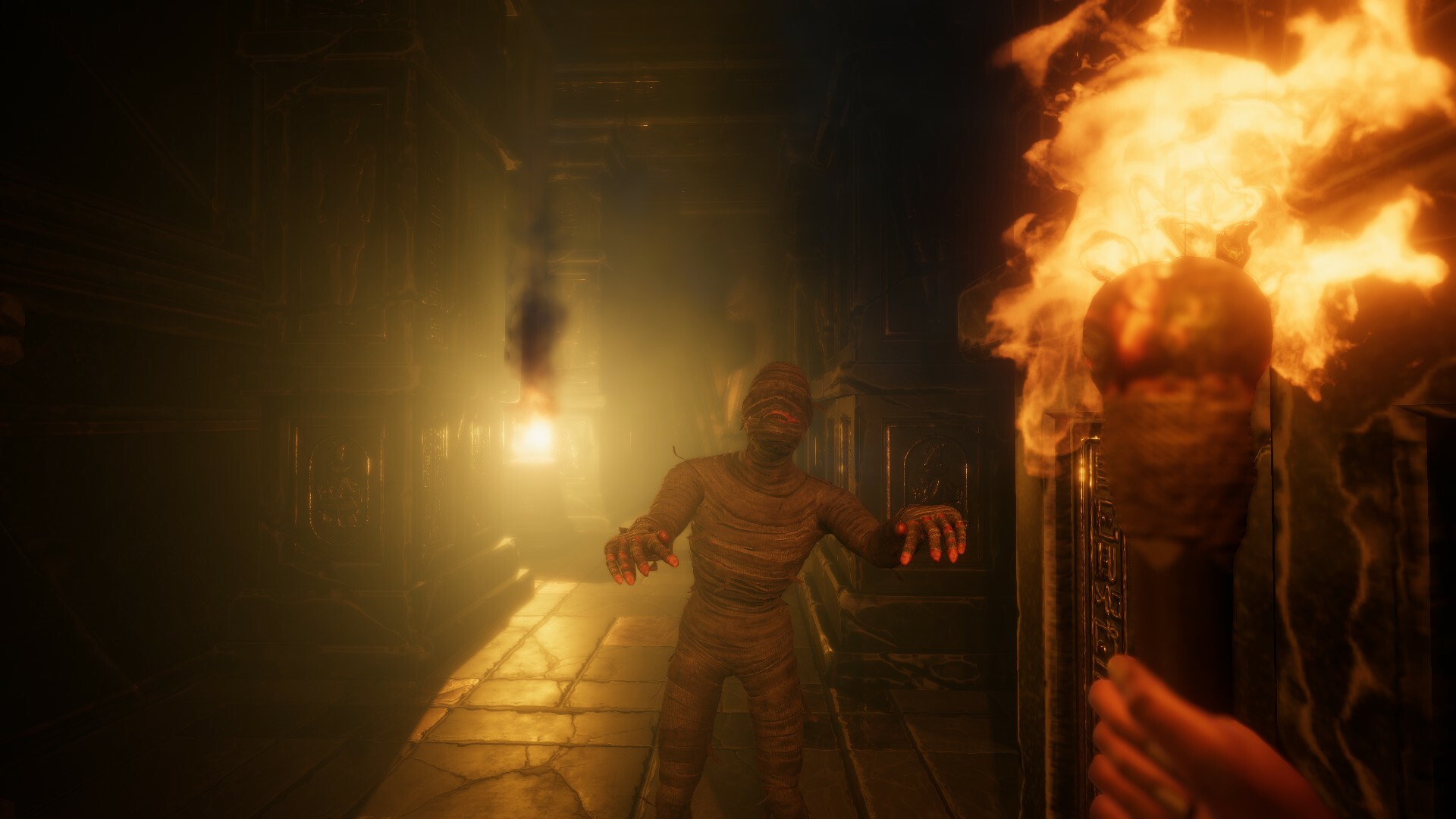
A mummy attacking a player holding a torch (Source: https://dreambytegames.com/)
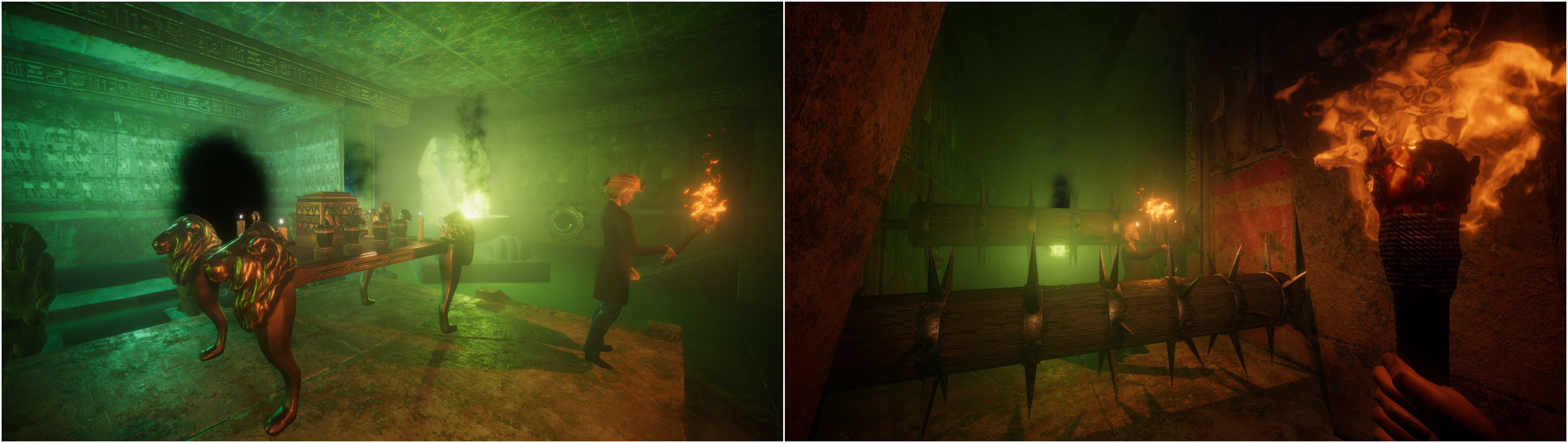
On the left, a room containing a statue of a pharaoh holding globular vases, a golden bed with 19th century lion heads and paws onto which is a set of canopic jars with their box, and a sphinx statue. On the right, classic spiked poles working as traps inside the tomb (Source: https://dreambytegames.com/)
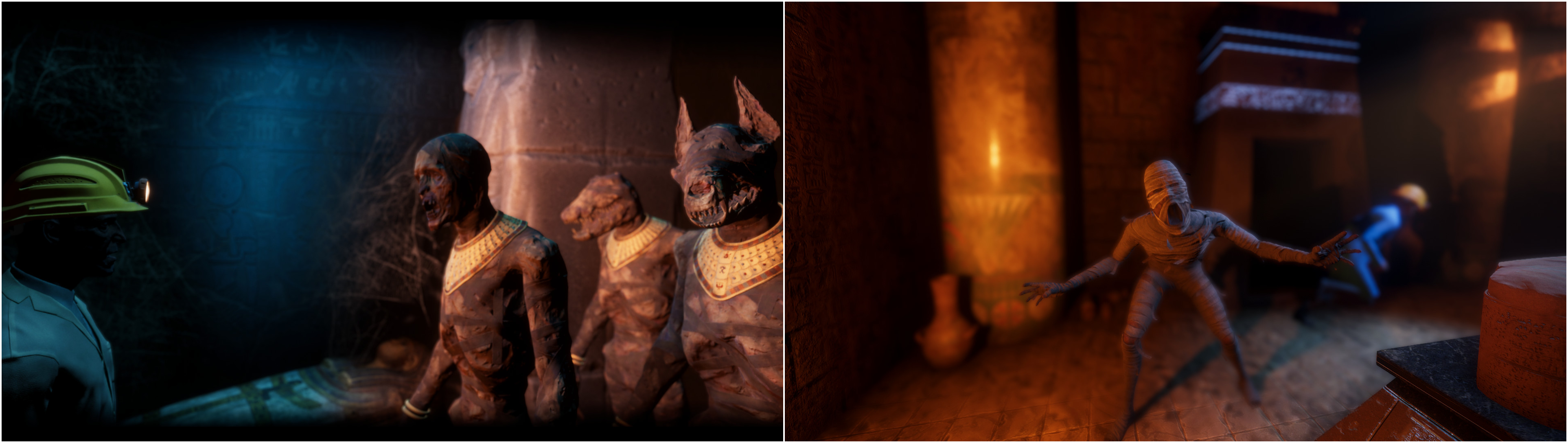
Left: An archaeologist facing three standing mummified beings: a man, a crocodile-headed creature, and a dog-headed creature. Right: A mummy makes its terrifying presence known while an archaeologist runs away (Source: https://dreambytegames.com/)
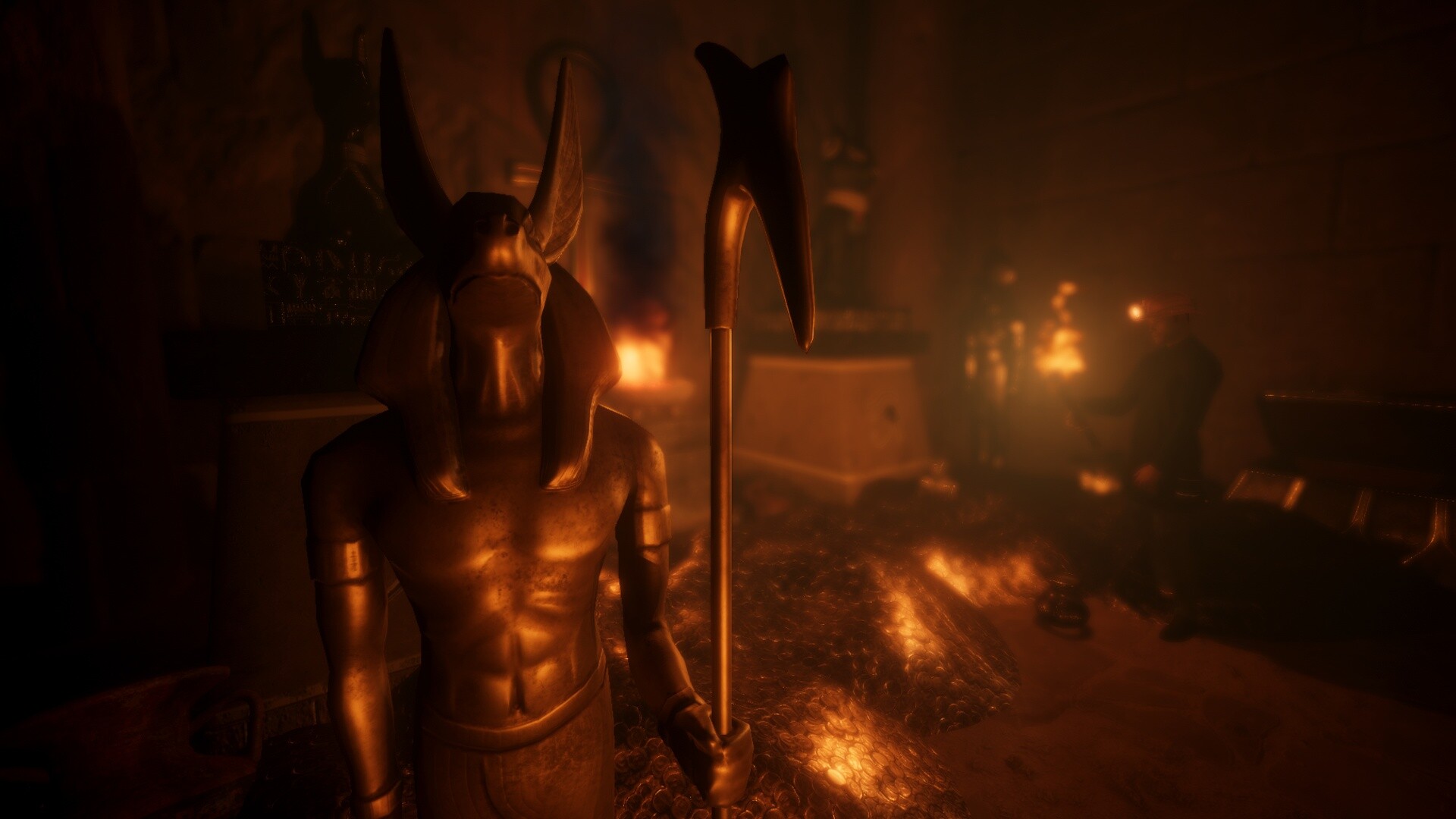
A treasure vault filled with gold coins and statues of various gods (Source: https://dreambytegames.com/)
Egyptomania narratives or motifs
This game has it all. The premise of newly-appeared ancient tombs filled with riches delivers an uncanny parade of tropes of the horror genre. Players have to deal with, in no particular order: rare artifacts and other objects that can be looted from said tomb without any archaeological documentation; traps; vindictive spirits (called ‘the Mejai’) haunting the archaeologists; statues of Anubis and other threatening-looking Egyptian gods; possessed crocodiles; laser beams; hieroglyphic texts to interpret; banishing rituals to be performed to lift the curse; and, of course, evil ambulatory mummies protecting the Relics and treasures stored in the tombs. On the latter topic, it is worth pointing out that only one of the six possible Mejai is a mummified man, albeit an extremely large one (the others are more ‘standard’ grotesque humanoid monsters with various elements of body horror). The trope of the ambulatory mummy has been present in popular culture since the 1820s, and it became intertwined with vengeance and curses (tied to specific objects or the defiling of tombs) a few decades later in literary works such as "The Mummy’s Soul" and "Lot Mo. 249". Mummy stories told tales of desecration and revenge, and in the 1930s these topics became incredibly popular in a new medium: movies. American and British films popularized horror as the dominant mummy genre, but added two elements to these stories: Western protagonists ultimately defeating Oriental magic, and mummies becoming fallible and visually associated with traits of decadence and body horror (as opposed to Western values of beauty, youth, and hygiene). Forewarned, like many previous games, fully embraces these literary and cinematic tropes, but adds an element of subversion in changing the fate of the defeated archaeologists, who instead of simply dying can come back as mummies themselves to finish the game. ‘Reborn’ players can choose to be either helpful or side with the Mejai and assist them in killing the other members of the archaeological team.
Some of the objects found in the tombs are copies of New Kingdom pieces, such as a kneeling statue of a pharaoh holding globular vases, sphinx statues, a monumental version of a statue of Ramesses III flanked by Horus and Set, and various sets of canopic jars. The tomb decorations are also copies of New Kingdom frescoes, such as the stars on the ceiling and an image of Ramesses I between Horus and Set. The Mejai relics are shaped after popular Egyptian objects such as ankh and Wedjat-Eye amulets, khopesh swords, and the statues of a cat and a jackal, but they are not copies of existing pieces. Others – ‘rare artifacts’, such as the bust of Nefertiti, the Rosetta Stone, a kneeling statue of Tuthmosis III, and the couple statue of officer Yuni and his wife Renenutet – are real-life objects. The rest of the assemblage is a pastiche of Greek vases (!) and jewels and vases whose design is inspired more by European Egyptomania pieces than Egyptian artifacts.
Some of the objects found in the tombs are copies of New Kingdom pieces, such as a kneeling statue of a pharaoh holding globular vases, sphinx statues, a monumental version of a statue of Ramesses III flanked by Horus and Set, and various sets of canopic jars. The tomb decorations are also copies of New Kingdom frescoes, such as the stars on the ceiling and an image of Ramesses I between Horus and Set. The Mejai relics are shaped after popular Egyptian objects such as ankh and Wedjat-Eye amulets, khopesh swords, and the statues of a cat and a jackal, but they are not copies of existing pieces. Others – ‘rare artifacts’, such as the bust of Nefertiti, the Rosetta Stone, a kneeling statue of Tuthmosis III, and the couple statue of officer Yuni and his wife Renenutet – are real-life objects. The rest of the assemblage is a pastiche of Greek vases (!) and jewels and vases whose design is inspired more by European Egyptomania pieces than Egyptian artifacts.
Author: Kate Minniti
Tags
Write a Comment
Tem de iniciar a sessão para publicar um comentário.