
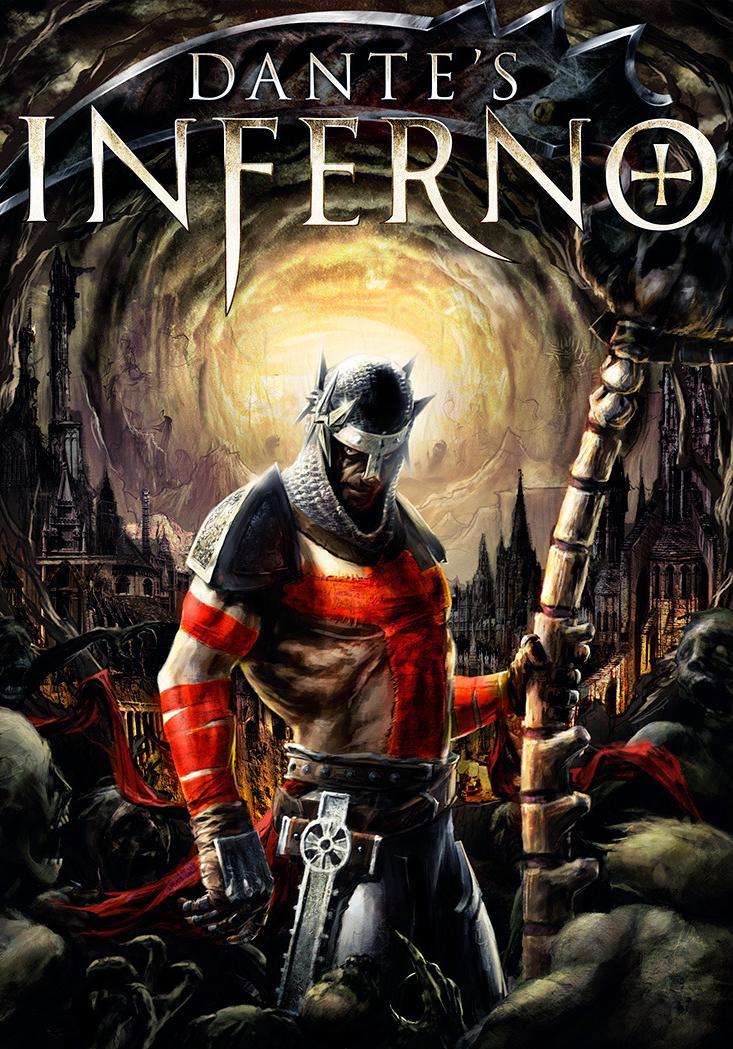
Dante’s Inferno
Game Family:
Year:
2010
Nationality:
USA
Authors:
Jonathan Knight, Stephen Barry
Designer:
Stephen Desilets, Michael Cheng, Vincent Napoli
Artists:
Ash Huang
Publisher:
EA and Visceral Games
Number of Players:
1
Genre:
Action-adventure, hack and slash
Other websites:

Videos by players:

Summary of the game
The game's story is loosely based on Inferno, the first canticle of Dante Alighieri's Divine Comedy. It follows Dante, imagined as a Templar knight from The Crusades, who, guided by the spirit of the poet Virgil, must fight through the nine Circles of Hell to rescue his wife Beatrice from the clutches of Lucifer himself. In the game, players control Dante from a third-person perspective. His primary weapon is a scythe that can be used in a series of combination attacks and finishing moves. (Wikipedia)
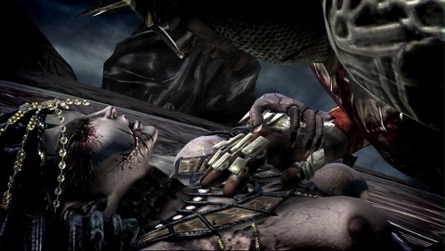
Screenshot of cutscene where Dante kills the Kleopatra boss in Dante’s Inferno (Screenshot from Infernopedia: https://static.wikia.nocookie.net/dantesinferno/images/a/a0/Cleopatra_and_Dante.jpg/revision/latest?cb=20111029033720)
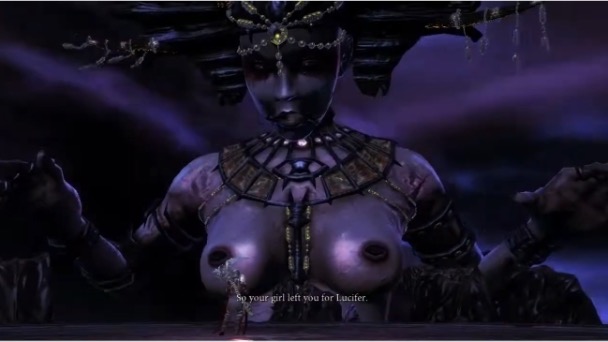
Screenshot of the Kleopatra boss during gameplay, showing her vaguely Egyptionizing clothing (Screenshot by author)
Egyptomania narratives or motifs
Kleopatra VII is the final boss of the second circle of Hell, Lust, and it is indicated that she and Mark Antony were placed there by Lucifer after their suicides. The player fights her as she summons a “lust storm” and tries to prevent Dante from ascending her “Carnal Tower.” After the player ascends the Carnal Tower, he fights Marc Antony, who a giant Kleopatra aids by smashing her hands on the platform on which the players are fighting. Once the player defeats Antony, Kleopatra attempts to seduce Dante as a last resort, but the player stabs and kills her (see first image).
As the Queen of Lust, Kleopatra is depicted as demonically enhanced, in vaguely Egyptian attire, with a linen skirt, belt, ornate headdress (somewhat reminiscent of a nemes), and jeweled collar and harness (see second image). She is topless and can spawn minions (demonic, unbaptized babies) from her breasts. She controls her minions in her circle of Hell via seduction; those she kisses are forced to follow her commands.
The queen depicted in this game is a caricature of Kleopatra, one based on the Augustan propaganda that was produced after her death and which solidified her reputation as a lustful, transgressive seductress. This representation of the queen also signifies a second trend, where the Augustan propaganda version of the queen was translated into the Medieval and Renaissance periods. The caricature of Kleopatra the seductress was modified to fit the tenets of courtly love common in these later periods, so her relationship with and love for Antony was celebrated, even while her position as a seductress and transgressive queen was maligned. We see this in the Kleopatra character in the game, as she seems genuinely distraught when Antony is killed by the player, but she still attempts to seduce the player anyway.
This game is one of the most popular console games to feature Kleopatra VII, prior to Assassin’s Creed Origins. It is estimated to have sold over 1 million copies world-wide. As a result, this popular culture image of Kleopatra reaches a much wider audience than historians can hope to connect with, meaning that most audiences are exposed only to the image of Kleopatra the seductress, rather than the more historically accurate version of the queen.
As the Queen of Lust, Kleopatra is depicted as demonically enhanced, in vaguely Egyptian attire, with a linen skirt, belt, ornate headdress (somewhat reminiscent of a nemes), and jeweled collar and harness (see second image). She is topless and can spawn minions (demonic, unbaptized babies) from her breasts. She controls her minions in her circle of Hell via seduction; those she kisses are forced to follow her commands.
The queen depicted in this game is a caricature of Kleopatra, one based on the Augustan propaganda that was produced after her death and which solidified her reputation as a lustful, transgressive seductress. This representation of the queen also signifies a second trend, where the Augustan propaganda version of the queen was translated into the Medieval and Renaissance periods. The caricature of Kleopatra the seductress was modified to fit the tenets of courtly love common in these later periods, so her relationship with and love for Antony was celebrated, even while her position as a seductress and transgressive queen was maligned. We see this in the Kleopatra character in the game, as she seems genuinely distraught when Antony is killed by the player, but she still attempts to seduce the player anyway.
This game is one of the most popular console games to feature Kleopatra VII, prior to Assassin’s Creed Origins. It is estimated to have sold over 1 million copies world-wide. As a result, this popular culture image of Kleopatra reaches a much wider audience than historians can hope to connect with, meaning that most audiences are exposed only to the image of Kleopatra the seductress, rather than the more historically accurate version of the queen.
Author: Tara Sewell-Lasater
Other information
Sewell-Lasater, T. 2023. Eternally Maligned as the Power-hungry Femme Fatale: Kleopatra VII in Assassin’s Creed Origins and Other Video Games, in A.I. Fernández Pichel (ed) How Pharaohs Became Media Stars: Ancient Egypt and Popular Culture: 198. Oxford: Archaeopress.
Open access
Tags
Write a Comment
Tem de iniciar a sessão para publicar um comentário.