
Conan – Stygia Serpent of the South
RPG Family or System:
Conan the Roleplaying Game
Year:
2006
Nationality:
USA
Authors:
Vincent N. Darlage
Art Director:
Publisher:
Mongoose Publisher
Genre:
Adventure, Fantasy
Other websites:

Videos by players :
Summary of the game
Stygia Serpent of the South is one of 38 modules published for the game Conan: The Roleplaying Game (Sturrock, Tucker, Barker, and Darlage, 2004). In the adventures that take place within this RPG, players play characters from the different races of Robert E. Howard's literary universe. These include the Cinmerian barbarians, the knights of Aquilonia, and the Stygian priests, among others. As is evident, the adventures in the game take place in the fictional world created by Howard in his novels. The different modules of the game extend that created universe by offering numerous descriptions of each of the regions. In this regard, we are particularly interested in Stygia. In addition to an ethnographic description of the region, this module contains a wealth of information on the game system (based on a d20 dice system), objects specific to the region, new social classes, and trades that can be played by the characters or by non-player characters created by the game directors. There are also summaries of the history and evolution of the region and the human groups that inhabit it.
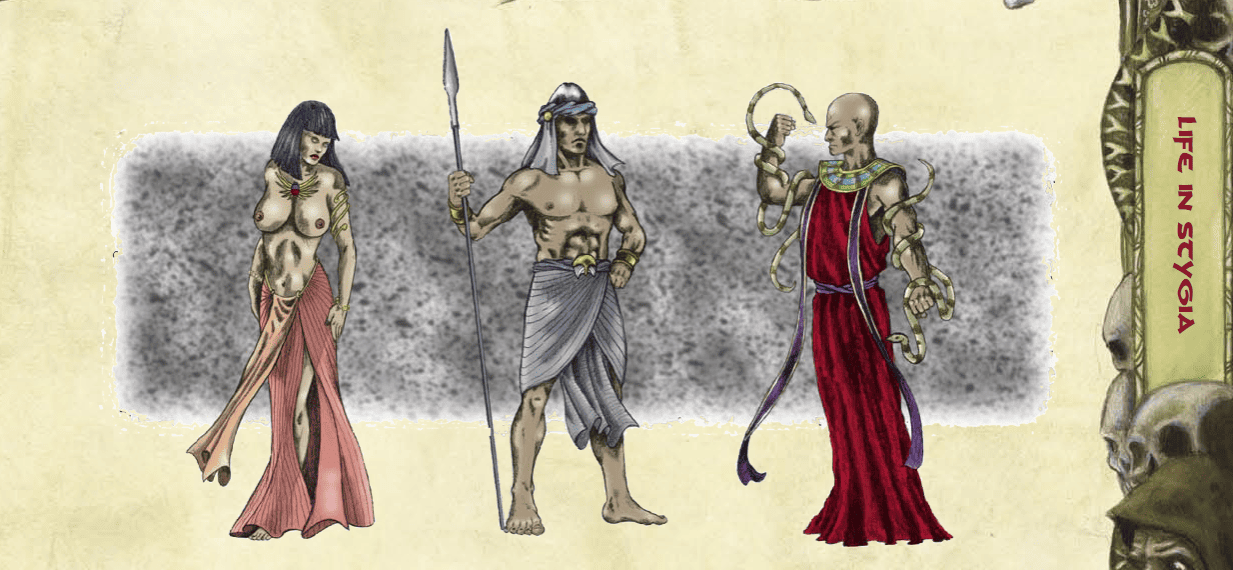
Inhabitants of Stygia and their typical costumes (Screenshot by author)
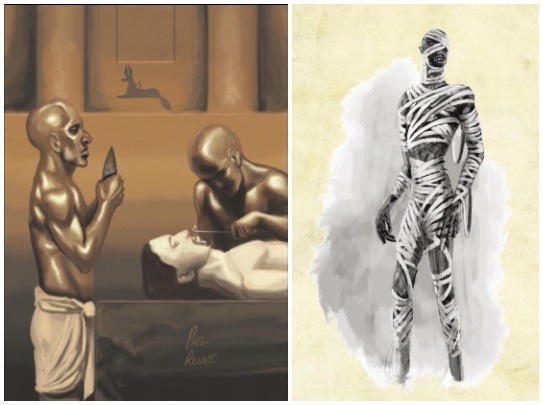
Scene of the technicians performing the mummification (left) and Stygian mummy (right) (Screenshots by author)
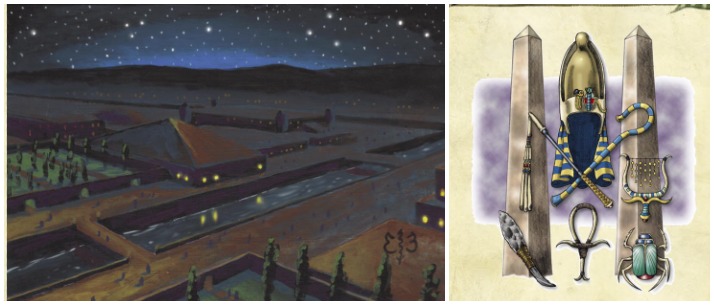
Representation of the city of Luxur (left) and Ornamenta of the Stygian monarchy (right) (Screenshots by author)
Egyptomania narratives or motifs
Stygia Serpent of the South is divided into 14 chapters, which cover all aspects of Stygian life and culture. This culture has many similarities with ancient Egypt: its system of theocratic monarchy, its geography (marked by a main river, the Stynx), and endless deserts, as well as the cult of death and many other aspects of Stygian religion. To this we must add abundant aesthetic elements, which show evident Egyptianising traits, such as the clothing and the type of ornaments worn by the inhabitants (Image 3).
The book also deals with aspects of religiosity, magic, and medicine in Stygia, referencing many topics usually associated with ancient Egypt in popular culture, such as the development of advanced medicine (within the confines of an ancient society), the practice of a cult of death and mummification (Image 2), and a religious system that affects almost every aspect of daily life. It is striking how Stygia has a religious system based primarily on the worship of Seth, a violent and evil serpent deity. To this is added a whole pantheon of divinities inspired by the Egyptian world, such as Bastet, the cat goddess, along with Bes, Khepri, and Hap-i, god of the source of the river Stynx. There is also mention of religious festivals with strong ancient Egyptian overtones, such as the Opet festival and the Heb-Sed, or the festival of the goddess Bastet of Stygia, which is centred on drunkenness and debauchery.
Other chapters of the book focus on content relating to the organisation of the Stygian state and the theocratic monarchy of Stygia. In these chapters we can again see the direct inspiration of Egyptian elements, both in the names of kings and cities (fig. 4) and some of the symbols of power of the monarchy (fig. 5).
In the last chapters of the book, the game's own aspects are detailed, such as character classes, the presentation of characters from the novels, the description of sects and cults, as well as a bestiary where, among a multitude of serpentiform and other monstrous creatures of the deserts, we find the mummies (image 6).
The book also deals with aspects of religiosity, magic, and medicine in Stygia, referencing many topics usually associated with ancient Egypt in popular culture, such as the development of advanced medicine (within the confines of an ancient society), the practice of a cult of death and mummification (Image 2), and a religious system that affects almost every aspect of daily life. It is striking how Stygia has a religious system based primarily on the worship of Seth, a violent and evil serpent deity. To this is added a whole pantheon of divinities inspired by the Egyptian world, such as Bastet, the cat goddess, along with Bes, Khepri, and Hap-i, god of the source of the river Stynx. There is also mention of religious festivals with strong ancient Egyptian overtones, such as the Opet festival and the Heb-Sed, or the festival of the goddess Bastet of Stygia, which is centred on drunkenness and debauchery.
Other chapters of the book focus on content relating to the organisation of the Stygian state and the theocratic monarchy of Stygia. In these chapters we can again see the direct inspiration of Egyptian elements, both in the names of kings and cities (fig. 4) and some of the symbols of power of the monarchy (fig. 5).
In the last chapters of the book, the game's own aspects are detailed, such as character classes, the presentation of characters from the novels, the description of sects and cults, as well as a bestiary where, among a multitude of serpentiform and other monstrous creatures of the deserts, we find the mummies (image 6).
Author: Víctor Sánchez Domínguez
Tags
Write a Comment
Tem de iniciar a sessão para publicar um comentário.