

Comic-ban Sekai no Denki: Cleopatra
Year:
2013
Nationality:
Japan
Language:
Japanese
Writer:
Nozomu Kawai
Artist:
Natsumi Mukai
Publisher:
POPLAR Publishing Co.
Genre:
Drama, Romance, Historical, Adventure Seinen
Other websites:
Summary
Comic-ban Sekai no Denki: Cleopatra (コミック版世界の伝記: クレオパトラ), also known as Les grands noms de l’Histoire en manga: Cléopâtre, is a single manga volume, consisting of 5 chapters, that belongs to the "Comic-ban Sekai no Denki" series on the biographies of historical characters depicted in manga. This volume recounts the life of Cleopatra, from her birth until her death, and highlights her relationship with her kingdom, her family, and Rome. Under the supervision of Japanese Egyptologist Nozomu Kawai, the manga closely follows the primary sources from Graeco-Roman authors, such as Plutarch or Cassius Dio, as well as the Egyptian sources.
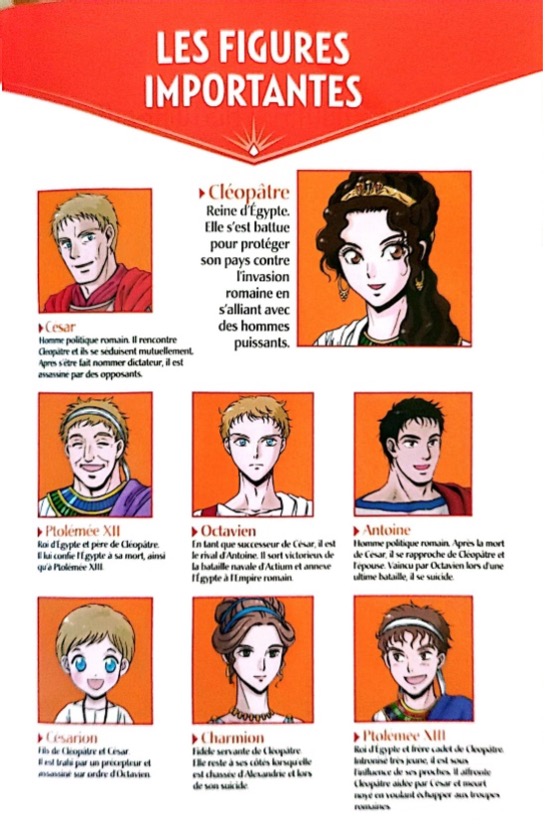
Main cast in the French version of the manga (Photo taken by the author)
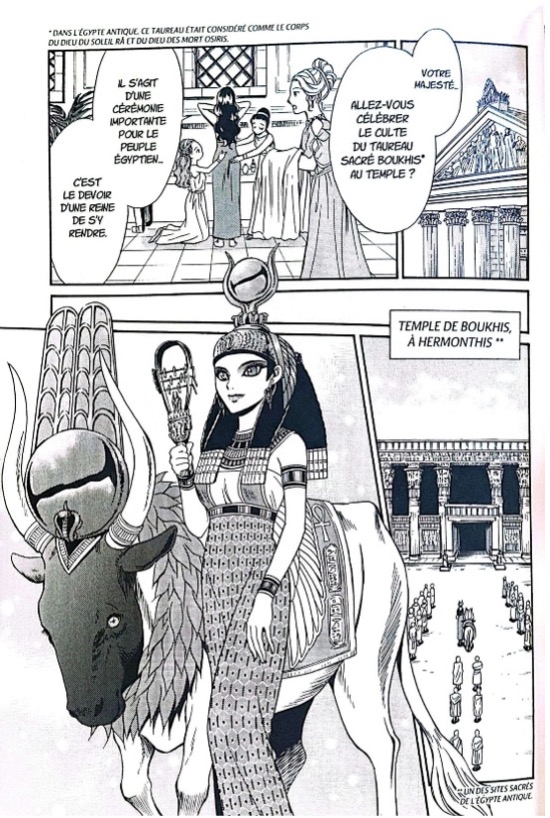
Cleopatra in her royal Egyptian regalia as Isis, and the Buchis bull at the temple of Hermonthis (Photo taken by the author)
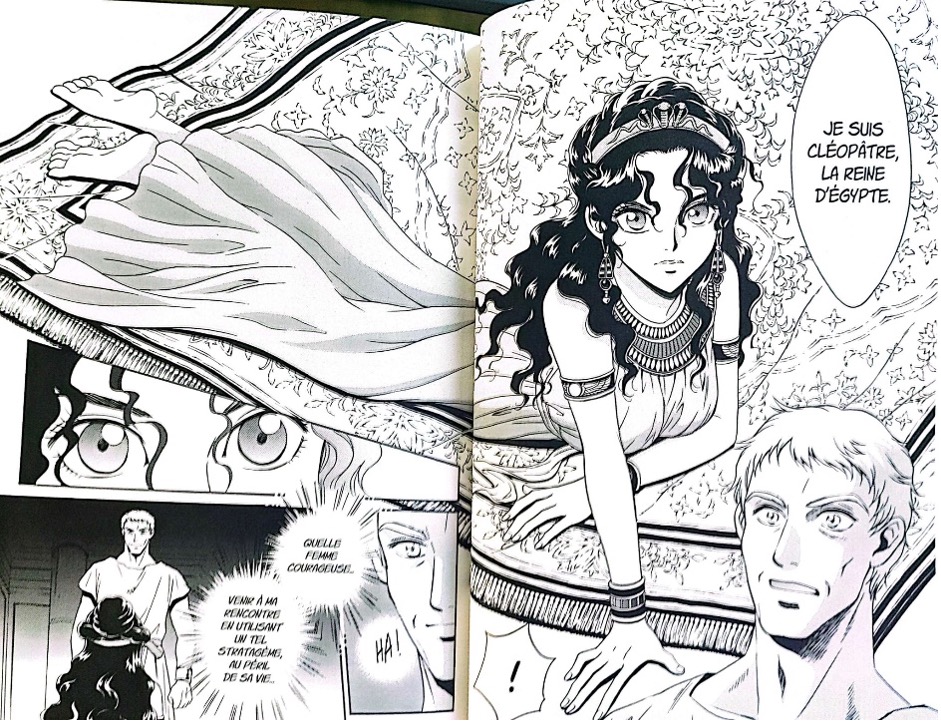
Caesar and Cleopatra’s famous encounter during the carpet episode (Photo taken by the author)
Egyptomania narratives or motifs
Cleopatra is depicted both as a Hellenistic queen and as an Egyptian pharaoh. Whereas most of the time she appears wearing a chiton and a himation, she also wears Egyptianising jewelry: double crown pendants, a diadem with three uraei, bracelets, and a typical Egyptian pectoral. However, when she appears in front of her subjects, she is depicted in an Egyptian fashion with makeup, kohl eyeliner, a black wig, a sistrum, a kalasiris, and the vulture headdress with the uraeus, solar disk, and horns resembling Hathor’s crown.
The first chapter delves into Cleopatra’s childhood and how the Ptolemies came to be kings of Egypt after the conquest of Alexander. Here, Cleopatra is presented as a loyal daughter to her father Ptolemy XII, who is shown as a kind man who nonetheless enjoys drinking and playing the lute. The dynastic struggles, Ptolemy’s exile from Egypt, and Ptolemy’s alliance with Rome are also depicted in the first chapter, where Cleopatra meets Antony for the first time when she is still a teenager.
Chapter 2 revolves around her accession to the throne with her brother Ptolemy XIII and her relationship with Caesar during the civil war. Cleopatra is presented as an intelligent woman who can speak different languages and who is worried about the fate of her people and Rome’s increasing influence, as Plutarch recounts. Her crowning of a new Buchis bull of Hermonthis is one of the first scenes where she appears as queen, wearing Egyptian garments and being described as a new Isis. The Buchis Bull wears a solar disk with horns combined with the double feather crown. After being manipulated by his advisors and by his sister Arsinoe, Ptolemy XIII betrays Cleopatra, and she is forced into exile. There she hears about Caesar’s triumph over Pompey in the civil war and manages to meet him after the famous carpet episode. Cleopatra and Caesar fight against the former’s brother, and, after getting back her throne, Cleopatra decides to visit Rome to present Caesarion to Caesar. In Rome she meets both Antony and Octavian. Finally, she has to flee from the city when Caesar is murdered.
Chapter 3 focuses on Cleopatra’s relationship with Antony after their famous meeting at Tarsus, where she is depicted wearing flowers and a Greek tunic representing Aphrodite. She invites Antony to her ship where she holds her well-known, sumptuous banquet. After this, the joyful life that Antony and Cleopatra led in Alexandria and some of the anecdotes that are described by Plutarch are narrated, until Antony must go back to Rome to ensure an alliance with Octavian by marrying his sister Octavia.
Chapter 4 deals with Antony’s failed expedition against the Parthians, the Donations of Alexandria, Octavian’s declaration of war against Cleopatra, and the battle of Actium. The last chapter shows the war of Alexandria and Octavian’s invasion of Egypt, Antony’s suicide, Cleopatra’s negotiation with Octavian, and, finally, her suicide. Whereas in the comic she dies by the famous story of getting bitten by a snake, both Plutarch and Cassius Dio gave different versions of her death. In the aftermath, the manga tells how Octavian came to build the Roman empire and how Cleopatra’s children (except Caesarion, who was murdered by Octavian) were raised by Octavia in Rome.
Last but not least, the manga also includes a “Read More” final section where the reader can find more information on the chronologies and key events from Cleopatra’s life, historical characters, and sociocultural aspects, as well as a general context of Ptolemaic Egypt and Republican Rome.
The first chapter delves into Cleopatra’s childhood and how the Ptolemies came to be kings of Egypt after the conquest of Alexander. Here, Cleopatra is presented as a loyal daughter to her father Ptolemy XII, who is shown as a kind man who nonetheless enjoys drinking and playing the lute. The dynastic struggles, Ptolemy’s exile from Egypt, and Ptolemy’s alliance with Rome are also depicted in the first chapter, where Cleopatra meets Antony for the first time when she is still a teenager.
Chapter 2 revolves around her accession to the throne with her brother Ptolemy XIII and her relationship with Caesar during the civil war. Cleopatra is presented as an intelligent woman who can speak different languages and who is worried about the fate of her people and Rome’s increasing influence, as Plutarch recounts. Her crowning of a new Buchis bull of Hermonthis is one of the first scenes where she appears as queen, wearing Egyptian garments and being described as a new Isis. The Buchis Bull wears a solar disk with horns combined with the double feather crown. After being manipulated by his advisors and by his sister Arsinoe, Ptolemy XIII betrays Cleopatra, and she is forced into exile. There she hears about Caesar’s triumph over Pompey in the civil war and manages to meet him after the famous carpet episode. Cleopatra and Caesar fight against the former’s brother, and, after getting back her throne, Cleopatra decides to visit Rome to present Caesarion to Caesar. In Rome she meets both Antony and Octavian. Finally, she has to flee from the city when Caesar is murdered.
Chapter 3 focuses on Cleopatra’s relationship with Antony after their famous meeting at Tarsus, where she is depicted wearing flowers and a Greek tunic representing Aphrodite. She invites Antony to her ship where she holds her well-known, sumptuous banquet. After this, the joyful life that Antony and Cleopatra led in Alexandria and some of the anecdotes that are described by Plutarch are narrated, until Antony must go back to Rome to ensure an alliance with Octavian by marrying his sister Octavia.
Chapter 4 deals with Antony’s failed expedition against the Parthians, the Donations of Alexandria, Octavian’s declaration of war against Cleopatra, and the battle of Actium. The last chapter shows the war of Alexandria and Octavian’s invasion of Egypt, Antony’s suicide, Cleopatra’s negotiation with Octavian, and, finally, her suicide. Whereas in the comic she dies by the famous story of getting bitten by a snake, both Plutarch and Cassius Dio gave different versions of her death. In the aftermath, the manga tells how Octavian came to build the Roman empire and how Cleopatra’s children (except Caesarion, who was murdered by Octavian) were raised by Octavia in Rome.
Last but not least, the manga also includes a “Read More” final section where the reader can find more information on the chronologies and key events from Cleopatra’s life, historical characters, and sociocultural aspects, as well as a general context of Ptolemaic Egypt and Republican Rome.
Author: Esperanza Macarena Ródenas Perea
Tags
Write a Comment
Tem de iniciar a sessão para publicar um comentário.