

Cat People
Year:
1942
Running time:
73 mn
Nationality:
USA
Language:
English
Genre:
Horror, Mystery, Thriller
Director:
Jacques Tourneur
Producer:
RKO Radio Pictures
Screenwriter/s:
DeWitt Bodeen
Cast:
Simone Simon, Kent Smith, Tom Conway, Jane Randolph, Jack Holt.
Other websites:


Trailer:

Summary of the film
Irena Dubrovna (Simone Simon), a New York City-based sketch designer of Serbian descent, marries marine engineer Oliver Reed (Kent Smith). Despite her love for Oliver, Irena is unwilling to have sexual intercourse with him, as she believes an old curse originated in her native land (an ancient tribe of Cat People) looms ahead, waiting to be released were she to pursue her passions and deep instincts. (Filmaffinity)
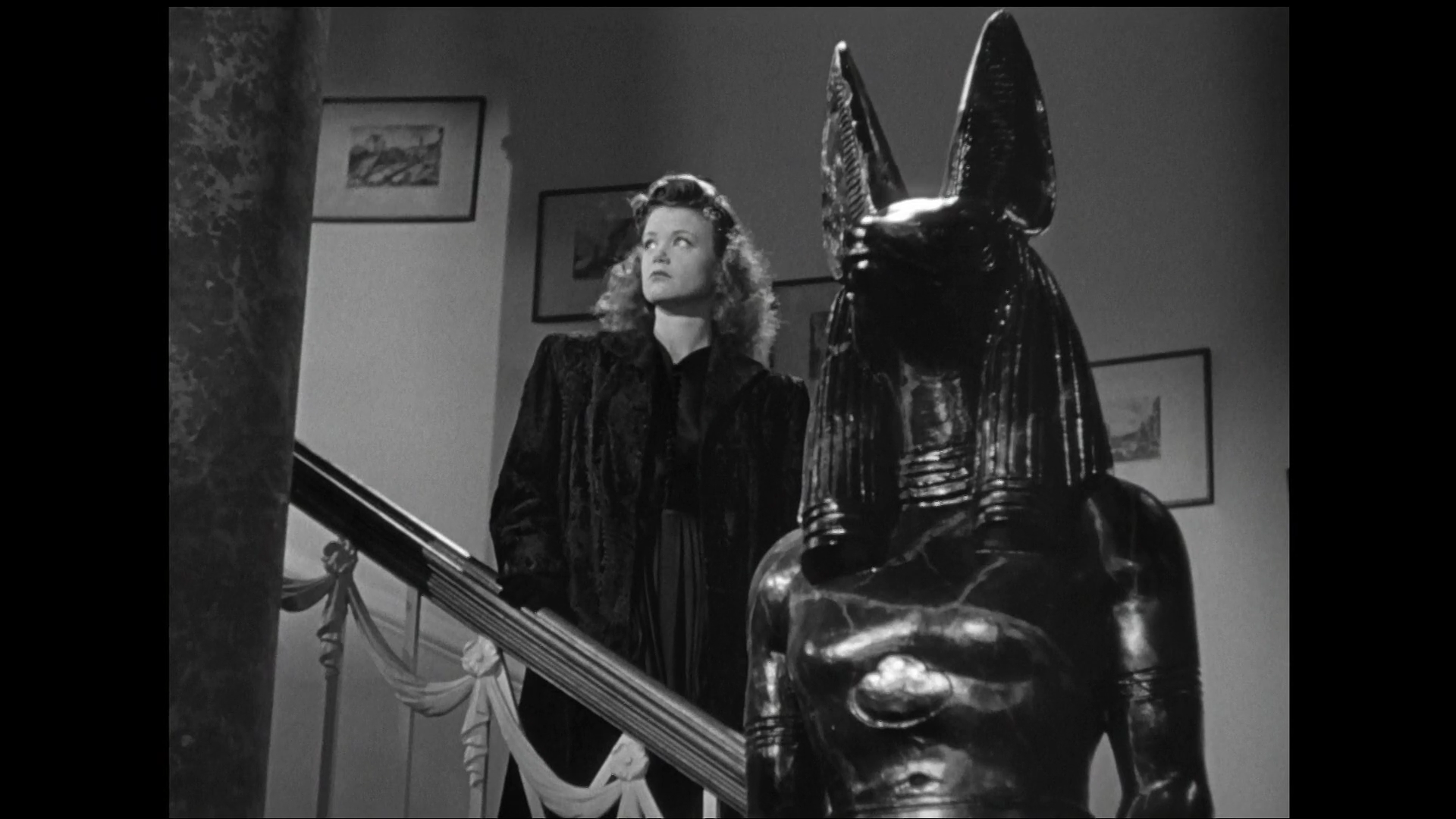
Statue of Anubis in Cat People (1942) (Screenshot by the author)
Egyptomania narratives or motifs
Jacques Tourneur and Val Lewton’s Cat People is a film rich in mythological reverberations (from biblical allusions to sin, and made-up Slavic folk tales, to the imaginary of the metamorphosis in Greco-Roman antiquity). This hybrid mythical pattern is displayed in the movie through textual-narrative devices and iconography. Among the latter, it must be noticed the centrality (in terms of its implicit symbolism) attached to a giant statue of the Egyptian god Anubis in a scene near the climax of the movie. At this point, Irena decides to leave, in a fit of jealousy, the museum she has been visiting in the company of her husband and one of his coworkers, Alice Moore (Jane Randolph), whom Irena is starting to see as a threat to her marriage. As she is climbing down the stairs to the museum’s foyer, Irena stops and stands pensively for a moment; at the forefront of the frame, the upper section of the statute of Anubis is shown, with Irena standing still right behind it. The image helps to draw parallels between the fate of the cursed (cat) woman, who in the film struggles to repress her death drive, and the jackal-headed Egyptian deity, patron of the lost souls and guide to the afterlife.
Author: Samuel Fernández-Pichel
Other information
Tags
Write a Comment
Tem de iniciar a sessão para publicar um comentário.