

Assassin’s Creed Origins
Game Family:
Assassin’s Creed
Year:
2017
Nationality:
France
Authors:
Jean Guesdon, Ashraf Ismail
Designer:
Eric Baptizat
Artists:
Raphael Lacoste
Publisher:
Ubisoft
Number of Players:
2 - 6
Genre:
Fantasy, Adventure, History
Other websites:


Videos by players:

Summary of the game
Assassin’s Creed Origins is the tenth installment in the Assassin’s Creed franchise. This game is a precursor, setting up the conflict between the Hidden Ones (a group established by the main characters, Bayek and Aya, and which eventually becomes the Order of Assassins/Assassin Brotherhood featured in the previous game installments), and the Order of the Ancients (which eventually becomes the Templar Order).
The game is set primarily during the years 49-43 BCE. The gamer plays as Bayek of Siwa and his wife Aya, who both get pulled into the political machinations of the period after their son, Khemu, is killed. The game begins during the civil war between Ptolemy XIII and Kleopatra VII. Bayek and Aya take up the cause of returning Kleopatra to her throne, and, as a result, the player is a driving force in the events of the period, including Kleopatra’s alliance with Julius Caesar, the Alexandrian Civil War, and Caesar’s assassination in Rome.
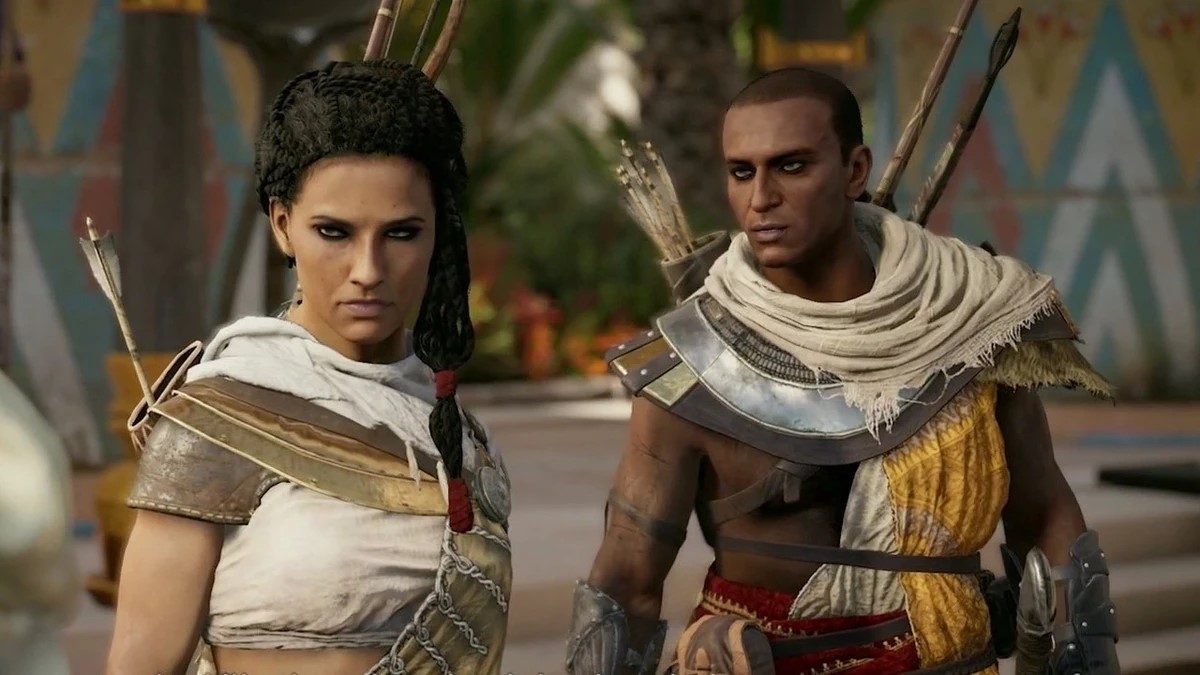
Main characters, Aya and Bayek of Siwa. Image from Assassin’s Creed Origins fandom.com’s main character page (https://www.fandom.com/articles/assassins-creed-origins-bayek-senu-aya)
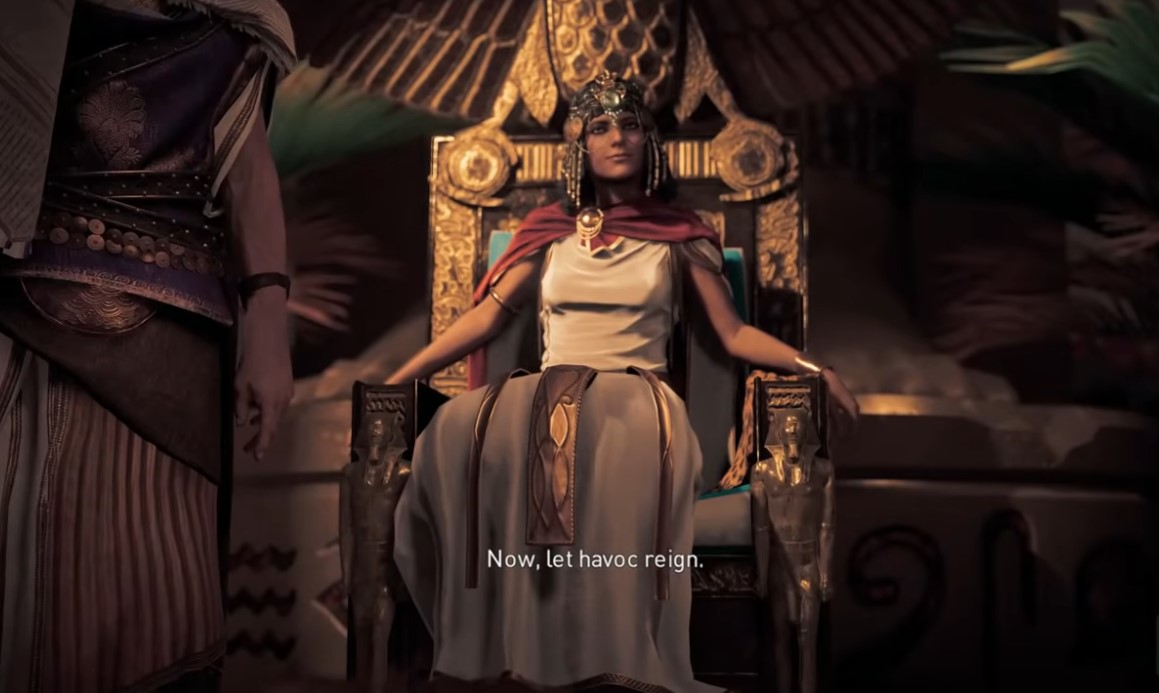
Screenshot of Kleopatra VII in Assassin’s Creed Origins (Screenshot by author)
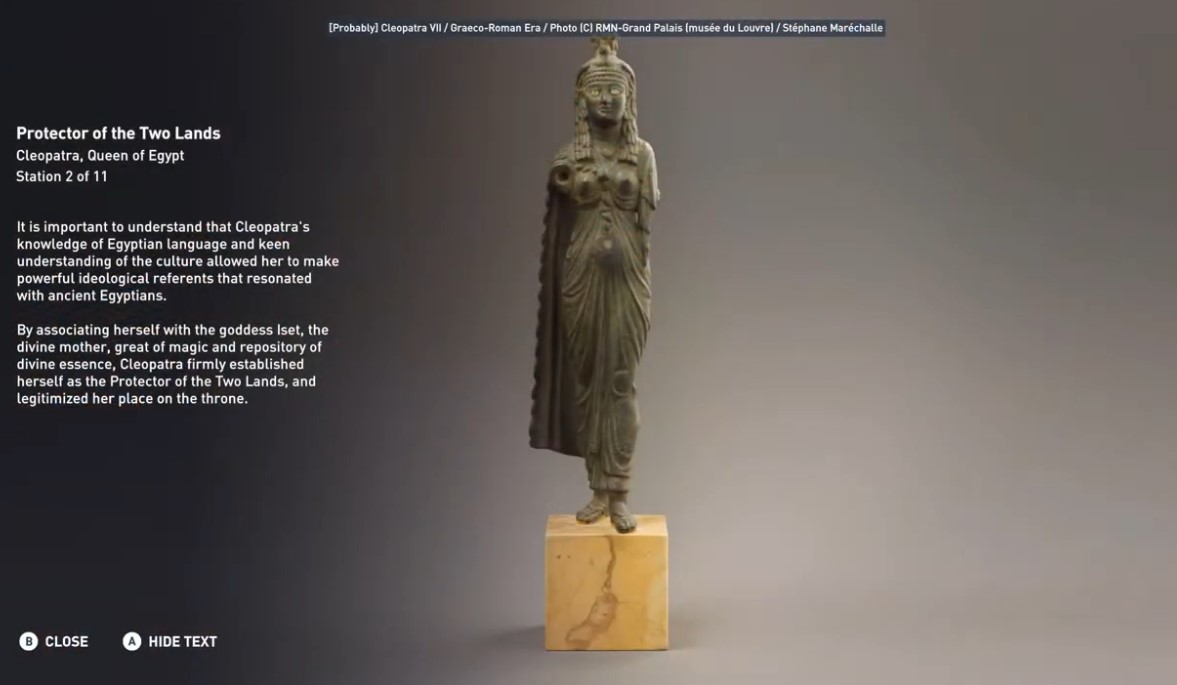
Screenshot of station 2 of the Kleopatra VII Discovery Tour (Screenshot by author)
Egyptomania narratives or motifs
While playing the game, the player is able to explore an open-world map of Ptolemaic Egypt, from the city of Alexandria in the delta, to the Great Pyramids at Giza, the Fayum Oasis, and extending south to the tombs in the Valley of the Kings. The environment and structures in these various locations are all reconstructed to appear as they would have during the reign of Kleopatra VII. The game developers and designers put a lot of effort into these recreations, using museum artifacts and extant structures to guide their design process and also consulting historians, art historians, and Egyptologists, who conducted seminars that instructed the designers on the history and culture of the period.
As a result, the player is presented with a snapshot of Egyptian life during the late Ptolemaic period, including being able to walk through Egyptian temples, visit the Library of Alexandria, the Mouseion, and the tomb of Alexander, and explore the interior of the pyramids and the tombs in the Valley of the Kings. Most notable, however, are the everyday interactions with the common people, like shopping at a market, visiting a mummification workshop, and hearing the realistic audio environment of Egyptian and Greek phrases being spoken by the populace.
On the whole, the game designers strove for as accurate a depiction of Hellenistic Egypt as possible, but certain inaccuracies were included for gameplay reasons. For instance, while the temple structures are faithfully recreated, including decorating them with the colorful carvings and architectural features that would have existed at the time, the game designers chose to inaccurately make the temples places that were open to the populace. When they were in use, the temples would have only been accessible for priests, especially the main sanctuaries. Yet in the game, priests and common people mingle and walk throughout the temples, an inaccuracy that was included to allow for full exploration of these recreated structures by the player. Another inaccuracy that was included is in the character of Kleopatra VII. She was recreated as a character in the game whose actions, and even some of her phrasing, were taken directly from the Roman propaganda that redefined her after her death. Rather than producing a more historically accurate depiction of her, the designers chose to include the sexualized caricature of her as queen, since it is more well known to audiences and also fits better with the in-game storyline in which she is a side character who ends up betraying the main characters. More on this topic is available below in the bibliography.
We also see additional Egyptomania motifs utilized during the game in order to facilitate gameplay and some of the extended storylines. For example, in one of the game’s DLCs (downloadable content that extends the game), Curse of the Pharaohs, the player ventures into the afterlife where they fight Anubis warriors and reanimated mummies (including four boss battles where the player fights a mummified and reanimated Akhenaten, Nefertiti, Ramesses, and Tutankhamen).
Where the game really shines, historically speaking, is in its production of Discovery Tour mode. Assassin’s Creed Origins is the first of the franchise to include Discovery Tour mode (subsequent installments have since included it as well). These tours allow the player to explore various locations in Egypt or various topics on ancient Egyptian culture, including practices like mummification, or people, like Kleopatra VII. They are comprised of various stations where the player walks through and reads small snippets on the topic, accompanied by scholarly images from museums or extant monuments (see the image of station 2 of the Kleopatra VII Discovery Tour above).
As a result, the player is presented with a snapshot of Egyptian life during the late Ptolemaic period, including being able to walk through Egyptian temples, visit the Library of Alexandria, the Mouseion, and the tomb of Alexander, and explore the interior of the pyramids and the tombs in the Valley of the Kings. Most notable, however, are the everyday interactions with the common people, like shopping at a market, visiting a mummification workshop, and hearing the realistic audio environment of Egyptian and Greek phrases being spoken by the populace.
On the whole, the game designers strove for as accurate a depiction of Hellenistic Egypt as possible, but certain inaccuracies were included for gameplay reasons. For instance, while the temple structures are faithfully recreated, including decorating them with the colorful carvings and architectural features that would have existed at the time, the game designers chose to inaccurately make the temples places that were open to the populace. When they were in use, the temples would have only been accessible for priests, especially the main sanctuaries. Yet in the game, priests and common people mingle and walk throughout the temples, an inaccuracy that was included to allow for full exploration of these recreated structures by the player. Another inaccuracy that was included is in the character of Kleopatra VII. She was recreated as a character in the game whose actions, and even some of her phrasing, were taken directly from the Roman propaganda that redefined her after her death. Rather than producing a more historically accurate depiction of her, the designers chose to include the sexualized caricature of her as queen, since it is more well known to audiences and also fits better with the in-game storyline in which she is a side character who ends up betraying the main characters. More on this topic is available below in the bibliography.
We also see additional Egyptomania motifs utilized during the game in order to facilitate gameplay and some of the extended storylines. For example, in one of the game’s DLCs (downloadable content that extends the game), Curse of the Pharaohs, the player ventures into the afterlife where they fight Anubis warriors and reanimated mummies (including four boss battles where the player fights a mummified and reanimated Akhenaten, Nefertiti, Ramesses, and Tutankhamen).
Where the game really shines, historically speaking, is in its production of Discovery Tour mode. Assassin’s Creed Origins is the first of the franchise to include Discovery Tour mode (subsequent installments have since included it as well). These tours allow the player to explore various locations in Egypt or various topics on ancient Egyptian culture, including practices like mummification, or people, like Kleopatra VII. They are comprised of various stations where the player walks through and reads small snippets on the topic, accompanied by scholarly images from museums or extant monuments (see the image of station 2 of the Kleopatra VII Discovery Tour above).
Other information
Tara Sewell-Lasater (2023). “Eternally Maligned as the Power-hungry Femme Fatale: Kleopatra VII in Assassin’s Creed Origins and Other Video Games”, in A.I. Fernández Pichel (ed), How Pharaohs Became Media Stars: Ancient Egypt and Popular Culture (Oxford: Archaeopress), 185-204.
Open access
Perrine Poiron (2021). “Assassin’s Creed Origins Discovery Tour: A Behind the Scenes Experience.” Near Eastern Archaeology 84: 79–85.
Access with registration and payment.
Christian Casey (2021). “Assassin’s Creed Origins: Video Games as Time Machines.” Near Eastern Archaeology 84: 71–78.
Access with registration and payment.
Tags
Write a Comment
Tem de iniciar a sessão para publicar um comentário.