

Ágora
Year:
2009
Running time:
126 mn
Nationality:
Spain
Language:
English
Genre:
Drama, Romance, Historical, Biography
Director:
Alejandro Amenábar
Producer:
Telecinco Cinema, Mod Producciones, Himenóptero, Canal+ España, ICAA
Screenwriter/s:
Alejandro Amenábar, Mateo Gil
Cast:
Rachel Weisz, Max Minghella, Ashraf Bahrom, Oscar Isaac, Michael Lonsdale, Rupert Evans, Homayoun Ershadi, and others
Other websites:


Trailer:

Summary of the film
In the year 391, hordes of fanatics rampage through the legendary library of Alexandria. Trapped behind its walls, the brilliant astronomer and philosopher Hypatia (Rachel Weisz) struggles to save the wisdom of the ancient world. (Filmaffinity).
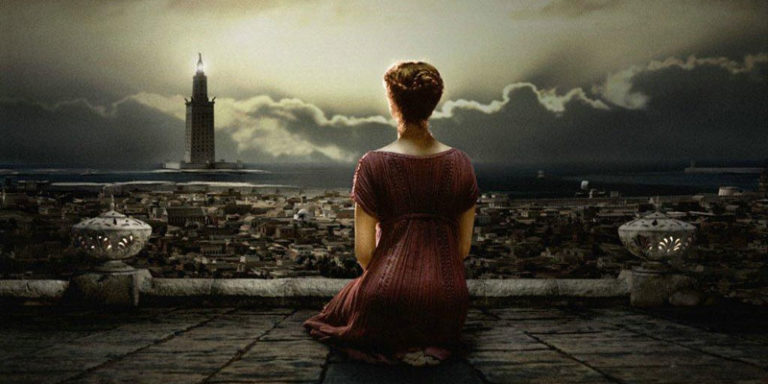
Hypatia contemplates Alexandria (Source: https://www.justwatch.com/ar/pelicula/agora)
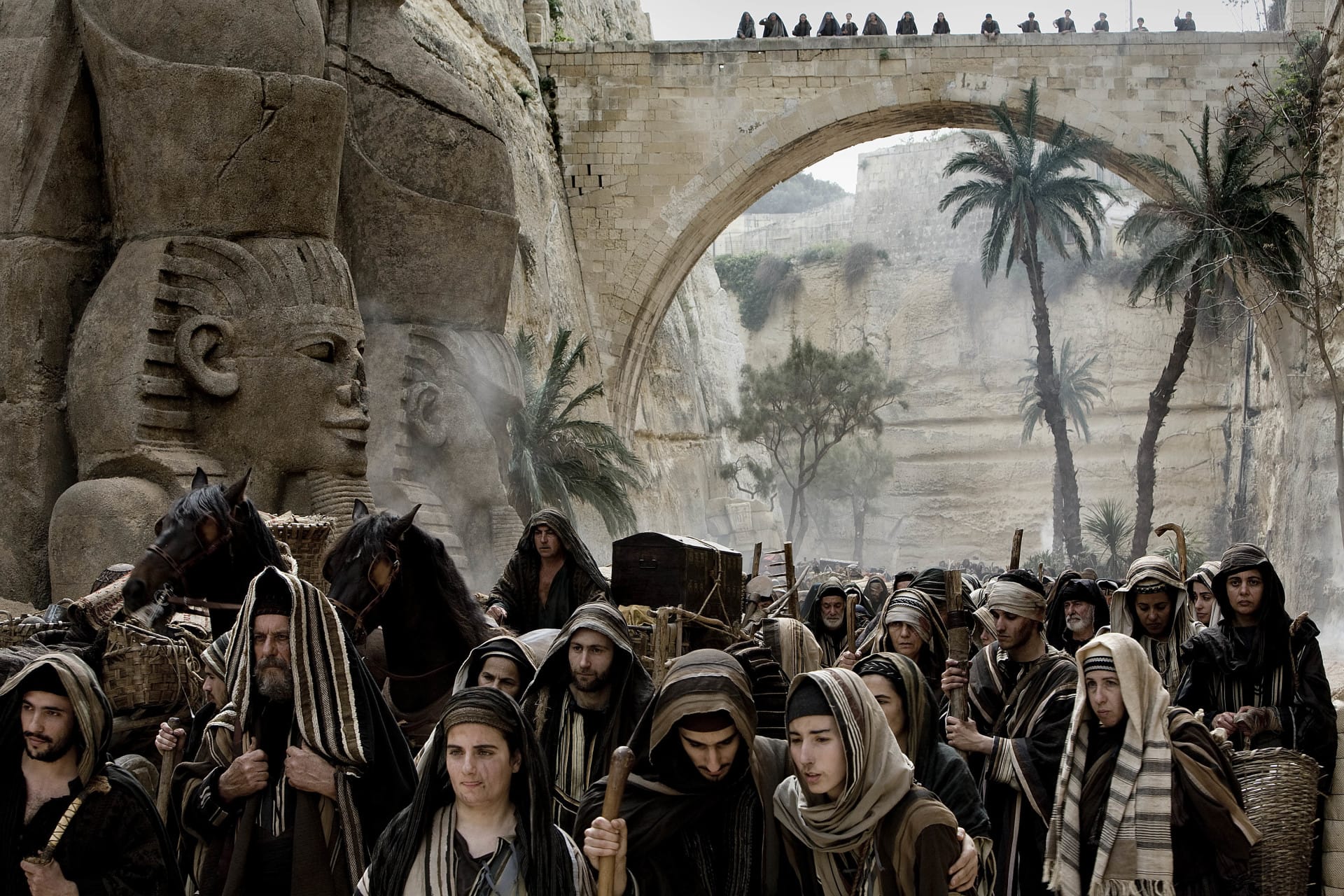
Production still from Ágora: the set aims to replicate the architecture as well as the hustle and bustle of city life in Roman Alexandria (Source: https://www.independent.com.mt/articles/2015-09-16/local-news/FIRST-magazine-Malta-s-versatile-film-locations-6736142148)
Egyptomania narratives or motifs
Although centered on the proto-feminist historical figure of the mathematician, astronomer, and philosopher Hypatia (played by Rachel Weisz), Alejandro Amenábar’s Agora may well be read, too, as a film about the decline of classical antiquity. Set in Alexandria in the 4th century AD, the movie addresses the political and religious turmoil associated to the end of the pagan epoch, and the rise of a new order sanctioned by the primacy of Christianity in its alliance with Roman power under Theodosius I. In a combination of historical fact and fiction, Alexandria is reimagined as a cosmopolitan city where the architectural features of ancient Egyptian culture are still clearly visible against the backdrop of the clash between several religious factions (Jews, pagans, Christian sectors and sub-groups, and followers of vernacular cults). With the aim of staging the urban setting of Alexandria as an ancient port city, Agora was shot at Fort Ricasoli in Kalkara, Malta, where major examples of historical epic movies of the 21st century such as Gladiator (Ridley Scott, 2001), Troy (Wolfgang Petersen, 2004), and Napoleon (Ridley Scott, 2023) were also filmed. Production design by Guy Hendrix Days emphasized the reconstruction of the recognizable landmarks of Graeco-Roman Alexandria (the Pharos / Lighthouse, the pagan temples, the Serapeum, etc.), partly following the aesthetic templates of reinterpretations of the Egyptian and / or classical imaginary by artists of the likes of Lawrence Alma-Tadema and Charles William Mitchell.
By constantly broadening the scope of its thematic focus and focalization (“the view from above”) to encompass the tragic reverberations of global history, as well as the idea of Hypatia’s love for science and the cosmos, Amenábar delivered a cautionary tale about the rise of intolerance, fundamentalism, and misogyny in the context of the War on Terror.
By constantly broadening the scope of its thematic focus and focalization (“the view from above”) to encompass the tragic reverberations of global history, as well as the idea of Hypatia’s love for science and the cosmos, Amenábar delivered a cautionary tale about the rise of intolerance, fundamentalism, and misogyny in the context of the War on Terror.
Author: Samuel Fernández-Pichel
Other information
Duce Pastor. E. 2016. Ágora de Alejandro Amenábar: nuevo uso cinematográfico del fin de la Antigüedad. Anuario del Centro de Estudios Históricos “Profesor Carlos S. A. Segreti” 16: 15-31.
Open access
Jordan, B. 2019. Alejandro Amenábar: 225-266. Manchester: Manchester University Press.
Not available
Moschini, S. 2013. Ágora, resistencia y poder. Aplicación de teorías cinematográficas en el estudio de la Tradición Clásica, in Borja Antela Bernárdez and César Sierra Martín (eds.) La Historia Antigua a través del cine: Arqueología, Historia Antigua y Antigüedad Clásica: 169-180. Barcelona: UOC.
Not available
López Martínez, M. P. 2014. "Había una mujer en Alejandría que se llamaba Hipatia": su presencia en Ágora de Amenábar. Asparkía - Investigació Feminista 25: 202-222.
Open access
Piñas Azpitarte, M. 2012. Recreando Alejandría, dos visiones distintas de la misma ciudad: los decorados digitales de la película “Ágora” y la pieza estereoscópica “Alejandría, El sueño de Alejandro Magno”. Virtual Archaeology Review 3(6): 12-19.
Open access
Tags
Write a Comment
Tem de iniciar a sessão para publicar um comentário.