Mummy
RPG Family or System:
Vampire: The Masquerade (1st) / Classic World of Darkness
Year:
1992-2001
Nationality:
USA
Authors:
Jim Comer, Robert Hatch, Jesse Heinig, Conrad Hubbard, and others
Art Director:
Justin Achilli, Tim Avers, Andrew Bates, Kraig Blackwelder, and others
Publisher:
White Wolf
Genre:
Horror, Conspiracy, Gothic, Oriental
Other websites:

Videos by players :
Summary of the game
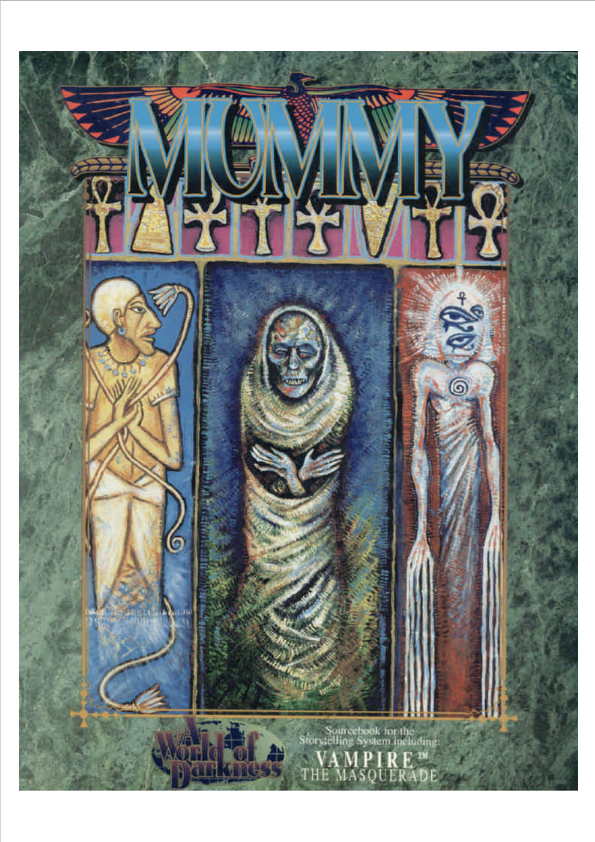
Mummy is one of the publications belonging to the World of Darkness universe, in which players play as fantastic creatures in a dystopian present with a gothic-punk aesthetic. While the concept of mummies was already presented in books such as Clanbook: Setites (1995) and Silent striders Tribebook (1996), Mummy, published in its first edition in 1992, will be the one that develops the story of the mummies in more detail. In its second edition, these contents were expanded, with a clearer explanation of how to play a mummy character. Finally, in 2001, the game was further revised with the book Mummy: The Resurrection, an update that changed the initial concept of the game to bring it closer to other games in the same universe such as Wraith: the Oblivion (1994) (focused on ghosts).
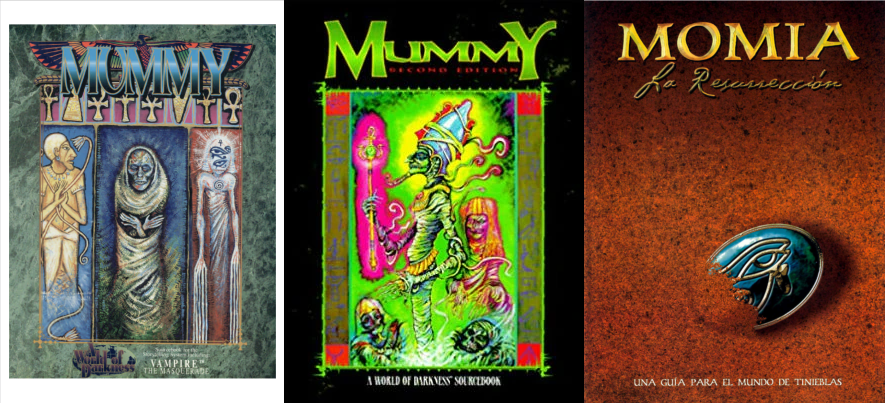
Covers of the 3 editions of the book Mummy (Screenshot by the author)
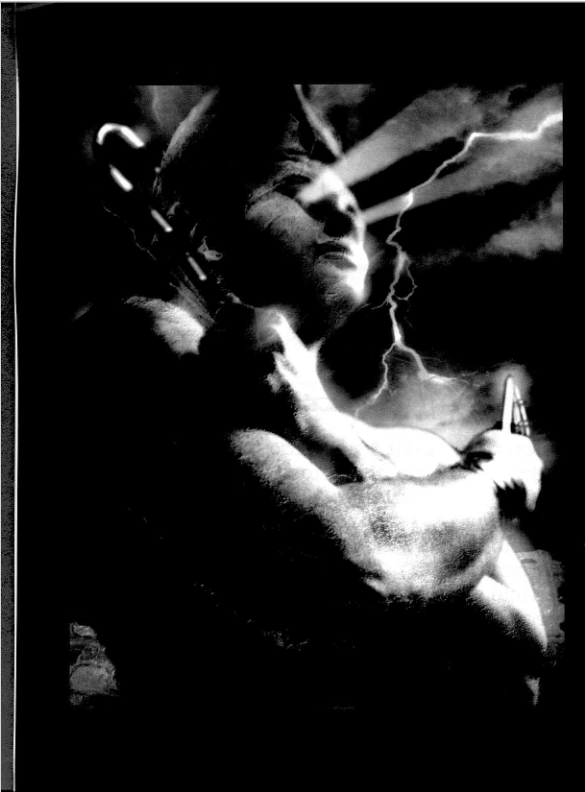
Mummy emerging from its sarcophagus in the present day (Mummy, 1992, p. 74) (Screenshot by the author)
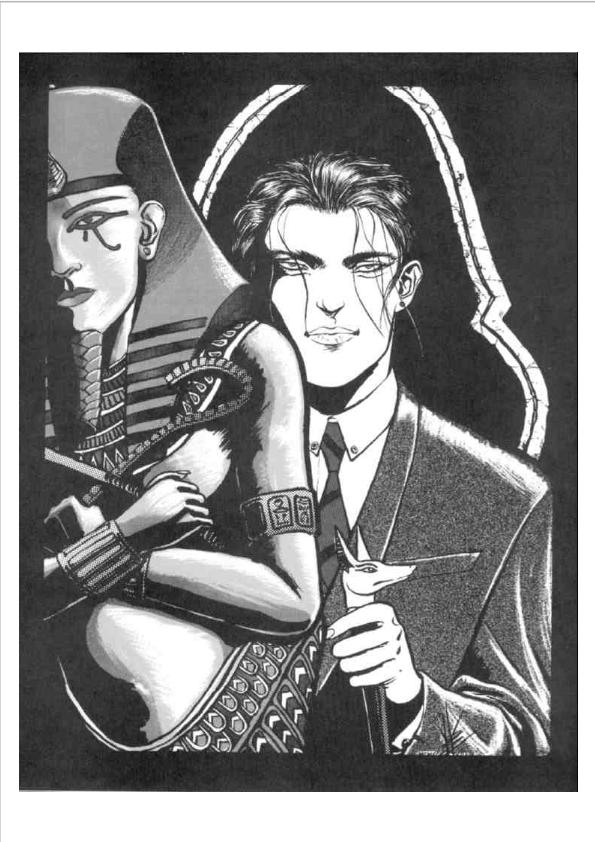
Representation of Osiris at his awakening in Amenti (Mummy: The resurrection, 2002, p.4) (Screenshot by the author)
Egyptomania narratives or motifs
All three editions of the Mummy RPG focus on the Egyptian religion, adapted to the World of Darkness (henceforth WoD) universe.
Thus, the first two editions state that the mummies were ancient Egyptian humans who, upon their death, underwent a special funeral rite, known as the ‘Great Rite’ (a variant of mummification). Through this rite, mummies are reborn into a kind of “immortal” life, where each new death (due to violent death or exhaustion, as these characters do not age or get sick) means that their soul parts are separated and the Ba travels to the Shadowlands, or place inhabited by ghosts in the WoD universe. Here, the mummies regained their magic to re-unify their constituent parts, both physical and spiritual, and thus come back to life.
The Great Rite was revealed by Thoth to Isis, the magician, who wanted to cure her son Horus of the evil inflicted by Set; this took place in the context of the struggle between Set and Osiris, the two vampires vying for power in Egypt. After Set's victory, Horus and his mummies, the Shemsu Heru or "followers of Horus" embarked on a millenary crusade against Set, his followers and Apophis, a representation of chaos and corruption.
The first two editions of Mummy focus on the story of the mummies from their origins, including the aforementioned conflict against Set, and the subsequent struggle on the side of Horus. He is portrayed here as the leader of the 43 mummies created by the Great Rite over the 3 millennia of ancient Egyptian history.
The entire historical setting of these books seeks to immerse the players in the culture of ancient Egypt, constructed from the partial memories of the mummies themselves. There are, therefore, numerous gaps in these narratives, due to the constant process of death and resurrection of the characters and the normal forgetting of their successive lives and long history.
As for the mummy-characters, they live in the present day and have a modern name in our present, but they also keep their ancient Egyptian name. The Ba and Ka are fundamental elements in this game, being the real engines of the mummy's body, while the Sekhem has mainly to do with the use of their powers. In addition, the mummies have access to He Kau or Egyptian magic, which is detailed especially in the second edition where different specialties are described focusing on alchemy, the creation of amulets, the use of necromancy, the control of the weather and the creation of shabties, all closely linked to the Egyptian tradition.
In addition to these Egyptianising elements, the game features in its various editions a multitude of ideas and concepts linked to ancient Egypt, such as the Amenti, a spiritual realm in Shadowlands where the spirits of the ancient Egyptians congregate around the soul of Osiris.
Mummy: The Resurrection deserves a special mention because, although it provides continuity with respect to the previous editions, it updates the story with new events that are decisive for the entire narrative: a catastrophe takes place in the Shadowlands, probably caused by Apophis, a world-destroying character opposed to the order of the Maat. This leads to the destruction of the Amenti and the dispersion and mutilation of the souls of its inhabitants, who will only be saved in extremis thanks to the intervention of Osiris. The powerful spirit of Osiris, with the help of Maat and Isis, sheltered the souls in safe places in the Shadowlands and improved the "Great Rite" so that these souls were brought back to life in the bodies of people who had recently died or were about to die. This concept modifies, as we see, the concept of the mummy as described in the first two editions.
Thus, the first two editions state that the mummies were ancient Egyptian humans who, upon their death, underwent a special funeral rite, known as the ‘Great Rite’ (a variant of mummification). Through this rite, mummies are reborn into a kind of “immortal” life, where each new death (due to violent death or exhaustion, as these characters do not age or get sick) means that their soul parts are separated and the Ba travels to the Shadowlands, or place inhabited by ghosts in the WoD universe. Here, the mummies regained their magic to re-unify their constituent parts, both physical and spiritual, and thus come back to life.
The Great Rite was revealed by Thoth to Isis, the magician, who wanted to cure her son Horus of the evil inflicted by Set; this took place in the context of the struggle between Set and Osiris, the two vampires vying for power in Egypt. After Set's victory, Horus and his mummies, the Shemsu Heru or "followers of Horus" embarked on a millenary crusade against Set, his followers and Apophis, a representation of chaos and corruption.
The first two editions of Mummy focus on the story of the mummies from their origins, including the aforementioned conflict against Set, and the subsequent struggle on the side of Horus. He is portrayed here as the leader of the 43 mummies created by the Great Rite over the 3 millennia of ancient Egyptian history.
The entire historical setting of these books seeks to immerse the players in the culture of ancient Egypt, constructed from the partial memories of the mummies themselves. There are, therefore, numerous gaps in these narratives, due to the constant process of death and resurrection of the characters and the normal forgetting of their successive lives and long history.
As for the mummy-characters, they live in the present day and have a modern name in our present, but they also keep their ancient Egyptian name. The Ba and Ka are fundamental elements in this game, being the real engines of the mummy's body, while the Sekhem has mainly to do with the use of their powers. In addition, the mummies have access to He Kau or Egyptian magic, which is detailed especially in the second edition where different specialties are described focusing on alchemy, the creation of amulets, the use of necromancy, the control of the weather and the creation of shabties, all closely linked to the Egyptian tradition.
In addition to these Egyptianising elements, the game features in its various editions a multitude of ideas and concepts linked to ancient Egypt, such as the Amenti, a spiritual realm in Shadowlands where the spirits of the ancient Egyptians congregate around the soul of Osiris.
Mummy: The Resurrection deserves a special mention because, although it provides continuity with respect to the previous editions, it updates the story with new events that are decisive for the entire narrative: a catastrophe takes place in the Shadowlands, probably caused by Apophis, a world-destroying character opposed to the order of the Maat. This leads to the destruction of the Amenti and the dispersion and mutilation of the souls of its inhabitants, who will only be saved in extremis thanks to the intervention of Osiris. The powerful spirit of Osiris, with the help of Maat and Isis, sheltered the souls in safe places in the Shadowlands and improved the "Great Rite" so that these souls were brought back to life in the bodies of people who had recently died or were about to die. This concept modifies, as we see, the concept of the mummy as described in the first two editions.
Author: Víctor Sánchez Domínguez
Other information
Fernández Pichel, A.I. and Sánchez Domínguez, V. 2023. Egypt and Role-Playing Games. Does the World of Darkness Universe Use Ancient Egyptian Sources?, in A.I. Fernández Pichel (ed.) How Pharaohs Became Media Stars: Ancient Egypt and Popular Culture: 205-224.Oxford: Archaeopress.
Open access
Tags
Write a Comment
Tem de iniciar a sessão para publicar um comentário.