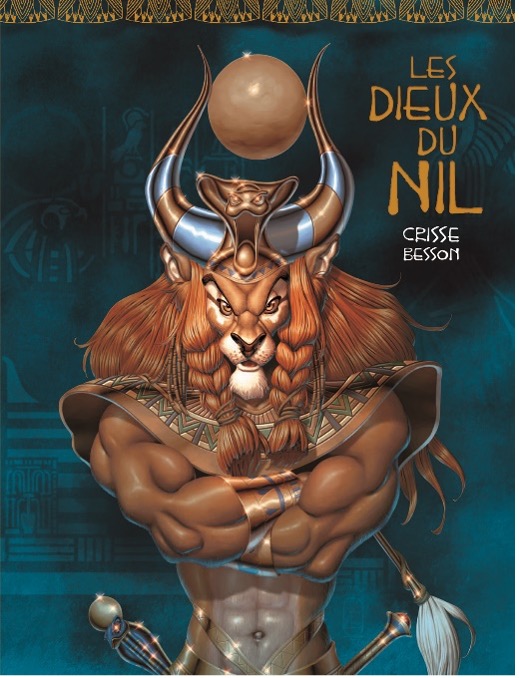
Les dieux du Nil
Year:
2012
Nationality:
France
Language:
French
Writer:
Didier Crisse
Artist:
Didier Crisse
Publisher:
Éditions Le Lombard
Genre:
Mythology, Fantasy, Adventure
Other websites:
Summary
It's a festival occasion in Per Bast, where celebrations of the goddess Bastet have even attracted the Pharaoh's royal family. But it's a different story for the cats! Their high priestess has just crossed the River Styx, and they need to elect her replacement. Apoua, the baboon, has heard of a white female cat who can only be the chosen one. For Nefertiti the cat, it's the start of a night's journey of a thousand dangers... (Translated from French from BDFugue).
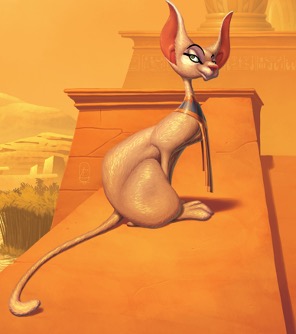
The royal cat Nefertiti, the comic’s protagonist (Source: https://assets.lastdodo.com/image/ld_medium/plain/assets/catalog/assets/2012/7/1/8/5/c/pdf_85cd90b0-a5d0-012f-55de-005056945a4e.jpg)
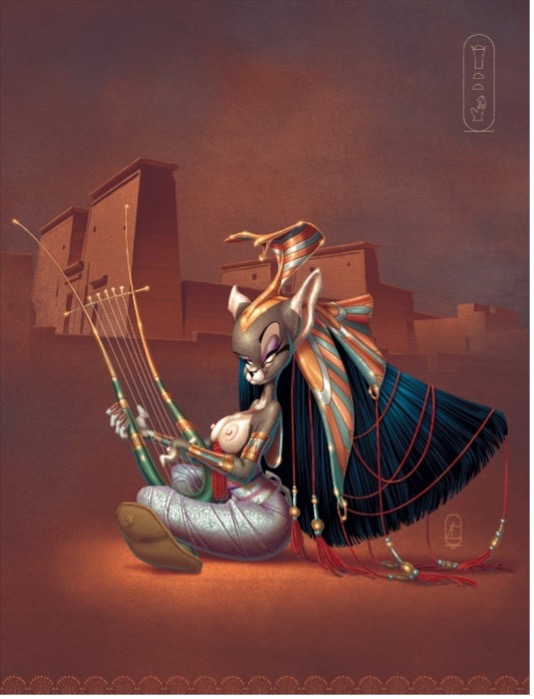
Goddess Bastet with a lyre and a temple behind her (Source: https://www.bandedessinee.info/Dieux-du-Nil-Les-bd)
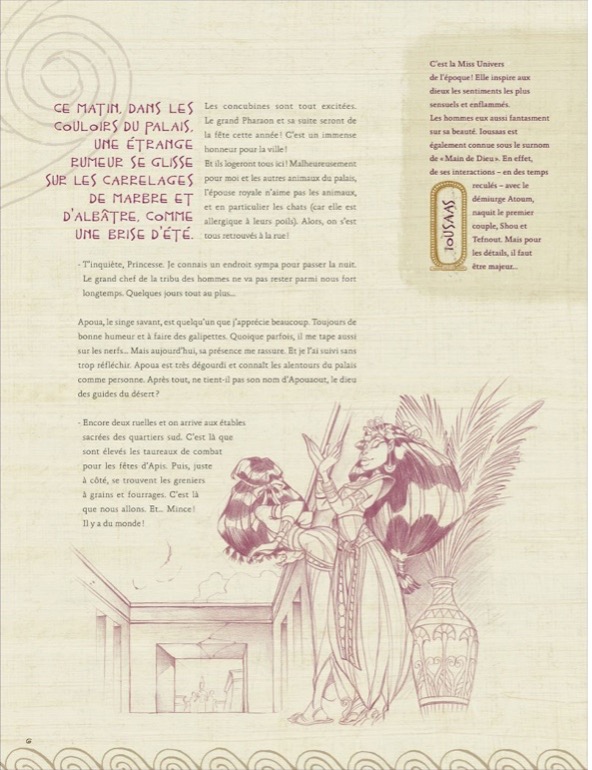
A sample of a “narrative” page, with text and an illustration done with a pencil-like technique, featuring the courtesans and the palace (Source: https://assets.bubblebd.com/img/xcrn03x9qo/rwt4latxro.jpg)
Egyptomania narratives or motifs
Les dieux du Nil is an illustrated tale set in the festival of Bastet at Bubastis. The story begins with the protagonist, a royal cat called Nefertiti. After hearing that the sacred cat who acted as an intermediary between the cats and the goddess Bastet has passed away, Nefertiti decides to join the cat city council to look for a successor. Rumor has it that a new beautiful cat has been born at the temple of Hathor, and Nefertiti, with her baboon friend Apoua and other cats she meets along the way, must travel throughout the entire festive city and the different temples in Bubastis to find the new chosen kitten before the end of the festival, when Sekhmet will descend to wreak havoc. Along the way, Nefertiti faces many obstacles and encounters with humans and Egyptian animals, such as crocodiles, baboons, ibis, cobras, etc…. Until she manages to find the kitten and her family and present her to the priests, who accept her as the new divine intermediary between cats, humans, and the gods.
The illustrated tale combines two different types of depictions. On the one hand, there are the sketches of the adventures of Nefertiti travelling through all the Bubastis temples and making friends. These sketches normally come with a short narrative text of dialogues. Bubastis is described as a festive and jubilant city where its inhabitants get drunk to celebrate the festival with joy and mayhem, which recalls Herodotus’ account on the topic. To recreate and Ancient Egyptian setting, the city is depicted with small houses, pylons, obelisks, columns with lotus and papyri motifs, as well as colossal statues of pharaohs. The city is also surrounded by the Nile. All the characters in the story are either talking animals or humans, and some of them share Egyptian royal names, such as Nefertiti herself or another cat named Ramesses.
On the other hand, full-coloured illustrations of different Egyptian gods are inserted at various points in the tale. To guide the reader through the different illustrations, the gods’ names are included in a serekh-cartouche (both in its Greek version and in hieroglyphic) and these are accompanied with a short description of the gods. Many of the gods are designed like anthropomorphic animals with some of their original attributes (such as Hathor with the cow’s horns and the solar disk or Amon with the double feather crown), but many gods are designed with Egyptianising elements, such as an ankh-scepter, the uraeus, the atef-crown, etc. Many of the goddesses are also depicted with an exotic, erotic, and sexualized view, alluding to orientalist portrayals of ancient Egypt.
The illustrated tale combines two different types of depictions. On the one hand, there are the sketches of the adventures of Nefertiti travelling through all the Bubastis temples and making friends. These sketches normally come with a short narrative text of dialogues. Bubastis is described as a festive and jubilant city where its inhabitants get drunk to celebrate the festival with joy and mayhem, which recalls Herodotus’ account on the topic. To recreate and Ancient Egyptian setting, the city is depicted with small houses, pylons, obelisks, columns with lotus and papyri motifs, as well as colossal statues of pharaohs. The city is also surrounded by the Nile. All the characters in the story are either talking animals or humans, and some of them share Egyptian royal names, such as Nefertiti herself or another cat named Ramesses.
On the other hand, full-coloured illustrations of different Egyptian gods are inserted at various points in the tale. To guide the reader through the different illustrations, the gods’ names are included in a serekh-cartouche (both in its Greek version and in hieroglyphic) and these are accompanied with a short description of the gods. Many of the gods are designed like anthropomorphic animals with some of their original attributes (such as Hathor with the cow’s horns and the solar disk or Amon with the double feather crown), but many gods are designed with Egyptianising elements, such as an ankh-scepter, the uraeus, the atef-crown, etc. Many of the goddesses are also depicted with an exotic, erotic, and sexualized view, alluding to orientalist portrayals of ancient Egypt.
Author: Esperanza Macarena Ródenas Perea
Other information
A.I. Fernández Pichel and M. Orriols-Llonch, "Sex, Gender and Sexualisation: Ancient Egypt in Contemporary Popular Culture", in A.I. Fernández Pichel (ed.), How Pharaohs Became Media Stars: Ancient Egypt and Popular Culture: 179-180. Oxford: Archaeopress.
Open access
Tags
Write a Comment
Tem de iniciar a sessão para publicar um comentário.