

Desperately Seeking Susan
Year:
1985
Running time:
104 mn
Nationality:
USA
Language:
English
Genre:
Comedy, Romance
Director:
Susan Seidelman
Producer:
Orion Pictures
Screenwriter/s:
Leora Barish
Cast:
Rosanna Arquette, Madonna, Aidan Quinn, Will Patton, John Turturro, and others
Other websites:


Trailer:

Summary of the film
Through following a series of romantic personal ads, dissatisfied New Jersey housewife Roberta Glass (Rosanna Arquette) becomes vicariously infatuated with New York City bohemian Susan (Madonna). In a series of unexpected and often comedic events, their lives become increasingly intertwined, inspiring Roberta to change her life for the better.
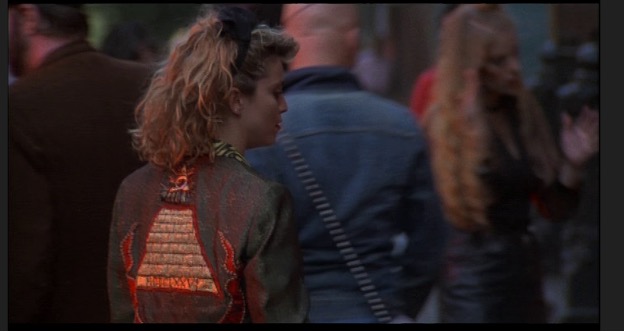
Fig. 1: Susan (Madonna) walks the streets of Manhattan in a pyramid-emblazoned jacket (Screenshot by author)
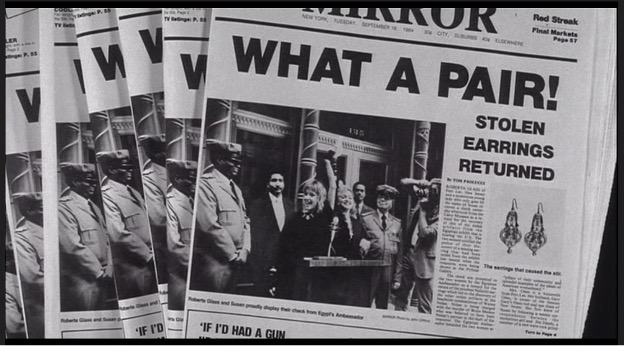
Fig. 2: While “Into the Groove” plays as non-diegetic music, Roberta (Rosanna Arquette) and Susan (Madonna) receive recognition for returning stolen Egyptian antiquities in the film’s very final image (Screenshot by author)
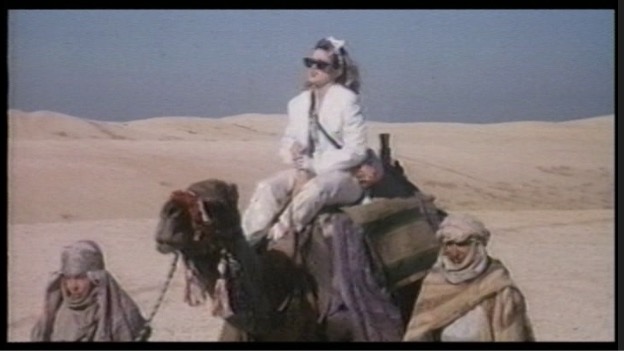
Fig. 3: Susan (Madonna) rides a camel through the Egyptian desert while accompanied by attendants, in the alternate ending (Screenshot by author)
Egyptomania narratives or motifs
Desperately Seeking Susan is characterized by three major interwoven strands of Egyptomania.
The first and most well-known strand is also the most indirect reference: a now-iconic black tuxedo jacket featuring the eyeball-topped pyramid best known from the United States dollar bill. Specially created for the film by costume designer Santo Loquasto, the jacket is first worn by New York City bohemian Susan (Madonna), but it is soon acquired by New Jersey housewife Roberta Glass (Rosanna Arquette) in her quest to try on new social roles and new versions of herself. In her memoir, director Susan Seidelman has explicitly stated that the jacket’s symbolism includes providence, “exotic adventure,” and money, and it corresponds to the hip half of the film’s key New Jersey - New York City dichotomy – most specifically, the legendary Lower East Side counterculture from which both Seidelman and Madonna emerged. Thus, the long-standing tradition of esoteric interpretations of Ancient Egypt has been tapped for its symbolic potential to signify a new elite: not those who possess timeless wisdom, but rather people who are plugged into the exciting and constantly-shifting cultural effervescence of worlds like art, fashion, music, and film.
Slyly hinted at through the jacket’s pyramid, the second and less well-remembered strand of Desperately Seeking Susan’s Egyptomania is a much more direct reference to Ancient Egypt: a subplot about earrings of Nefertiti that were stolen in New York while on loan from “the Cairo Museum.” Beyond causing an “exotic adventure” of recurring conflict with the mafia, the earrings are separated for a time and worn by both of the female leads, in subtle resonance with the film’s complicated feminist thematics about desire, wholeness, and different ways of being a woman. Most prominently, the return of the earrings to the Egyptian government forms the final scene of the theatrical release, where the two heroines’ jubilant press conference with the ambassador turns into a front-page newspaper story as Madonna’s “Into the Groove” plays in its soundtrack reappearance. This ultimate image is in part a reference to the still photographs that close the Katharine Hepburn - Cary Grant film The Philadelphia Story(George Cukor, 1940), a classic of the screwball comedy genre of which Desperately Seeking Susan is a later reinterpretation and reinvention. In terms of Egyptomania, this climactic and thematically-multifaceted restoration of the stolen artifacts also concludes a morality tale, where theft is reversed and objects are entrusted to internationally-cooperative cultural institutions that prioritize public good over private profit.
The last and least-known strand of Egyptomania is an alternate ending that was cut from Desperately Seeking Susan’s theatrical release because test audiences became confused by a series of scenes that seemed final only for other scenes to appear. Now found on DVD and occasionally mentioned in the media, this final scene depicts the two heroines using their reward money to travel to Egypt, where they trek through the desert on camels as Roberta praises its beauty and attendants in ethnic garb walk alongside them. In terms of the film’s overrriding concerns, this scene was intended to undercut a preceding scene wherein each of the heterosexual heroines ended up with her romantic interest, through showing that two women can still have adventures together without men. In terms of its specific Egyptian content, this alternate ending assumes the importance of tourism to the modern state. With the heroines’ obliviousness to the workers, it also introduces a note of social satire around the “exotic adventure” of colonialism, where adventurers from “the West” most value Egypt for its ancient history and beautiful landscape and fail to notice post-pharaonic civilizations and its present-day inhabitants.
The first and most well-known strand is also the most indirect reference: a now-iconic black tuxedo jacket featuring the eyeball-topped pyramid best known from the United States dollar bill. Specially created for the film by costume designer Santo Loquasto, the jacket is first worn by New York City bohemian Susan (Madonna), but it is soon acquired by New Jersey housewife Roberta Glass (Rosanna Arquette) in her quest to try on new social roles and new versions of herself. In her memoir, director Susan Seidelman has explicitly stated that the jacket’s symbolism includes providence, “exotic adventure,” and money, and it corresponds to the hip half of the film’s key New Jersey - New York City dichotomy – most specifically, the legendary Lower East Side counterculture from which both Seidelman and Madonna emerged. Thus, the long-standing tradition of esoteric interpretations of Ancient Egypt has been tapped for its symbolic potential to signify a new elite: not those who possess timeless wisdom, but rather people who are plugged into the exciting and constantly-shifting cultural effervescence of worlds like art, fashion, music, and film.
Slyly hinted at through the jacket’s pyramid, the second and less well-remembered strand of Desperately Seeking Susan’s Egyptomania is a much more direct reference to Ancient Egypt: a subplot about earrings of Nefertiti that were stolen in New York while on loan from “the Cairo Museum.” Beyond causing an “exotic adventure” of recurring conflict with the mafia, the earrings are separated for a time and worn by both of the female leads, in subtle resonance with the film’s complicated feminist thematics about desire, wholeness, and different ways of being a woman. Most prominently, the return of the earrings to the Egyptian government forms the final scene of the theatrical release, where the two heroines’ jubilant press conference with the ambassador turns into a front-page newspaper story as Madonna’s “Into the Groove” plays in its soundtrack reappearance. This ultimate image is in part a reference to the still photographs that close the Katharine Hepburn - Cary Grant film The Philadelphia Story(George Cukor, 1940), a classic of the screwball comedy genre of which Desperately Seeking Susan is a later reinterpretation and reinvention. In terms of Egyptomania, this climactic and thematically-multifaceted restoration of the stolen artifacts also concludes a morality tale, where theft is reversed and objects are entrusted to internationally-cooperative cultural institutions that prioritize public good over private profit.
The last and least-known strand of Egyptomania is an alternate ending that was cut from Desperately Seeking Susan’s theatrical release because test audiences became confused by a series of scenes that seemed final only for other scenes to appear. Now found on DVD and occasionally mentioned in the media, this final scene depicts the two heroines using their reward money to travel to Egypt, where they trek through the desert on camels as Roberta praises its beauty and attendants in ethnic garb walk alongside them. In terms of the film’s overrriding concerns, this scene was intended to undercut a preceding scene wherein each of the heterosexual heroines ended up with her romantic interest, through showing that two women can still have adventures together without men. In terms of its specific Egyptian content, this alternate ending assumes the importance of tourism to the modern state. With the heroines’ obliviousness to the workers, it also introduces a note of social satire around the “exotic adventure” of colonialism, where adventurers from “the West” most value Egypt for its ancient history and beautiful landscape and fail to notice post-pharaonic civilizations and its present-day inhabitants.
Author: David Mihalyfy
Other information
Fischer, L. 1990. "The Desire to Desire: Desperately Seeking Susan", in P. Lehman (ed.) Close Viewings: An Anthology of New Film Criticism: 206-209. Tallahassee: The Florida State University Press.
Not available
Shumway, D.R. 1991. "Screwball Comedies: Constructing Romance, Mystifying Marriage". Cinema Journal 30(4): 20.
Access with registration and payment.
Wales, A. 1996. "Jackets: Engendering the Object in Desperately Seeking Susan", in P. Kirkham (ed.) The Gendered Object: 177-178, 181. Manchester and New York: Manchester University Press.
Not available
Seidelman, S. 2024. Desperately Seeking Something: A Memoir About Movies, Mothers, and Material Girls: 149-150, 157, 172-174. New York: St. Martin’s Press.
Not available
Tags
Write a Comment
Tem de iniciar a sessão para publicar um comentário.