

Timothée Octave Wang – La statue vivante
Year:
1989
Nationality:
France
Language:
French
Writer:
Luc Warnant, Jean-Luc Berger, Richard Quarré
Artist:
Luc Warnant
Publisher:
Soleil Éditions
Genre:
Historical fiction, Fantasy, Time travel
Other websites:

Summary
The adventures of Timothée Octave Wang, a Tibetan scientist who uses his supernatural gifts to solve mysteries, in the company of Professor Lafouille and his nephew Philbert. (Wikipedia)
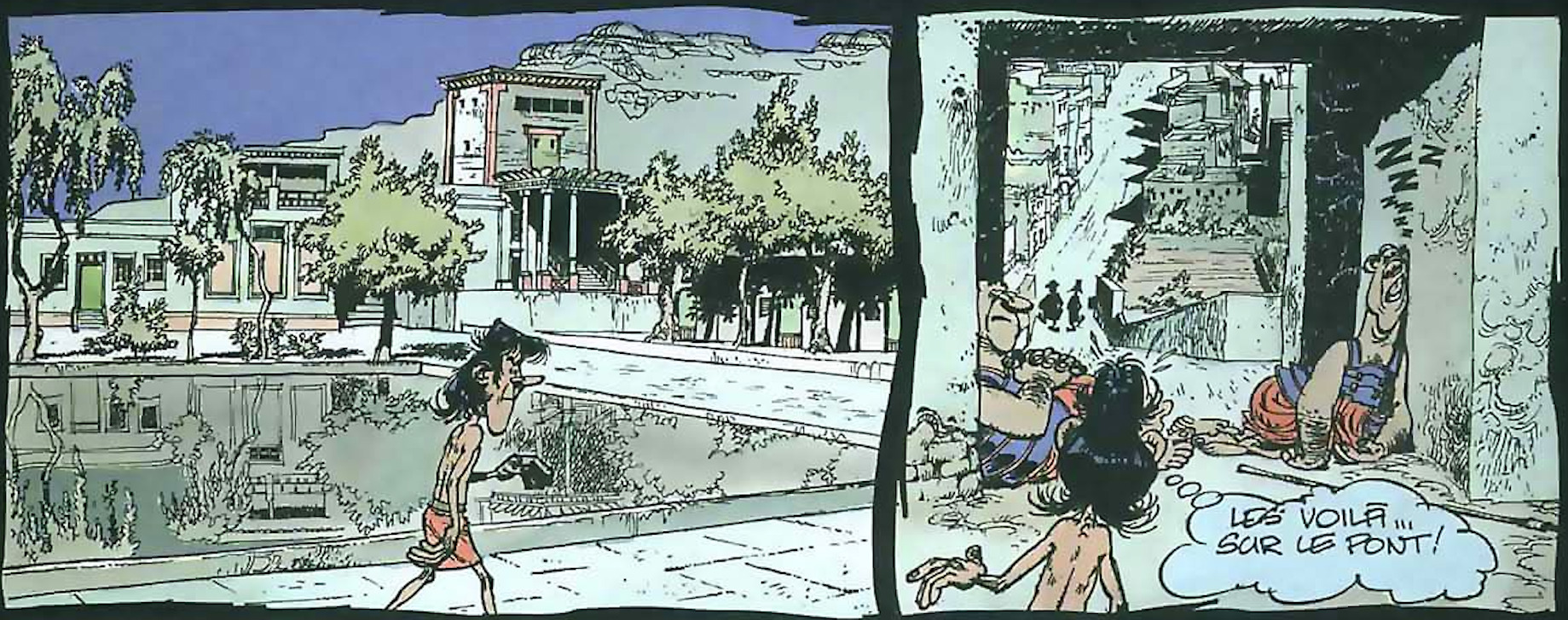
Tefoudi travels through the spaces of the palace and the city of Heliopolis in search of the conspirators (Screenshot by author)

Reception at the royal palace before Pharaoh Djedefra (Screenshot by author)
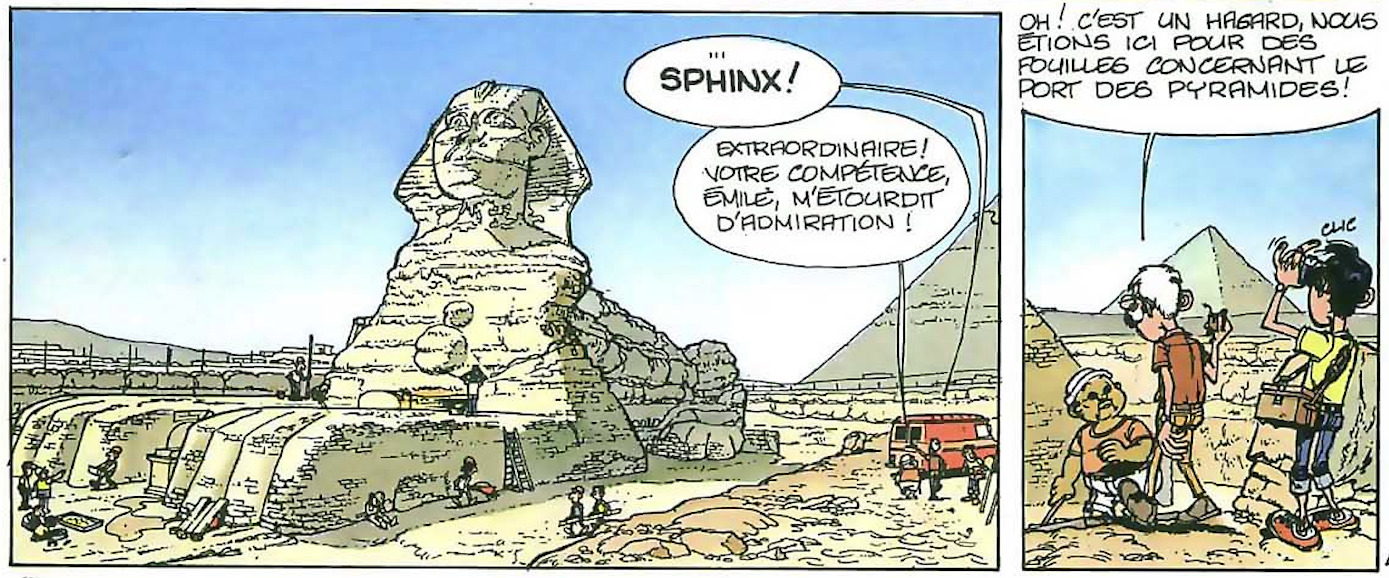
Timothée and the professor at the archaeological dig in Giza (Screenshot by author)
Egyptomania narratives or motifs
Timothée's adventure takes us on a journey through time between the ancient Egypt of the 4th Dynasty, the famous time of the pyramids, and the present day. In the first scenario in the year 2757 BC, Prince Tefoudi is found dying after an attack by strangers. The only way for him to possibly live is to cryogenise him. His attendants follow the instructions on a papyrus for this process, hoping that his body, conveniently hidden, can be discovered and healed by people from the future. In the present, Timothée and Professor Lafouille manage to find Tefoudi's tomb in the basement of the Sphinx and begin his reanimation. Upon awakening, Tefoudi, bewildered, expresses his desire to return to his own time to resolve the situation created in his family, the royal family. Timothée's supernatural knowledge and powers allow them to time travel to ancient Egypt, where they appear in Heliopolis.
Once there, the professor and his friends intervene in the power struggles between the Heliopolites and the Memphites. The leaders of the city of the sun and the sun god Ra have stripped Memphis and its god Ptah of their pre-eminence in the land of the Nile, an act on which the Memphites have sworn revenge. All this also conceals a conflict of succession, which is exacerbated by a great royal conspiracy that Djedefra intends to use to eliminate the influence of the ancient pharaoh Khufu and assassinate his entire family. The attempted assassination of Tefoudi is part of this criminal plan, which is the starting point of the adventure narrated in the comic. However, Tefoudi reappears from the future and begins to investigate the events, revealing the palace plot and securing his brother Khaefra's path to the throne of Egypt.
The ancient Egypt recreated in this comic echoes some traditional tropes of popular culture, notably the idea of the advanced scientific knowledge of the ancient Egyptians. In keeping with this trope, Tefoudi's body will be preserved for thousands of years in the subsoil of Giza awaiting the intervention of modern science, thus establishing an unbroken thread of Egyptian science leading to our present. Interestingly, detective intrigue is created around the reigns of the kings of the 4th Dynasty. Thus, Khufu, Khaefra, and Djedefra are the pharaohs mentioned in a plot that frees the first two from the ‘black legend’ usually attributed to them, mainly based on Herodotus' account. In this comic, Khufu is a just king, and his son Khaefra is his legitimate successor and Tefoudi's brother.
In the recreation of Egyptian settings, we find an enormous diversity of environments, such as the mines in the desert, the city, the palaces, navigation on the river Nile, etc. Equally striking are the fleeting recreations of worship in the temples, specifically before the god Khnum (who is asked to control the floods, reminiscent of the ‘Famine Stela’ on the island of Sehel), the mention of the expeditions to Punt, allusions to the sed-festival, or the recreation of the funerary rituals in honour of the pharaoh Khufu in his pyramid complex at Giza.
Finally, it should be noted that the comic plays on some of the humorous principles made famous, among others, in the Astérix et Obélix comics. In this respect, one of the characters, an assistant to the Egyptian vizier, has the curious name of ‘Jimihendris’.
Once there, the professor and his friends intervene in the power struggles between the Heliopolites and the Memphites. The leaders of the city of the sun and the sun god Ra have stripped Memphis and its god Ptah of their pre-eminence in the land of the Nile, an act on which the Memphites have sworn revenge. All this also conceals a conflict of succession, which is exacerbated by a great royal conspiracy that Djedefra intends to use to eliminate the influence of the ancient pharaoh Khufu and assassinate his entire family. The attempted assassination of Tefoudi is part of this criminal plan, which is the starting point of the adventure narrated in the comic. However, Tefoudi reappears from the future and begins to investigate the events, revealing the palace plot and securing his brother Khaefra's path to the throne of Egypt.
The ancient Egypt recreated in this comic echoes some traditional tropes of popular culture, notably the idea of the advanced scientific knowledge of the ancient Egyptians. In keeping with this trope, Tefoudi's body will be preserved for thousands of years in the subsoil of Giza awaiting the intervention of modern science, thus establishing an unbroken thread of Egyptian science leading to our present. Interestingly, detective intrigue is created around the reigns of the kings of the 4th Dynasty. Thus, Khufu, Khaefra, and Djedefra are the pharaohs mentioned in a plot that frees the first two from the ‘black legend’ usually attributed to them, mainly based on Herodotus' account. In this comic, Khufu is a just king, and his son Khaefra is his legitimate successor and Tefoudi's brother.
In the recreation of Egyptian settings, we find an enormous diversity of environments, such as the mines in the desert, the city, the palaces, navigation on the river Nile, etc. Equally striking are the fleeting recreations of worship in the temples, specifically before the god Khnum (who is asked to control the floods, reminiscent of the ‘Famine Stela’ on the island of Sehel), the mention of the expeditions to Punt, allusions to the sed-festival, or the recreation of the funerary rituals in honour of the pharaoh Khufu in his pyramid complex at Giza.
Finally, it should be noted that the comic plays on some of the humorous principles made famous, among others, in the Astérix et Obélix comics. In this respect, one of the characters, an assistant to the Egyptian vizier, has the curious name of ‘Jimihendris’.
Author: Abraham I. Fernández Pichel
Tags
Write a Comment
Tem de iniciar a sessão para publicar um comentário.