
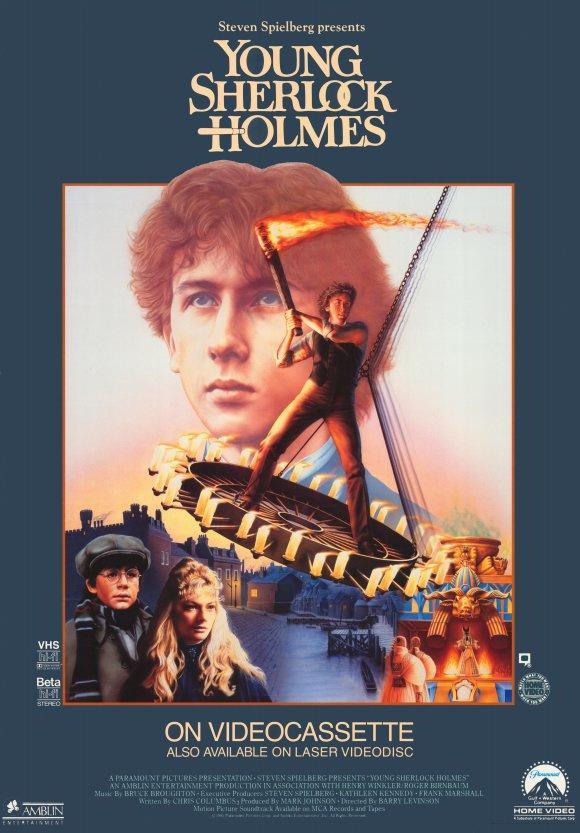
Young Sherlock Holmes
Year:
1985
Running time:
115 mn
Nationality:
USA
Language:
English
Genre:
Adventure, Mystery
Director:
Barry Levinson
Producer:
Amblin Entertainment
Screenwriter/s:
Chris Columbus
Cast:
Nicholas Rowe, Alan Cox, Sophie Ward, Anthony Higgins, Susan Fleetwood, Freddie Jones, and others
Other websites:


Trailer:

Summary of the film
Although Sir Arthur Conan doyle did not write about the very youthful years of Sherlock Holmes and established the initial meeting between Holmes and Dr. Watson as adults, the film Young Sherlock Holmes is an affectionate speculation about what might have happened had the sleuth and his partner met during thier college years. It has been made with respectful admiration and in tribute to the author and his enduring works. (Filmaffinity)
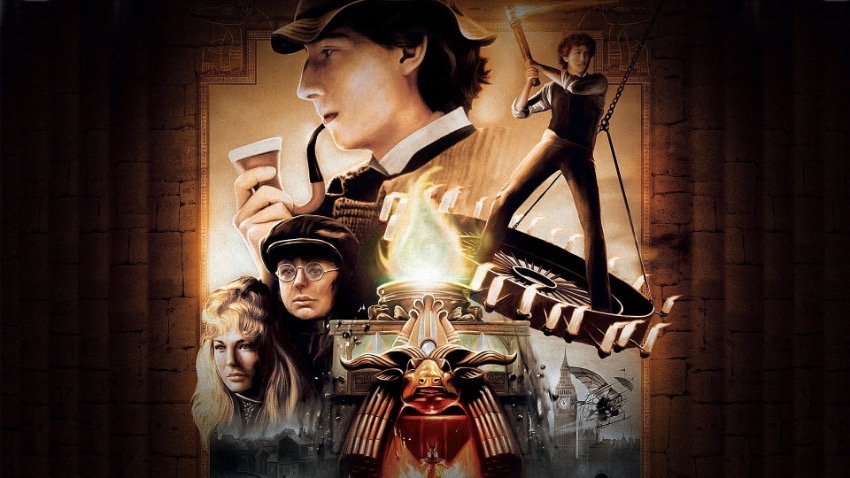
Advertising image of the film with the ram sculpture (Source: https://www.themoviedb.org/movie/11904-young-sherlock-holmes/images/backdrops )

Egyptian priests prepare princess for human sacrifice (Screenshot by the author)
Egyptomania narratives or motifs
In late 19th century Victorian England, young Sherlock Holmes and James Watson are boarding students at a prestigious London school, the Brompton Academy. There they begin to investigate a series of mysterious murders associated with people connected with the school. The crimes are committed by hooded men who drug their victims by throwing poisoned darts at them, and all the secrecy seems to point to an ancient archaeological mission in Egypt. Holmes consults some of the participants, including Lord Cragwitch and the retired Professor Waxflatter, whose niece Elizabeth he is in love with.
Holmes and Watson go to see Cragwitch, who explains that in his youth, he and the other five men were in Egypt, where they looted an underground pyramid containing the tombs of five Egyptian princesses. A local boy named Eh-Tar and his sister vowed to seek revenge and replace the bodies of the five princesses. As they return to the school, a chance remark by Watson causes Holmes to realize that Eh-Tar is none other than Professor Rathe, Holmes’ preferred professor at Brompton. Rathe and his sister Mrs. Dribb abduct Elizabeth, planning to use her as the final sacrifice in a pyramid. Using Waxflatter's flying machine, Holmes and Watson reach the warehouse just in time to rescue Elizabeth and destroy the temple.
Unfortunately, Elizabeth is killed by the evil Professor Rathe, who escapes with his life and takes on the false identity of Moriarty, Holmes' arch-nemesis in Conan Doyle's Sherlock Holmes texts.
The Egyptian elements in the film have to do with an intentional vision of Pharaonic Egypt as an evil society, held in check by dangerous priests, propagators of perverse cults, who spread through London's underworld, while performing human sacrifices in the pyramid hidden in the Thames Docks. This is clearly a historical anachronism, presenting the existence of human sacrifice in classical Pharaonic Egypt, which is the era to which those famous princesses whose mummies were stolen would have belonged, following the aesthetics and sources on which the film is based.
In reality, the film is an indictment of the British colonialism that obliterated the Egyptian cultural tradition (if such a tradition could have been maintained in Egypt until 1870). This issue is clearly seen in the roles played by Rathe and Mrs Dribb, who have to renounce their Egyptian origins and camouflage them in the eyes of their host society. This will accentuate their desire for revenge against those who destroyed their people and their traditions – the five original members of the expedition – but also against the society that promotes this colonialist expansion that perverts the traditions of the places where it spreads and uses them as its own amusement, in the form of museums and archaeological collections.
Holmes and Watson go to see Cragwitch, who explains that in his youth, he and the other five men were in Egypt, where they looted an underground pyramid containing the tombs of five Egyptian princesses. A local boy named Eh-Tar and his sister vowed to seek revenge and replace the bodies of the five princesses. As they return to the school, a chance remark by Watson causes Holmes to realize that Eh-Tar is none other than Professor Rathe, Holmes’ preferred professor at Brompton. Rathe and his sister Mrs. Dribb abduct Elizabeth, planning to use her as the final sacrifice in a pyramid. Using Waxflatter's flying machine, Holmes and Watson reach the warehouse just in time to rescue Elizabeth and destroy the temple.
Unfortunately, Elizabeth is killed by the evil Professor Rathe, who escapes with his life and takes on the false identity of Moriarty, Holmes' arch-nemesis in Conan Doyle's Sherlock Holmes texts.
The Egyptian elements in the film have to do with an intentional vision of Pharaonic Egypt as an evil society, held in check by dangerous priests, propagators of perverse cults, who spread through London's underworld, while performing human sacrifices in the pyramid hidden in the Thames Docks. This is clearly a historical anachronism, presenting the existence of human sacrifice in classical Pharaonic Egypt, which is the era to which those famous princesses whose mummies were stolen would have belonged, following the aesthetics and sources on which the film is based.
In reality, the film is an indictment of the British colonialism that obliterated the Egyptian cultural tradition (if such a tradition could have been maintained in Egypt until 1870). This issue is clearly seen in the roles played by Rathe and Mrs Dribb, who have to renounce their Egyptian origins and camouflage them in the eyes of their host society. This will accentuate their desire for revenge against those who destroyed their people and their traditions – the five original members of the expedition – but also against the society that promotes this colonialist expansion that perverts the traditions of the places where it spreads and uses them as its own amusement, in the form of museums and archaeological collections.
Author: Alfonso Álvarez-Ossorio Rivas
Tags
Write a Comment
Tem de iniciar a sessão para publicar um comentário.