

Astérix et Obélix: L’Empire du milieu
Year:
2023
Running time:
111 mn
Nationality:
France
Language:
French
Genre:
Comedy, Adventure
Director:
Guillaume Canet
Producer:
Les Editions Albert René, Les Enfants Terribles, Pathé, Trésor Films
Screenwriter/s:
Guillaume Canet, Julien Hervé, Philippe Mechelen
Cast:
Guillaume Canet, Gilles Lellouche, Vincent Cassel, Marion Cotillard, José García, Linh Dan Pahm, Pierre Richard, and others
Other websites:


Trailer:

Summary of the film
The only daughter of the Chinese Emperor Han Xuandi escapes from the grips of a rogue prince and runs off to Gaul, seeking help from two valiant warriors, Asterix and Obelix. (Filmaffinity)
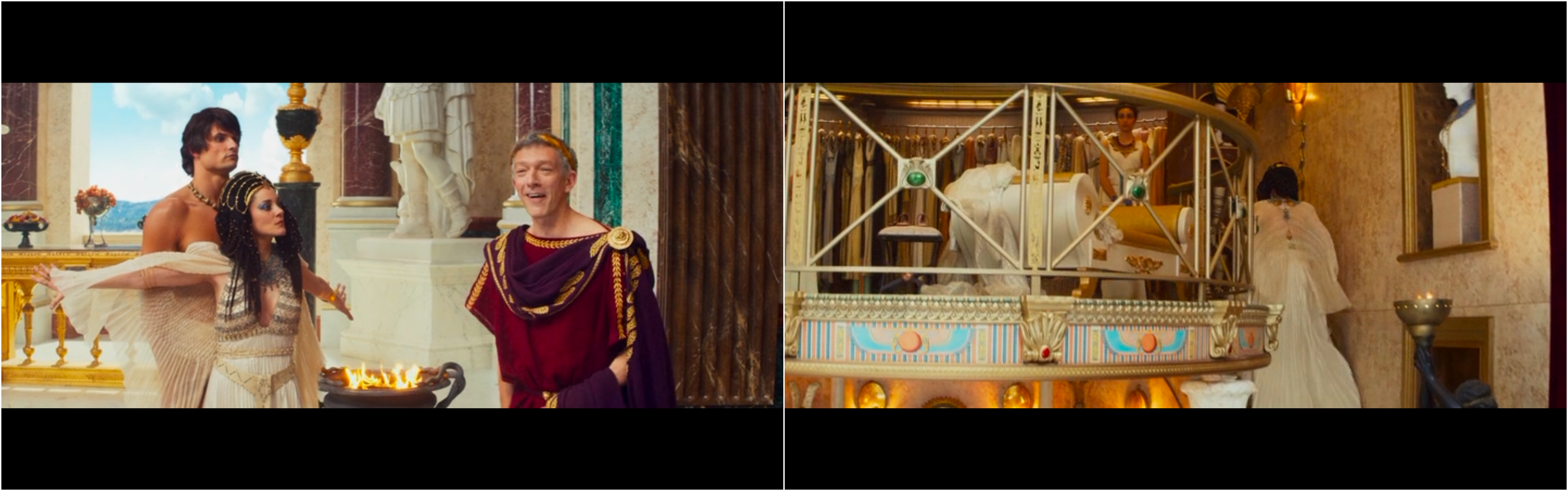
Cleopatra reveals to Caesar that she has a lover, the Greek Tabascus (left) as she tours his chambers in the palace (right) (Screenshot by the author)
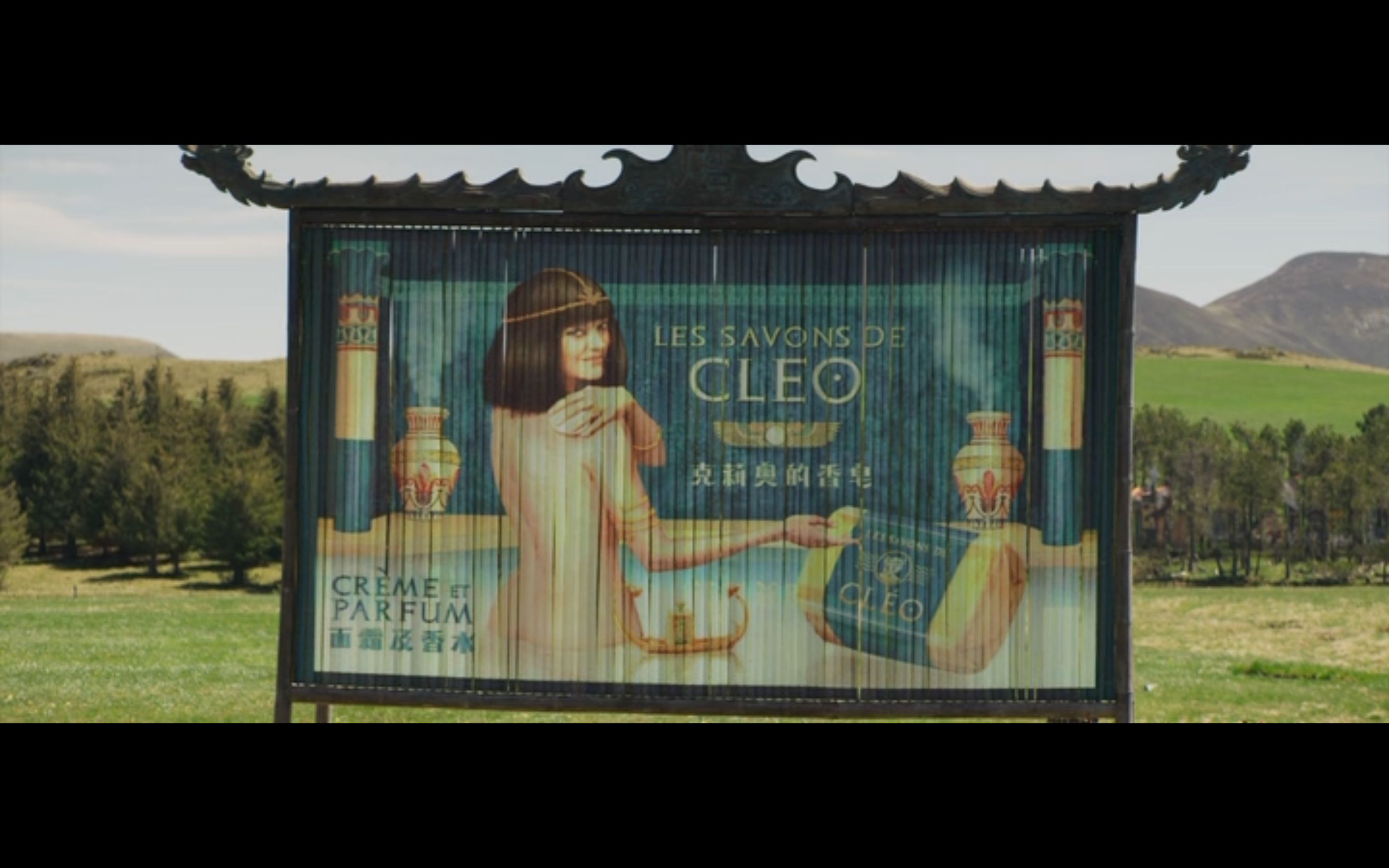
Advertising of "Les savons de Cléo" (Screenshot by the author)
Egyptomania narratives or motifs
In the opening part of the film, while the Chinese princess seeks the support of the intrepid Gauls in their village, Caesar and Cleopatra live in Caesar’s palace in Rome. Cleopatra, played by Marion Cotillard, astonishes the Chinese envoy in the palace, who exclaims “Elle est sublime!”. In her dialogue with Caesar, she tells him that she can no longer bear to be in Rome and that she should have listened to her mother, thus reproducing a common comic sketch about marital disputes in today’s world. Cleopatra’s chambers recreate numerous decorative objects very much in the taste of 19th- and early 20th-century Egyptomania, such as lamps in the shape of snakes (a clear allusion to the asp that presumably killed Cleopatra VII), Egyptian columns, hieroglyphs decorating the furniture, friezes with winged suns, etc. The queen lives in luxury and frivolity, with an enormous wardrobe containing a multitude of dresses. The dialogue continues, and she tells Caesar that she has a lover, the Greek Tabascus, a young, muscular gymnast whose physique is reminiscent of Greek sculptures.
On their journey to China, the Gauls and the Chinese princess cross the Egyptian desert in the north of Africa, which has the typical image of large dunes crossed by camels. They reach the Egyptian city of Klysma, later to become Suez, a port on the Red Sea. The appearance of the city is much more similar to Egypt today, with Islamic towers and minarets, than to ancient Egypt. The music emphasizes the exotic appearance of the place, with the typical melody that accompanies many recreations of the Orient in popular culture.
Caesar decides to go to China to make himself known and extend his power, after Cleopatra tells him that no one knows Caesar beyond Rome. Once in China, in fact, nobody knows him, but they do know Cleopatra. This is a comical way of showing the importance of Queen Cleopatra in the world’s popular culture. She is even featured in the advertising of “Les savons de Cleo”, a Chinese brand of skin soap (In a similar way to the well-known Cleopatra and Palmolive advertisements of the early 1900s). Seeing her depicted so beautifully (Caesar’s entire army whistles at the sight of the advertisement), he longs for Cleopatra, who is still in Rome preparing for her return to Egypt. Caesar’s chronicler makes a joke about Cleopatra’s departure, saying: “Elle rentre en Égypte, de profil ou de face, on s’en fous, mais elle degage” (“She's going back to Egypt, profile or full face, who cares, but she's getting out”), an allusion to the Egyptian perspective of artistic representation. Remembering Cleopatra, Caesar recalls their kisses in the desert by the pyramids. But it is too late, for he has sent her a messenger pigeon telling her to leave the palace in Rome and return to Egypt, as he is the one in a dominant position in the relationship. The film raises the question of gender roles on other occasions, and this dispute between Caesar and Cleopatra shows the empowerment of the queen. To highlight this issue, Cleopatra’s final message to Caesar is clear: “T’es pas près de revoir ma petite pyramide” (“You're not about to see my little pyramid again”).
On their journey to China, the Gauls and the Chinese princess cross the Egyptian desert in the north of Africa, which has the typical image of large dunes crossed by camels. They reach the Egyptian city of Klysma, later to become Suez, a port on the Red Sea. The appearance of the city is much more similar to Egypt today, with Islamic towers and minarets, than to ancient Egypt. The music emphasizes the exotic appearance of the place, with the typical melody that accompanies many recreations of the Orient in popular culture.
Caesar decides to go to China to make himself known and extend his power, after Cleopatra tells him that no one knows Caesar beyond Rome. Once in China, in fact, nobody knows him, but they do know Cleopatra. This is a comical way of showing the importance of Queen Cleopatra in the world’s popular culture. She is even featured in the advertising of “Les savons de Cleo”, a Chinese brand of skin soap (In a similar way to the well-known Cleopatra and Palmolive advertisements of the early 1900s). Seeing her depicted so beautifully (Caesar’s entire army whistles at the sight of the advertisement), he longs for Cleopatra, who is still in Rome preparing for her return to Egypt. Caesar’s chronicler makes a joke about Cleopatra’s departure, saying: “Elle rentre en Égypte, de profil ou de face, on s’en fous, mais elle degage” (“She's going back to Egypt, profile or full face, who cares, but she's getting out”), an allusion to the Egyptian perspective of artistic representation. Remembering Cleopatra, Caesar recalls their kisses in the desert by the pyramids. But it is too late, for he has sent her a messenger pigeon telling her to leave the palace in Rome and return to Egypt, as he is the one in a dominant position in the relationship. The film raises the question of gender roles on other occasions, and this dispute between Caesar and Cleopatra shows the empowerment of the queen. To highlight this issue, Cleopatra’s final message to Caesar is clear: “T’es pas près de revoir ma petite pyramide” (“You're not about to see my little pyramid again”).
Author: Abraham I. Fernández Pichel
Tags
Write a Comment
Tem de iniciar a sessão para publicar um comentário.