
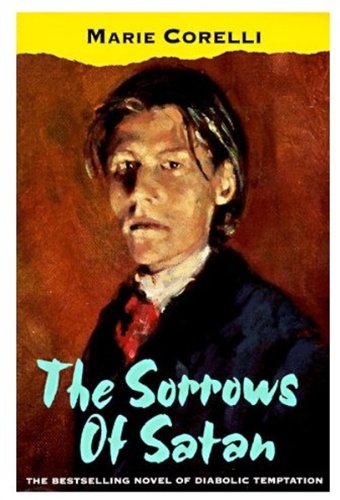
The Sorrows of Satan
Year:
1895
Author:
Marie Corelli
Contry:
UK, USA
Language:
English
Publisher:
J. B. Lippincott Company
Genre:
Horror, Gothic, Fantasy
Other websites:

Summary
The setting is London, 1895, and the Devil is on the loose. He is searching for someone morally strong enough to resist temptation, but there seems little chance he will succeed. Britain is all but totally corrupt. The aristocracy is financially and spiritually bankrupt; church leaders no longer believe in God; Victorian idealism has been banished from literature and life; and sexual morality is being undermined by the pernicious doctrines of the "New Woman." Everything and everyone is up for sale, and it takes a special kind of moral courage to resist the Devil's seductions. (Goodreads)
Egyptomania narratives or motifs
The Sorrows of Satan (1895) is a bestselling novel by Marie Corelli on the subject of the devil seeking redemption. While Corelli’s novel is not concerned primarily with ancient Egypt, a noteworthy reference is found in Corelli’s revelation the devil has a familiar in the form of a beetle that emerged from the mummified body of an ancient Egyptian princess. This is not a significant plot point; rather, this part of the novel serves to aligns the devil with the morbid associations of mummification, along with the decadent opulence evoked by the beetle’s beautiful appearance but grotesque point of origin. The devil describes finding the beetle thus:
The devil is evidently attached to the beetle despite
Corelli draws upon the idea of reincarnation here, despite this not being part of ancient Egyptian religion. Instead, this chimes with ideas popularised in the contemporary consciousness via systems of belief including Theosophy, which drew upon ancient Egypt’s mystical reputation, and which Corelli would turn to again in her later novel, Ziska (1897). The devil’s imagination of the princess’s soul as vampiric adds an additional Gothic element.
I was present at the uncasing of an Egyptian female mummy;—her talismans described her as a princess of a famous royal house. Several curious jewels were tied round her neck, and on her chest was a piece of beaten gold quarter of an inch thick. Underneath this gold plate, her body was swathed round and round in an unusual number of scented wrappings; and when these were removed it was discovered that the mummified flesh between her breasts had decayed away, and in the hollow or nest thus formed by the process of decomposition, this insect I hold was found alive, as brilliant in colour as it is now!
The devil is evidently attached to the beetle despite
believe[ing] it to be an evil creature. […] But I like it none the less for that. In fact I have rather a fantastic notion about it myself. I am much inclined to accept the idea of the transmigration of souls, and so I please my humour sometimes by thinking that perhaps the princess of that Royal Egyptian house had a wicked, brilliant, vampire soul,—and that ... here it is!
Corelli draws upon the idea of reincarnation here, despite this not being part of ancient Egyptian religion. Instead, this chimes with ideas popularised in the contemporary consciousness via systems of belief including Theosophy, which drew upon ancient Egypt’s mystical reputation, and which Corelli would turn to again in her later novel, Ziska (1897). The devil’s imagination of the princess’s soul as vampiric adds an additional Gothic element.
Author: Eleanor Dobson
Other information
Dobson, E. 2020. Writing the Sphinx: Literature, Culture and Egyptology. Edinburgh: Edinburgh University Press, p. 66-84.
Not available
Leaf, J. 2022. Locating the Sympathetic Insect: Cultural Entomology, Egyptianised Gothic, and Emotional Affect in Richard Marsh’s ‘The Beetle’ (Unpublished doctoral thesis). London: Birkbeck, University of London, p. 131-132, 169-175.
Open access
Tags
Write a Comment
Tem de iniciar a sessão para publicar um comentário.