

Land of the Pharaohs
Year:
1955
Running time:
105 mn
Nationality:
USA
Language:
English
Genre:
Fantasy, Action, Adventure
Director:
Howard Hawks
Producer:
Warner Bros
Screenwriter/s:
William Faulkner, Harry Kurnitz, Harold Jack Bloom
Cast:
Jack Hawkins, Joan Collins, Dewey Martin, alex Minotis, Kerima, James Robertson, Luisella Boni, Sydney Chaplin, James Hayter
Other websites:


Trailer:

Summary of the film
In ancient Egypt the Pharaoh Khufu (Jack Hawkins) is obsessed with acquiring gold and plans to take it all with him into the "second life". To this end he enlists the aid of Vashtar (James Robertson Justice), an architect whose people he has enslaved in Egypt. The agreement is to build a robber-proof tomb in exchange for the slaves' release, although Vashtar will have to die when the pyramid-tomb is finished to preserve the secret of its construction against tomb robbers. During the years that the pyramid is being built, the pharaoh demands tribute from all the territories. Nellifer (Joan Collins) is the princess and ambassador of the tributary province of Cyprus. Nellifer says that her province is poor and cannot afford to pay the tribute of grain—so she offers herself to the pharaoh instead. Nellifer becomes the pharaoh's second wife. (Filmaffinity)
Egyptomania narratives or motifs
Long discredited for its failure at the box office, and for being considered an “anomaly” in Howard Hawks’s oeuvre, Land of the Pharaohs has achieved cult status in recent decades thanks to critical reappraisal by filmmakers and critics such as Martin Scorsese, Pedro Costa and Jonathan Rosenbaum. The script, developed by Nobel laureate William Faulkner, together with fellow co-writers Harry Kurnitz and Harold Jack Bloom, stands as a fictionalized account of the building of the Great Pyramid of Giza during the reign of pharaoh Khufu (Fourth Dynasty of the Old Kingdom). Two strands converge in the “emplotment” of this major historical event: on the one hand, a semidocumentary approach to the construction of the monumental tomb of the pharaoh (Hawks’s original intent and thematic focus); on the other hand, an intrigue and romance plot involving Khufu (played by Jack Hawkins, portrayed here as a virile autarch), his virtuous first wife, Queen Nailla (Kerima), and the Cypriot seductress, scheming princess Nellifer (Joan Collins). Additionally, the film introduces the Kushites (led by the fictional Master Architect Vashtar) as the enslaved people commanded to build the pyramid, in a somehow analogous position to the role played by the Israelites in the Exodus narrative.
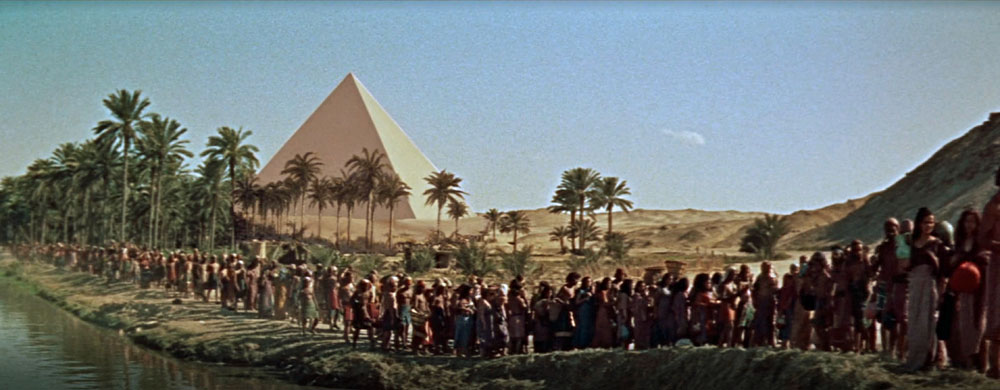
Partly shot on location in Egypt, Land of the Pharaohs benefits from the use of CinemaScope anamorphic lenses, which gives the film a recognizable historical epic, widescreen aesthetics, especially suited to comply with the goal of portraying the colossal efforts implied in the building of the Great Pyramid. The enrolment of multiple extras in outdoor scenes further intensifies the sense of visual spectacle of the film. Probably, one of the most remarkable achievements of Hawk’s movie derives from this fact: the combination of “high concept” entertainment and a kind of “pensive realism”. Seen in this light, the long panoramic takes of landscapes and workers, of land and labor being mobilized and exploited following the unrestrained megalomania of a supreme leader, may resonate as a contemporary (meta)commentary on both the political and religious project of Pharaonic Egypt and the historical epic as a film / pop culture artifact. Because, as Pedro Costa noted in his poetic review of the film, Land of the Pharaohs is, in a way, Howard Hawks’s replication of the grandiose enterprises of ancient Egyptian rulers:
Partly shot on location in Egypt, Land of the Pharaohs benefits from the use of CinemaScope anamorphic lenses, which gives the film a recognizable historical epic, widescreen aesthetics, especially suited to comply with the goal of portraying the colossal efforts implied in the building of the Great Pyramid. The enrolment of multiple extras in outdoor scenes further intensifies the sense of visual spectacle of the film. Probably, one of the most remarkable achievements of Hawk’s movie derives from this fact: the combination of “high concept” entertainment and a kind of “pensive realism”. Seen in this light, the long panoramic takes of landscapes and workers, of land and labor being mobilized and exploited following the unrestrained megalomania of a supreme leader, may resonate as a contemporary (meta)commentary on both the political and religious project of Pharaonic Egypt and the historical epic as a film / pop culture artifact. Because, as Pedro Costa noted in his poetic review of the film, Land of the Pharaohs is, in a way, Howard Hawks’s replication of the grandiose enterprises of ancient Egyptian rulers:
His duel with the Absolute, to which he gave such magnificent expression in Land of the Pharaohs, left him with a deafening violence in a blind terror that never went away. A man dreams about the Absolute, submits to its cosmic rhythms only to get lost”.
Author: Samuel Fernández-Pichel
Other information
Bovot, J.-M. 2022. L’influence durable de l’égyptomanie au cinéma, in J.-M. Humbert (ed.) Egyptomania. La Collection Jean-Marcel Humbert. Lyon: Éditions Libel, pp. 106.
Not available
Combs, R. 1997. The Choirmaster and the Slavedriver: Howard Hawks and Land of the Pharaohs. Film Comment 33(4): 42-49.
Not available
Richards, J. 2008. Hollywood’s Ancient Worlds. London: Bloomsbury Publishing, pp. 146-149.
Not available
Serafy, S. 2003. Egypt in Hollywood: Pharaohs of the Fifties, in S. MacDonald and M. Rice (eds.) Consuming Ancient Egypt. London. University College London, pp. 83-84.
Not available
Tags
Write a Comment
Tem de iniciar a sessão para publicar um comentário.