

Ziska: The Problem of a Wicked Soul
Year:
1897
Author:
Marie Corelli
Contry:
UK
Language:
English
Publisher:
J. W. Arrowsmith, Bristol, United Kingdom
Genre:
Classics, Gothic, Horror, Fiction
Other websites:

Summary
Ziska centers on the ghost of an ancient Egyptian dancer who pursues her former lover (who killed her in their previous life) in his new incarnation. She assumes the identity of ‘Ziska Charmazel’, a Russian princess, before revealing her spectral form to him - and murdering him - underneath the Great Pyramid.
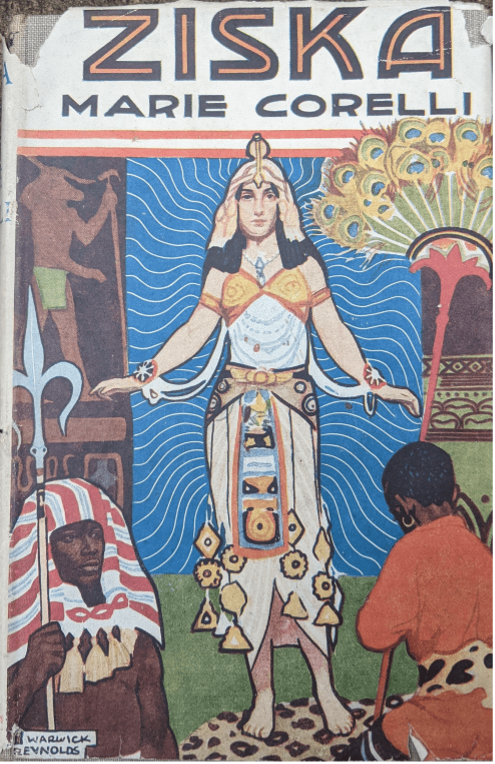
Marie Corelli, Ziska (London: J. W. Arrowsmith, 1923) (https://harngroup.wordpress.com/2023/07/12/howard-carter-and-the-curse-of-tutankhamun-fabrications-and-mutilations-guest-blog/)
Egyptomania narratives or motifs
Ziska: The Problem of a Wicked Soul (1897) centres on the ghost of an ancient Egyptian dancer who pursues her former lover (who killed her in their previous life) in his modern incarnation, a French artist named Gervase. Corelli’s novel is a Gothic revenge plot set in the fashionable hotels of Egypt, where this wronged spirit assumes the identity of ‘Ziska Charmazel’, a Russian princess. Ziska herself is a veritable Orientalist fantasy, attending a fancy dress ball in ancient Egyptian ‘costume’ where, veiled and bedecked with jewels, she captivates the guests and, in particular, Gervase:
That there is an otherwordly quality to Ziska is indicated by her painted portrait, which seems to change to reveal something deathly, along with the suspicions of psychical researcher Dr Dean, who notices the physical resemblances that she and Gervase share to ancient Egyptian carvings depicting their ancient personages. The novel’s occultism blends alternative belief systems popular in the final decades of the nineteenth century, including Theosophy and Spiritualism, to emphasise the continued power of the ancient, Eastern and ‘other’ in the modern world. Ziska, the ultimate femme fatale, eventually exacts her revenge on Gervase, revealing her spectral form to him – and murdering him – in a secret chamber underneath the Great Pyramid. Despite Dr Dean’s assertion that ‘the Pyramids have been very thoroughly explored’ and ‘Nothing of any importance remains in them now’, the Great Pyramid, Ziska asserts, contains all of the hidden knowledge of Egypt, along with Araxes’ tomb, itself revealed to exist in a hidden chamber that draws upon fantasies of ancient Egyptian material opulence and its supernatural possibilities:
"a group of people in fancy dress […] were all eagerly pressing round one central figure—the figure of a woman clad in gleaming golden tissues and veiled in the old Egyptian fashion up to the eyes, with jewels flashing about her waist, bosom and hair,—a woman who moved glidingly as if she floated rather than walked, and whose beauty, half hidden as it was by the exigencies of the costume she had chosen, was so unusual and brilliant that it seemed to create an atmosphere of bewilderment and rapture around her as she came. She was preceded by a small Nubian boy in a costume of vivid scarlet, who, walking backwards humbly, fanned her slowly with a tall fan of peacock’s plumes made after the quaint designs of ancient Egypt. The lustre radiating from the peacock’s feathers, the light of her golden garments, her jewels and the marvellous black splendor of her eyes, all flashed for a moment like sudden lightning on Gervase."
That there is an otherwordly quality to Ziska is indicated by her painted portrait, which seems to change to reveal something deathly, along with the suspicions of psychical researcher Dr Dean, who notices the physical resemblances that she and Gervase share to ancient Egyptian carvings depicting their ancient personages. The novel’s occultism blends alternative belief systems popular in the final decades of the nineteenth century, including Theosophy and Spiritualism, to emphasise the continued power of the ancient, Eastern and ‘other’ in the modern world. Ziska, the ultimate femme fatale, eventually exacts her revenge on Gervase, revealing her spectral form to him – and murdering him – in a secret chamber underneath the Great Pyramid. Despite Dr Dean’s assertion that ‘the Pyramids have been very thoroughly explored’ and ‘Nothing of any importance remains in them now’, the Great Pyramid, Ziska asserts, contains all of the hidden knowledge of Egypt, along with Araxes’ tomb, itself revealed to exist in a hidden chamber that draws upon fantasies of ancient Egyptian material opulence and its supernatural possibilities:
"the walls and roof […] were thickly patterned and glistening with gold. Squares of gold were set in the very pavement on which he trod, and at the furthest end of the chamber, a magnificent sarcophagus of solid gold, encrusted with thousands upon thousands of jewels, which were set upon it in marvellous and fantastic devices, glittered and flashed with the hues of living fire. Golden cups, golden vases, a golden suit of armor, bracelets and chains of gold intermixed with gems, were heaped up against the walls and scattered on the floor; and a round shield of ivory inlaid with gold, together with a sword in a jewelled sheath, were placed in an upright position against the head of the sarcophagus, from whence all the spectral and mysterious light seemed to emerge."
Author: Eleanor Dobson
Other information
Blumberg, A. 2019. “Something Vile in the Composition”: Marie Corelli’s Ziska, Decadent Portraiture and the New Woman, in B. Ayres, S.E. Maier (eds) Reinventing Marie Corelli for the Twenty-First Century: 177-192. London: Anthem Press.
Not available
Delyfer, C. 2016. Re-writing Myths of Creativity: Pygmalionism, Galatea Figures, and the Revenge of the Muse in Late Victorian Literature by Women, in H.A. Laird (ed.) The History of British Women’s Writing, 1880-1920: 97-110. London: Palgrave Macmillan.
Access with registration and payment.
Dobson, E. 2018. A Tomb with a View: Supernatural Experiences in the Late Nineteenth Century’s Egyptian Hotels, in M. Elbert, S. Schmid (eds) Anglo-American Travelers and the Hotel Experience in Nineteenth Century Literature: Nation, Hospitality, Travel Writing: 89-105. London: Routledge.
Not available
Hutchison, S. 2015. Marie Corelli’s Ziska: A Gothic Egyptian Ghost Story, in S. Hutchinson, R.A. Brown (eds) Monsters and Monstrosity from the Fin de Siècle to the Millennium: 29-48. Jefferson, NC: McFarland.
Not available
Jones, M. C. 2018. Marie Corelli’s Ziska and Fantastic Feminism, in L. McCormick, J. Mitchell, R. Soares (eds) The Female Fantastic: Gendering the Supernatural in the 1890s and 1920s: 119-134. New York: Routledge.
Access with registration and payment.
Woodward, S. 2023. The Persistent Pyramid: Exploring the Creation of Egypt as Religious Foil in Marie Corelli’s Ziska, in A.I. Fernández Pichel (ed.) How Pharaohs Became Media Stars: Ancient Egypt and popular Culture: 73-87. Oxford: Archaeopress.
Open access
Tags
Write a Comment
Tem de iniciar a sessão para publicar um comentário.