

Testament: Roleplaying in the Biblical Era
RPG Family or System:
d20 System
Year:
2008
Nationality:
USA
Authors:
Scott Bennie
Art Director:
Ilya Astrakhan,Kent Burles,Toren “Macbin†Atkinson,Chris Keefe,Mike May,Josh Parker,Chris Martinez,James Smith
Publisher:
Green Ronin Publishing
Genre:
Biblical, Ancient History
Other websites:

Videos by players :
Summary of the game
Testament is a game designed for the D20 role-playing system of the 3rd edition of the classic Dungeons and Dragons game. It is part of the Mythic Vistas collection where we find historical or pseudo-historical settings, such as the games Trojan War, Roma Aeterna, or Hamunaptra.
As its name suggests, Testament: Roleplaying in the Biblical Era is designed for players to immerse themselves in different passages of the Old Testament. Players can play different characters, such as a Babylonian magician, an Egyptian priest in the court of Akhenatos, or people from Canaan, or Israel.The Hebrews are the central people on which the game is based. Concerning the adventures, you can play alongside Abraham, witness the destruction of Sodom and Gomorrah, accompany Moses in the Exodus, belong to the court of King David, etc.
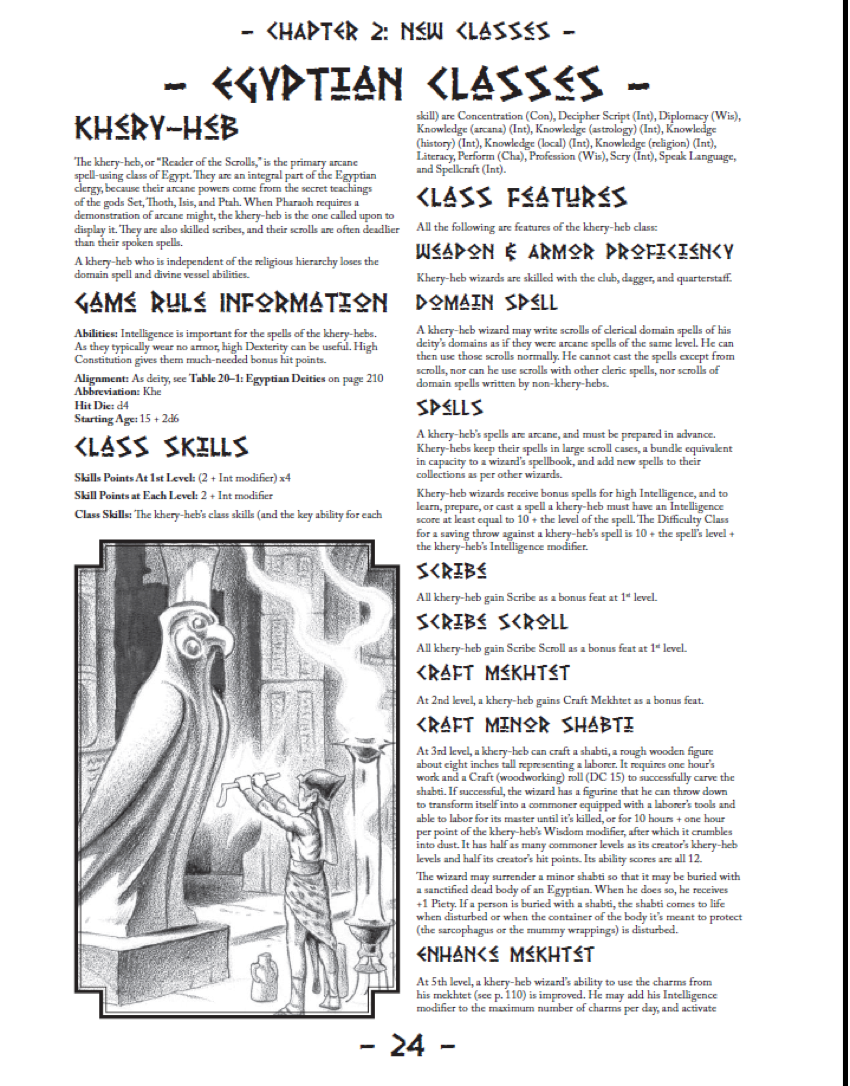
Image corresponding to page 24 of the game Testament: Roleplaying in the Biblical Era showing the Khery-Heb prestige class (Scanned from the book by the author)
Egyptomania narratives or motifs
The Hebrew’s stay in Egypt is the episode we are most interested in. This setting allows the introduction of multiple elements of the Egyptian civilization to the game, mainly religion and mythology. There is such a link with Egypt that two of the possible periods in which adventures can be set are located there: the period of the patriarchs, where Egypt becomes a point of reference for the Hebrews wandering through Canaan, and the Exodus.
In addition, players can also choose to be Egyptians, so the book has several chapters devoted to Egyptian character design. One example is the priest Kheri-heb, a reading priest. In the game, adventurers playing the Kheri-heb class can perform magic by reading the secret texts of the gods, performing rituals, such as raising Shabties, or even be possessed by a god. Another example of Egyptian elements developed in character design is the Ren-hekau prestige class, which is a title that certain characters can attain after obtaining specific priestly requirements according to the ancient Egyptian religion.
Since the adventures may be set in Egypt, there are sections of the game devoted to describing the landscape, history, and customs, such as mummification, the use of names, religion, and magic. It gives lists of city names (sometimes with the Egyptian name transliterated) with brief descriptions, a summary of Egyptian history, and an analysis of their religion and divinities. Concerning the latter, the game follows the D&D alignment system, which characterizes gods as good or evil, and, in the case of the Egyptian gods, none of them appear as evil.
The book also includes a clarification of the different theories about when the exodus took place and why the game adopts one precise version of this event. It should be noted that although the Hebrew world is the focus of the game, the peripheral cultures are not shown in a pejorative way, but rather the game gives an objective view so that game masters have the freedom to design their adventures.
Finally, it is worth noting that the book provides a bibliography for readers to consult. The books mentioned are mostly historiographic works of a near-eastern focus, such as those pivotal books by Leo Openheim, Studies of the Ancient Near East, or Samuel N. Kramer, History Begins at Sumer. There are also some references to Egyptian culture through older editions of the Book of the Dead or the monography Egyptian Saints: Deification in Pharaonic Egypt by Dietrich Wildung.
In addition, players can also choose to be Egyptians, so the book has several chapters devoted to Egyptian character design. One example is the priest Kheri-heb, a reading priest. In the game, adventurers playing the Kheri-heb class can perform magic by reading the secret texts of the gods, performing rituals, such as raising Shabties, or even be possessed by a god. Another example of Egyptian elements developed in character design is the Ren-hekau prestige class, which is a title that certain characters can attain after obtaining specific priestly requirements according to the ancient Egyptian religion.
Since the adventures may be set in Egypt, there are sections of the game devoted to describing the landscape, history, and customs, such as mummification, the use of names, religion, and magic. It gives lists of city names (sometimes with the Egyptian name transliterated) with brief descriptions, a summary of Egyptian history, and an analysis of their religion and divinities. Concerning the latter, the game follows the D&D alignment system, which characterizes gods as good or evil, and, in the case of the Egyptian gods, none of them appear as evil.
The book also includes a clarification of the different theories about when the exodus took place and why the game adopts one precise version of this event. It should be noted that although the Hebrew world is the focus of the game, the peripheral cultures are not shown in a pejorative way, but rather the game gives an objective view so that game masters have the freedom to design their adventures.
Finally, it is worth noting that the book provides a bibliography for readers to consult. The books mentioned are mostly historiographic works of a near-eastern focus, such as those pivotal books by Leo Openheim, Studies of the Ancient Near East, or Samuel N. Kramer, History Begins at Sumer. There are also some references to Egyptian culture through older editions of the Book of the Dead or the monography Egyptian Saints: Deification in Pharaonic Egypt by Dietrich Wildung.
Author: Víctor Sánchez Domínguez
Other information
Fernández Pichel, A.I. and Sánchez Domínguez, V. 2023. Egypt and Role-Playing Games Does the World of Darkness Universe Use Ancient Egyptian Sources?, in A.I. Fernández Pichel (ed.) How Pharaohs Became Media stars: Ancient Egypt and Popular Culture: 205. Oxford: Archeopress.
Open access
Carbó García, J. R. 2019. Living Antiquity. Role-Playing Games with a Setting in Ancient Times. Collection de l'Institut des Sciences et Techniques de l'Antiquité 1476(1): 253-254.
Open access
Tags
Write a Comment
Tem de iniciar a sessão para publicar um comentário.