
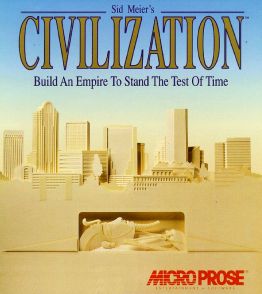
Sid Meier’s Civilization I
Game Family:
Sid Meier's Civilization
Year:
1991
Nationality:
USA
Authors:
B. C. Milligan, Jeffery L. Briggs, Bruce Campbell Shelley
Designer:
Bruce Shelley, Sid Meier
Artists:
Bruce Shelley, Sid Meier
Publisher:
MicroProse, Koei (SNES)
Number of Players:
Single-player
Genre:
Turn-based strategy, 4X
Other websites:


Videos by players:

Summary of the game
Civilization is a turn-based strategy video game (meaning players plan their moves in turns) where the player is able to act as the ruler of one of a variety of civilizations as they lead them through various periods of development (from the rise of civilizations around 4000 BCE to the Space Age). It pioneered the “4X” style of game play, in which players explore land, expand into new territories, exploit resources, and exterminate opposing civilizations. In this game, Egypt is a playable civilization, led by Ramesses and with a default capital city at Thebes.

Pharaoh Ramses in the Egyptian past (Screenshot by the author)

Pharaoh Ramses in present times (Screenshot by the author)

First steps of an egyptian city according to Sid Meier's Civilization I (Screenshot by the author)
Egyptomania narratives or motifs
Civilization (abbreviated as Civ or Civ I) is a turn-based strategy video game (meaning players plan their moves in turns) where the player is able to act as the ruler of one of a variety of civilizations as they lead them through various periods of development (from the rise of civilizations around 4000 BCE to the Space Age). It pioneered the “4X” style of game play, in which players explore land, expand into new territories, exploit resources, and exterminate opposing civilizations.
In this game, Egypt is a playable civilization, led by Ramesses and with a default capital city at Thebes. Ramesses is a generalized Egyptian figure, with Nemes headdress and holding a flail and crook (see gameplay screenshot). Although the player can develop their civilization from the ancient period into the space age, the Ramesses avatar always stays the same, presented with the imagery of an ancient pharaoh. In the payer’s in-game interactions with the pharaoh, only the background figures change to evolve with the times, as seen in the in-game screenshots where the people behind Ramesses go from Egyptian figures to modern police and political figures. This is partially a game mechanic, where the Ramesses avatar is kept the same so as to be recognized by the player throughout gameplay. But it also speaks to the current popular culture image of Egypt as a society that remained unchanged and unmodified for millennia, hinting towards the idea that Egypt was static and immobile. This idea is also echoed in the cover art of the game, where the image of a stone pharaoh is seen buried under a modern city (see game cover image). In popular culture, Egypt is seen as exotic and eternal, always stuck in the ancient past, which is seen as both a good characteristic, Egypt is lauded for its strength and longevity, but also a bad characteristic, where Egypt is a symbol of stasis and a reluctance to evolve with the times.
When a player chooses to play as Egypt, the buildings are vaguely Egyptian in style and motif, mostly simple huts and mastaba-like buildings during the ancient period (see gameplay screenshot), and players can utilize a unique military unit, the Egyptian chariot. Players can also build a Wonder once they have achieved a high level of in-game knowledge. The Wonder for the Egyptian civilization is a pyramid. The civilopedia (an in-game encyclopedia that includes explanations of various aspects of the game) entry on the pyramid wonder denotes that the pyramids were built as burial monuments to the pharaohs and indicated a strong, well-organized and stable government. Within the game itself, rather than being associated with the burial of the Egyptian leader, the pyramid wonder allows the player to unlock and transition to a democratic form of government and can be built by any playable civilization.
Autor: Tara Sewell-Lasater
Other information
Vrtačič, E. 2014. The grand narratives of video games: Sid Meier’s Civilization. Teorija in praksa 51(1): 91-105.
Open access
Mol, A., Politopoulos, A. 2021. Persia’s Victory The Mechanics of Orientalism in Sid Meier’s Civilization. Near Eastern Archaeology 84(1): 44-51.
Access with registration and payment.
Tags
Write a Comment
Tem de iniciar a sessão para publicar um comentário.